


















Lesson 16 of 46 · S-Parameters and Microwave Networks
Chapter 4 Overview: S-Parameters and Microwave Networks
A map of chapter 4: why microwave engineers use S-parameters instead of voltages and currents, what a vector network analyzer measures, and how two-port networks are described.
At low frequency you describe a network by the voltage and current at its terminals and measure them with a voltmeter and an ammeter. At microwave frequencies that approach breaks down. You cannot reliably measure the current in a wire that is a large fraction of a wavelength long, and to measure an open circuit or a short circuit you must place them exactly at the reference plane, which is both difficult and, for an active device, dangerous: many transistors oscillate when left open.
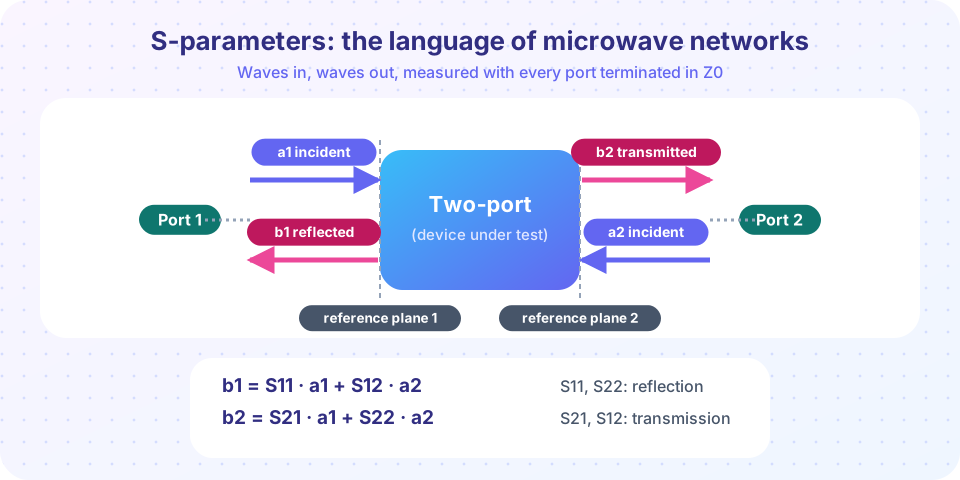
Scattering parameters, or S-parameters, solve both problems. They describe a network in terms of waves going in and coming out of each port, measured with the ports terminated in a matched load. They are what a vector network analyzer (VNA) measures, what datasheets for amplifiers, filters, switches and antennas publish and what circuit simulators consume.
What you will learn
- Why waves replace voltages and currents at high frequency.
- How the four two-port S-parameters are defined and what each one means.
- How S-parameters relate to gain, loss, return loss and isolation.
- Which network tools this chapter adds: ABCD matrices and passive components.
Why S-parameters?
Measure what is easy and robust.
The four numbers
Each is a ratio of waves.
This chapter
Then amplifiers in chapter 5.
The idea in one paragraph
Terminate every port of the network except one in a perfectly matched load (Z0, so the wave leaves and nothing returns). Send a wave into port j and measure the waves that come out of each port i. The ratio Sij = b_i / a_j is an S-parameter. It is a complex number: magnitude says how large, angle says how delayed. Because the other ports are matched, you never need an ideal open or short.
For a two-port: S11 is the reflection at the input, S21 is the forward transmission (gain of an amplifier, loss of a filter), S12 is reverse transmission (isolation) and S22 is the reflection at the output.
What each lesson covers
- S-parameter basics: definitions from voltages and currents, properties (reciprocal, lossless, passive), dB forms, shifting reference planes.
- ABCD matrices and cascaded networks: building blocks, multiplication, conversion to S and a filter example.
- Passive microwave components: attenuators, Wilkinson dividers, couplers.
- Chapter 4 review: summary and quiz.
Try it
This tool makes the definition concrete. It takes a network described by an ABCD matrix, drives port 1 with a unit wave, terminates port 2 in 50 Ω and computes the waves from voltages and currents. You can see that the result is S11 and S21.
Press Run (or Ctrl + Enter) to see the result here.
Program input · what you'd type while the program runs
Type the answers before you press Run, one per line. Each time the program reads a line (with input()), it gets the next line from this box.
The second tool shows what the S-parameters of a passive network mean for power. Enter |S11|, |S21| and the incident power; the tool reports reflected, transmitted and absorbed power and warns if the numbers would break energy conservation.
Check your understanding
Quick check · 4 questions
of 4 answered You scored / 4 · perfect!
-
1. What do S-parameters relate?
Sij = b_i / a_j: the ratio of the wave leaving port i to the wave entering port j. -
2. S21 of an amplifier represents its
S21 is the forward transmission; for an amplifier its magnitude in dB is the gain. -
3. When measuring S11, the other port should be
The definition assumes a2 = 0, i.e. no wave entering port 2, which a matched load guarantees. -
4. Why is a matched termination preferred to an open or short at microwave frequencies?
Parasitic inductance and capacitance spoil ideal opens and shorts, and an unstable device may oscillate with reactive terminations.
Summary
- S-parameters describe a network through waves, not terminal voltages and currents.
- Each
Sijis a complex ratio measured with all other ports terminated inZ0. - For a two-port: S11 and S22 are reflections, S21 and S12 are transmissions.
- A VNA measures them directly; datasheets and simulators use them.
- This chapter adds the definitions, the ABCD cascade method and three passive components.
Next: S-Parameter Basics
Track your progress
Create a free account to tick off lessons and pick up where you left off on any device.
of RF Engineering and Antennas lessons completed