


















Lesson 21 of 46 · Amplifiers and Mixers
Amplifiers and Mixers: The Big Picture
See how low noise amplifiers, mixers and filters fit together in a receiver, and what noise, linearity and frequency conversion each decide.
A radio signal arrives at your antenna at a power far below a billionth of a watt. Before anything can decode it, that signal must be made bigger, moved to a convenient frequency and cleaned up, all without adding so much noise or distortion that the information is lost. Amplifiers and mixers do that work. This chapter shows you how to reason about them as building blocks, using a few numbers per stage.
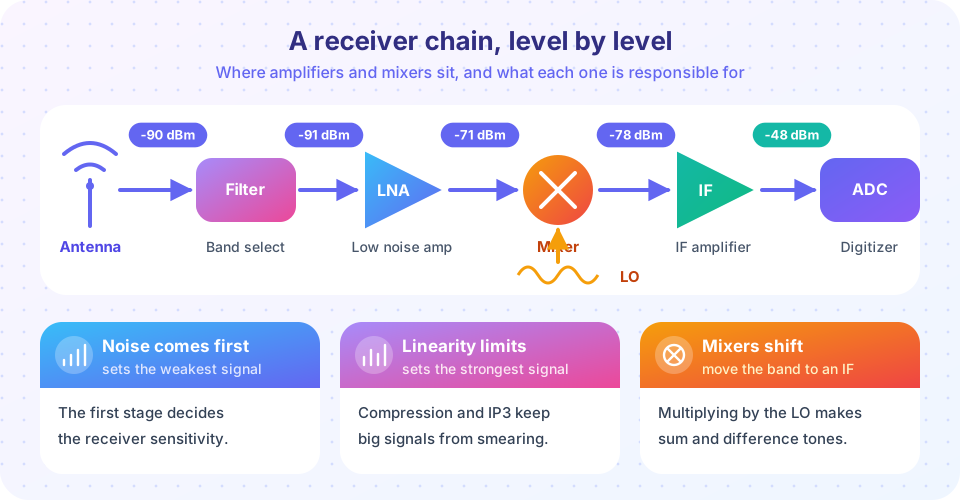
What you will learn
- Which blocks make up a receiver and what each one is responsible for.
- Why the first amplifier decides how weak a signal you can detect.
- Why the last stages decide how strong a signal you can handle.
- How a mixer moves a band to a new frequency, and why that creates an image problem.
The three questions
Every RF stage can be judged by three questions. Learn to ask them in this order.
Three questions per stage
Noise sets the bottom
A noisy first stage cannot be rescued later.
Linearity sets the top
Too much signal compresses and creates new tones.
Mixers shift frequency
What each lesson covers
- Noise figure and the cascade: gain in decibels, noise figure, the Friis cascade formula and why stage order matters.
- Linearity and stability: compression, intermodulation, intercept points, dynamic range, and the stability factor of a transistor amplifier.
- Mixers and frequency conversion: the multiplication that shifts a band, image frequencies, and receiver architectures.
- Chapter review: one picture, a recap table and ten questions.
Key terms
LNA (low noise amplifier): the first amplifier in a receiver, chosen for a very low noise figure. Noise figure (NF): how much worse the signal to noise ratio gets when it passes through a device, in dB. P1dB: the input or output power at which gain has fallen by 1 dB from its small signal value. LO (local oscillator): the reference tone a mixer multiplies the signal by. IF (intermediate frequency): the fixed lower frequency the signal is moved to for easy filtering and amplification.
Decibels in one minute
All the numbers in this chapter use decibels, so settle the rules now. A ratio of powers P2/P1 in decibels is 10 log10(P2/P1). Adding decibels multiplies ratios, which is why cascaded gains simply add. An absolute power in dBm is a decibel ratio against 1 milliwatt: 1 mW is 0 dBm, 100 mW is 20 dBm, 1 microwatt is -30 dBm. The tool below converts both ways.
Common misconceptions
"More gain is always better." Extra gain raises the level of noise and strong interferers too. A stage with too much gain compresses, and the rest of the chain then sees distortion instead of signal.
"Noise figure only matters for the whole receiver." It matters most for the first stage. Later stages are divided down by all the gain in front of them.
Try it
Press Run (or Ctrl + Enter) to see the console output here.
No output.
Press Run (or Ctrl + Enter) to see the console output here.
No output.
Check your understanding
Quick check · 4 questions
of 4 answered You scored / 4 · perfect!
-
1. A stage has a power gain of 100. What is that in decibels?
10 log10(100) = 20 dB. -
2. Which part of a receiver mainly determines its sensitivity to weak signals?
Later noise is divided by the gain ahead of it, so the first stage dominates. -
3. A signal of -60 dBm passes through +25 dB gain and -3 dB loss. What is the output level?
-60 + 25 - 3 = -38 dBm. -
4. What does a mixer do to a signal?
A mixer multiplies by the LO, producing sum and difference frequencies.
Summary
- A receiver chain is a series of blocks, each changing level, noise and frequency.
- Noise sets the weakest usable signal, linearity sets the strongest.
- Decibels turn gain and loss into addition.
- Mixers shift frequency using a local oscillator.
Track your progress
Create a free account to tick off lessons and pick up where you left off on any device.
of RF Engineering and Antennas lessons completed