


















Lesson 2 of 46 · Getting Started
What Is Religion? Definitions and Dimensions
Why scholars cannot agree on one definition of religion, what Tylor, Durkheim and Ninian Smart proposed, and how seven dimensions help you compare traditions.
Ask ten people what religion is and you will get ten answers: belief in God, a set of rituals, a way of life, a community, a source of morals, a comfort in grief, a source of conflict. Each answer is true of some religions and misses others. This is not a failure of education. It is one of the central puzzles of the subject, and scholars of religion have worked on it for well over a century.
This lesson shows why defining religion is hard, introduces three families of definitions, and gives you a practical tool, the seven dimensions of religion, that lets you describe any tradition without first deciding whether it "counts."
What you will learn
- Why no single definition of religion satisfies everyone, and why that matters.
- Three kinds of definition: substantive, functional and family-resemblance.
- Ninian Smart's seven dimensions as a practical description tool.
- Why "religion" itself is partly a modern, Western-shaped word.
Key terms
Substantive definition: defines religion by what it is about, usually belief in gods, spirits or the sacred.
Functional definition: defines religion by what it does for people or society, such as giving meaning or binding a community.
Sacred: set apart as special, powerful or deserving reverence; often contrasted with the ordinary or "profane."
Dimension: one of several aspects (ritual, myth, ethics, and so on) that together make up a tradition.
Why a definition is hard
A good definition has to be wide enough to include all the cases people agree are religions and narrow enough to exclude things that are clearly not. Try it with "belief in a god or gods." That fits Judaism, Christianity and Islam, which teach one creator God. It also fits many ancient and indigenous traditions with many gods. But core teachings of Theravada Buddhism and Jainism do not make a creator god central, and they are rightly treated as religions in every textbook. So the definition is too narrow. Now try "a set of beliefs that give life meaning." That includes religions, but it also includes political ideologies, humanist philosophies, and some people's devotion to science or family. Now it is too wide, unless you are happy to call all of those religions.
There is another difficulty. In many languages and eras there was no separate word for "religion." People spoke of law, custom, ritual obligation, the way, the teaching, or simply how things are done. Historians such as Wilfred Cantwell Smith argued that "religion" as a name for a bounded system of beliefs developed in Europe, and that applying it to everywhere else can distort what people were doing. Anthropologist Talal Asad made a related point: what counts as "religion" has often been decided by powerful institutions, including colonial governments. These warnings do not mean we must stop using the word. They mean we should use it with care.
Three kinds of definition
Substantive: what it is about
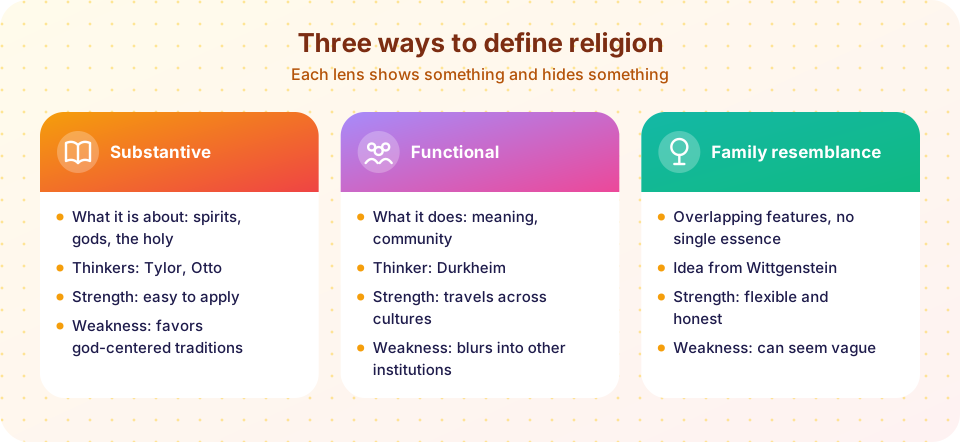
The anthropologist Edward Burnett Tylor (1832 to 1917) proposed a "minimum definition" of religion as belief in spiritual beings. The scholar Rudolf Otto (1869 to 1937) described religion's core as an encounter with the "holy," a mystery that is both terrifying and fascinating. Substantive definitions are easy to apply, but they tend to center on the sort of belief that Western Christianity emphasizes, and so they can misjudge traditions in which practice matters more than doctrine.
Functional: what it does
The sociologist Émile Durkheim (1858 to 1917) defined religion in The Elementary Forms of Religious Life (1912) as a unified system of beliefs and practices relative to sacred things, which unites its followers in one moral community. Other thinkers stress different functions: giving meaning to suffering, providing guidance for conduct, or reinforcing social order. Functional definitions travel well across cultures. Their weakness is that many non-religious institutions also build community and meaning, so the boundary blurs.
Family resemblance: no single essence
The philosopher Ludwig Wittgenstein noticed that the things we call "games" share no one feature; they overlap like members of a family, where one has the nose, another the eyes. Some scholars apply the same idea to religion. Traditions overlap on features such as gods, rituals, scriptures, moral codes, founders, communities and sacred places, but no one feature is present in every case. This view is flexible and honest, though critics say it leaves the category vague.
Seven dimensions: a practical tool
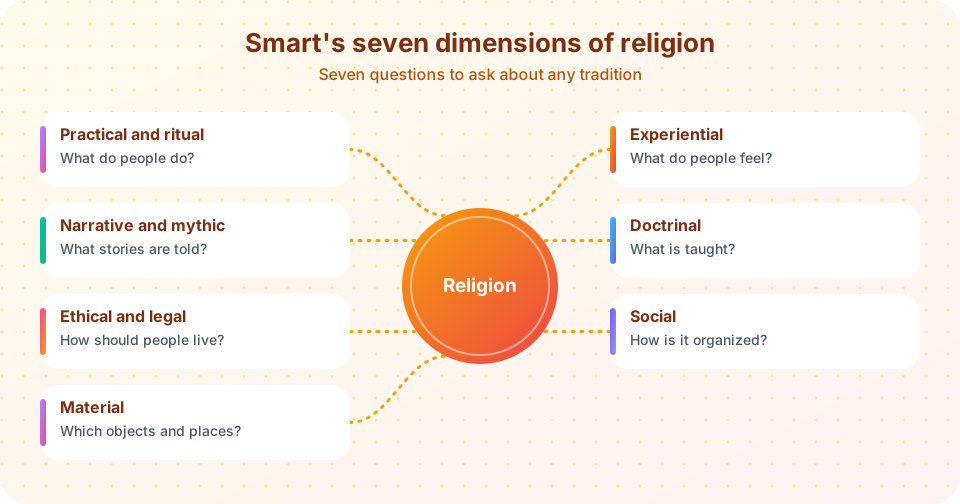
Because a single definition causes trouble, the scholar Ninian Smart (1927 to 2001) suggested describing religions by their dimensions. Here is a version of his scheme, with the sort of question each one asks.
| Dimension | Question to ask | Example in practice |
|---|---|---|
| Practical and ritual | What do people do? | Prayer, pilgrimage, fasting, meditation |
| Experiential and emotional | What do people feel or experience? | Awe, peace, conversion, mystical union |
| Narrative and mythic | What stories are told? | Creation accounts, the lives of founders |
| Doctrinal and philosophical | What is taught? | Creeds, teachings about the self, the afterlife |
| Ethical and legal | How should people live? | Commandments, rules, ideals of compassion |
| Social and institutional | How is the community organized? | Priests, monks, congregations, schools |
| Material | What objects and places matter? | Temples, scriptures, icons, clothing, food |
The strength of this approach is that it lets you describe before you decide. You can say, "Tradition X is strong in ritual and narrative but has little formal doctrine," without first deciding whether it is a "real" religion. The scheme also shows why two traditions can look alike on one dimension and different on another. Many Jewish and Muslim communities, for example, give great weight to law and practice; many Christian communities give great weight to creed and faith. Smart himself noted that the scheme can apply to secular worldviews such as nationalism or Marxism, which he called "worldviews," and this is one of the reasons scholars sometimes prefer the broad word worldview.
Religion, spirituality and the secular
You will often hear people say, "I'm spiritual but not religious." Scholars take this seriously as a real and growing self-description, especially in Europe and North America. It usually means personal experience and meaning without membership in an institution. Whether that is a different thing from religion, or one form of it, is debated; the dimensions above can describe it too (experiential and ethical dimensions strong, social and doctrinal weak).
The "secular" is the other half of this puzzle. Since "religion" is a category created partly by contrast with the non-religious, the definition of one shapes the other. Chapter 8 returns to secularism, law and the public square.
Common misconceptions
"Religion is belief in God." This describes many religions but not all. Some traditions emphasize practice, community or an impersonal ultimate reality, and in some, belief in a creator is not central.
"Defining religion means picking the true one." Scholars define religion to organize study, not to rank traditions. The definition is a tool for comparison.
"Religion is only about the supernatural." Many believers do not use that category. Their traditions describe nature, society and the divine as one ordered whole, and the supernatural/natural split is a modern distinction.
Try it
The first demonstration shows how Smart's seven dimensions look in five traditions. The entries are short summaries of typical features; any real community will vary. Choose a tradition and read across the dimensions.
The second demonstration tests a narrow definition against a few traditions, to show why "belief in a creator god" fails as a universal definition. The yes/no values are simplified generalizations used only to illustrate the logic.
Press Run (or Ctrl + Enter) to see the result here.
Program input · what you'd type while the program runs
Type the answers before you press Run, one per line. Each time the program reads a line (with input()), it gets the next line from this box.
Check your understanding
Quick check · 5 questions
of 5 answered You scored / 5 · perfect!
-
1. Why is 'belief in a god or gods' an unsatisfying universal definition of religion?
Theravada Buddhism and Jainism, for example, do not make a creator god central, yet are universally counted as religions. -
2. Who defined religion as a unified system of beliefs and practices relative to sacred things that unites a moral community?
Durkheim gave this functional-substantive definition in The Elementary Forms of Religious Life (1912). -
3. What is the main advantage of Smart's seven dimensions?
The dimensions are descriptive questions that can be asked of any tradition or worldview. -
4. The family-resemblance view says that religions
Borrowing from Wittgenstein, it treats religion like games: overlapping similarities, no single defining feature. -
5. Which dimension asks 'What objects and places matter?'
The material dimension covers temples, scriptures, icons, clothing and other physical things.
Summary
- No definition of religion works for every case; each type highlights something and hides something.
- Substantive definitions focus on beliefs, functional definitions on what religion does, and family-resemblance on overlapping features.
- Smart's seven dimensions (ritual, experience, narrative, doctrine, ethics, social, material) turn the question into a checklist of descriptions.
- "Religion" is partly a modern word shaped by Western history, so use it carefully.
- You can describe a tradition well without settling whether it "counts."
Next: Studying Religion Fairly
Track your progress
Create a free account to tick off lessons and pick up where you left off on any device.
of Religious Studies lessons completed