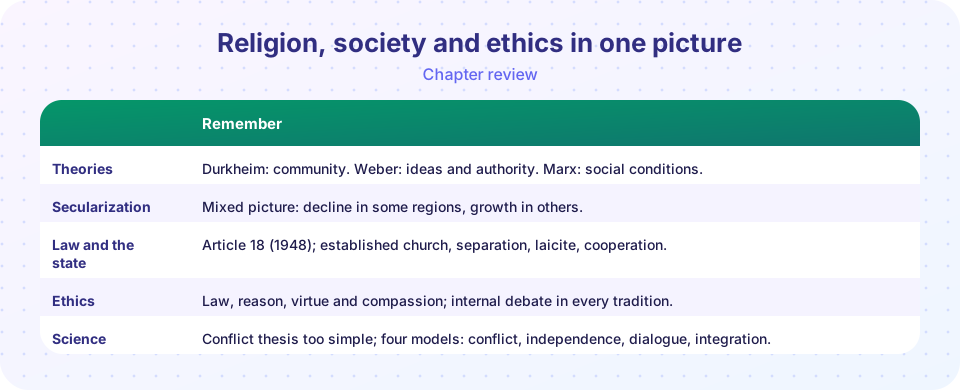
Review religion in society: classic theories, secularization, church-state models, ethics and the science-religion models, with a table, flashcards and a ten-question quiz.
This chapter shifted from individual traditions to the questions that run across all of them: why religion exists and how it changes, how states handle religious diversity, how traditions reason about right and wrong and how religion relates to science. Each question has several good answers, and the skill you have practiced is describing those answers fairly and attributing them to the people who hold them.
Caption: Five parts of the chapter and the key idea to remember for each.
A strong study of any religious topic uses several of these lenses at once. Suppose you want to understand a dispute about religious dress in a public school. The sociological lens asks what the clothing means to the community and what the school symbolizes. The legal lens asks what a particular country's constitution and international law say about free exercise and neutrality. The ethical lens asks how the tradition itself reasons about modesty and obligation, and who within the tradition holds which view. The historical lens asks how the issue arose. And the comparative lens asks whether other countries handle it differently. No single lens is enough, and each one protects you from the blind spots of the others.
The same approach works for questions about science and ethics. If a news story claims that "science has disproved religion," ask which religion and which claim, whether the claim is empirical, and which of Barbour's models the speaker assumes. If a debate about a moral issue is framed as "religion versus secular society," ask which traditions and which members are involved, because religious voices usually appear on several sides.
Notice also the importance of language. Words such as "secular," "fundamentalist," "radical" and "cult" carry judgments, and scholars try to use them with care. When in doubt, describe what people do and say, and quote their own terms where you can.
"Social theories of religion prove religion is merely social." Theories explain functions and effects; they do not by themselves settle questions about truth, which are outside the scope of sociology.
"Each religion speaks with a single voice on ethics." Every tradition contains debate and diversity.
<style>:root{--ink:#1e1b4b;--mut:#475569;--bg1:#faf5ff;--bg2:#eff6ff;--ac:#6366f1;--ac2:#ec4899}@media(prefers-color-scheme:dark){:root{--ink:#e0e7ff;--mut:#a5b4fc;--bg1:#1e1b4b;--bg2:#1e293b}}*{box-sizing:border-box}body{margin:0;padding:14px;font-family:system-ui,-apple-system,'Segoe UI',sans-serif;color:var(--ink);background:linear-gradient(135deg,var(--bg1),var(--bg2));min-height:100vh}h3{margin:0 0 4px;font-size:17px}.sub{margin:0 0 12px;color:var(--mut);font-size:13px}.card{background:#fff;color:#1e1b4b;border-radius:18px;padding:16px 18px;box-shadow:0 10px 24px rgba(67,56,202,.15)}button{font:inherit;cursor:pointer;border:0;border-radius:999px;padding:8px 14px;background:linear-gradient(135deg,#6366f1,#4338ca);color:#fff;font-weight:600;font-size:14px}button.ghost{background:#eef2ff;color:#312e81}button.on{background:linear-gradient(135deg,#a855f7,#db2777);color:#fff}.row{display:flex;flex-wrap:wrap;gap:8px;margin-bottom:12px}.muted{color:#475569;font-size:14px}.big{font-size:19px;font-weight:700}</style><h3>Chapter 8 flashcards</h3><pclass="sub">Click the card to flip it. Mark whether you knew it.</p><divid="c"class="card"style="min-height:130px;cursor:pointer;display:flex;flex-direction:column;justify-content:center;text-align:center"><divid="t"class="muted"></div><divid="x"class="big"></div></div><divclass="row"style="margin-top:12px"><buttonclass="ghost"id="p">Previous</button><buttonclass="ghost"id="n">Next</button><buttonclass="ghost"id="s">Shuffle</button><buttonid="k">I knew it</button></div><divclass="muted"id="st"></div><script>varD=[["Durkheim's main work on religion","The Elementary Forms of Religious Life (1912)"],["Weber's main thesis in The Protestant Ethic","Calvinist ideas favored habits that helped modern capitalism"],["Marx's line on religion","'The sigh of the oppressed creature' and 'the opium of the people'"],["What did Grace Davie describe?","Believing without belonging in Britain"],["Article 18 of the UDHR","Protects freedom of thought, conscience and religion"],["France's 1905 law","Separated churches and state (laicite)"],["Barbour's four models","Conflict, independence, dialogue and integration"],["Euthyphro dilemma","Is it good because God commands it, or does God command it because it is good?"],["Conflict thesis authors","Draper (1874) and White (1896)"],["Glock and Stark's five dimensions","Belief, practice, experience, knowledge and consequences"]],i=0,f=false,known=0,seen={};functionshow(){document.getElementById('t').textContent=(f?'Answer':'Question')+' '+(i+1)+' of '+D.length;document.getElementById('x').textContent=D[i][f?1:0];document.getElementById('st').textContent='Marked as known: '+known+' of '+D.length;}
document.getElementById('c').onclick=function(){f=!f;show()};
document.getElementById('n').onclick=function(){i=(i+1)%D.length;f=false;show()};
document.getElementById('p').onclick=function(){i=(i+D.length-1)%D.length;f=false;show()};
document.getElementById('s').onclick=function(){for(var a=D.length-1;a>0;a--){var b=Math.floor(Math.random()*(a+1));var t=D[a];D[a]=D[b];D[b]=t}i=0;f=false;show()};
document.getElementById('k').onclick=function(){if(!seen[D[i][0]]){seen[D[i][0]]=1;known++}show()};show();</script>
Which theorist?
<style>:root{--ink:#1e1b4b;--mut:#475569;--bg1:#faf5ff;--bg2:#eff6ff;--ac:#6366f1;--ac2:#ec4899}@media(prefers-color-scheme:dark){:root{--ink:#e0e7ff;--mut:#a5b4fc;--bg1:#1e1b4b;--bg2:#1e293b}}*{box-sizing:border-box}body{margin:0;padding:14px;font-family:system-ui,-apple-system,'Segoe UI',sans-serif;color:var(--ink);background:linear-gradient(135deg,var(--bg1),var(--bg2));min-height:100vh}h3{margin:0 0 4px;font-size:17px}.sub{margin:0 0 12px;color:var(--mut);font-size:13px}.card{background:#fff;color:#1e1b4b;border-radius:18px;padding:16px 18px;box-shadow:0 10px 24px rgba(67,56,202,.15)}button{font:inherit;cursor:pointer;border:0;border-radius:999px;padding:8px 14px;background:linear-gradient(135deg,#6366f1,#4338ca);color:#fff;font-weight:600;font-size:14px}button.ghost{background:#eef2ff;color:#312e81}button.on{background:linear-gradient(135deg,#a855f7,#db2777);color:#fff}.row{display:flex;flex-wrap:wrap;gap:8px;margin-bottom:12px}.muted{color:#475569;font-size:14px}.big{font-size:19px;font-weight:700}</style><h3>Which theorist?</h3><pclass="sub">Choose the best category for each item. You get feedback straight away.</p><divclass="card"><divclass="big"id="q"></div><divclass="row"id="b"style="margin-top:12px"></div><divid="f"class="muted"></div></div><divclass="muted"style="margin-top:10px"id="sc"></div><script>varCA=["Durkheim","Weber","Marx"],IT=[["Religion is the sigh of the oppressed creature","Marx","From his 1843 critique."],["Charisma and its routinization","Weber","His analysis of authority."],["The sacred is a symbol of the group itself","Durkheim","From The Elementary Forms of Religious Life."],["Calvinist ideas and the spirit of capitalism","Weber","The Protestant Ethic thesis."],["Collective effervescence in shared ritual","Durkheim","A feeling of belonging created by gatherings."],["Religion consoles but the conditions behind suffering need changing","Marx","His program was social change."]],i=0,ok=0,done=false;var b=document.getElementById('b');CA.forEach(function(c){var x=document.createElement('button');x.className='ghost';x.textContent=c;x.onclick=function(){pick(c)};b.appendChild(x)});functionshow(){if(i>=IT.length){document.getElementById('q').textContent='Finished';b.style.display='none';document.getElementById('f').textContent='You matched '+ok+' of '+IT.length+'. Reload the preview to try again.';return}
document.getElementById('q').textContent=IT[i][0];document.getElementById('f').textContent='';document.getElementById('sc').textContent='Item '+(i+1)+' of '+IT.length+' | Correct so far: '+ok;done=false}functionpick(c){if(done)return;done=true;var right=IT[i][1];if(c===right){ok++;document.getElementById('f').textContent='Correct: '+right+'. '+(IT[i][2]||'')}else{document.getElementById('f').textContent='Not quite. Best answer: '+right+'. '+(IT[i][2]||'')}
document.getElementById('sc').textContent='Correct so far: '+ok;setTimeout(function(){i++;show()},1700)}show();</script>