


















Lesson 27 of 46 · Christianity
Christianity: Chapter Overview
A map of Christianity before you dive in: the life of Jesus as Christians tell it, the early church, the major branches, and how Christians worship around the world.
Christianity is the largest religion in the world: about 2.3 billion people, roughly three in ten of all humans, identify as Christian. It began in the first century CE as a movement within Judaism, centered on Jesus of Nazareth, whom his followers called the Christ (from the Greek christos, "anointed one," the same idea as the Hebrew mashiach, Messiah). Within a few centuries it had spread across the Roman Empire and beyond, and today it is a global religion with its largest and fastest-growing communities in Africa, Latin America and Asia, not only in Europe and North America.
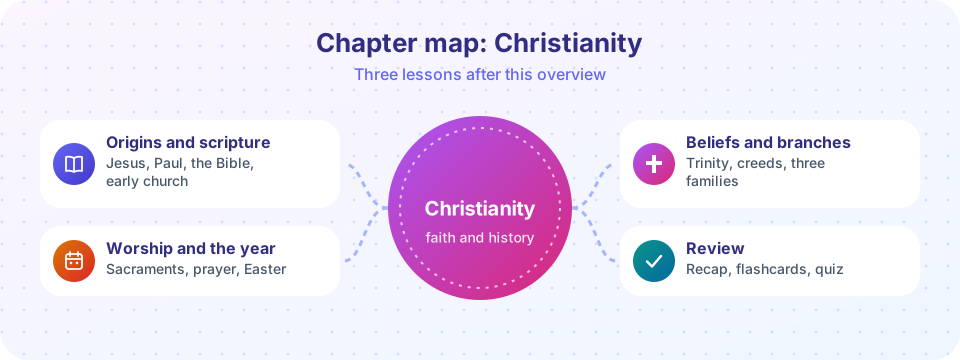
This chapter has three content lessons: the origins and scriptures, the beliefs and branches, and the practices and the church year. Throughout, you will see what Christians believe in their own terms, and where Christians disagree with each other. Historians and believers sometimes ask different questions about the same events; the course keeps them apart so that you can see both.
What you will learn
- The central figure and claims of Christianity and its origin within first-century Judaism.
- The main stages of Christian history, from the early church to the Reformation to today.
- The three major branches and why they split.
- Where Christianity is found today and how the global picture has shifted.
Key terms
Gospel: "good news"; also the name of the four accounts of Jesus' life, Matthew, Mark, Luke and John.
Church: the community of Christians (and the building where they meet); in some usages one of the denominations.
Denomination: a distinct organized branch of Christianity, such as Roman Catholic, Lutheran or Baptist.
Creed: a short formal statement of belief, such as the Nicene Creed.
Sacrament: a ritual understood as a means of divine grace, such as baptism or the Eucharist.
The story Christians tell
According to the Gospels, Jesus was born in Judea (then under Roman rule), grew up in Nazareth in Galilee, was baptized by John the Baptist, taught and healed publicly for a short time, gathered disciples, was arrested in Jerusalem and was crucified under the Roman governor Pontius Pilate. Christians believe he rose from the dead on the third day, and that his death and resurrection offer forgiveness and new life to all. His first followers were Jews; the movement became increasingly non-Jewish through the missions of the apostle Paul and others.
Most historians, whatever their own beliefs, accept that Jesus was a Jewish teacher from Galilee who was crucified under Pilate in about 30 CE. Historians cannot test claims such as the resurrection, which Christians hold as a matter of faith and others do not; the study of religion describes the belief and its effects without deciding it.
Five periods
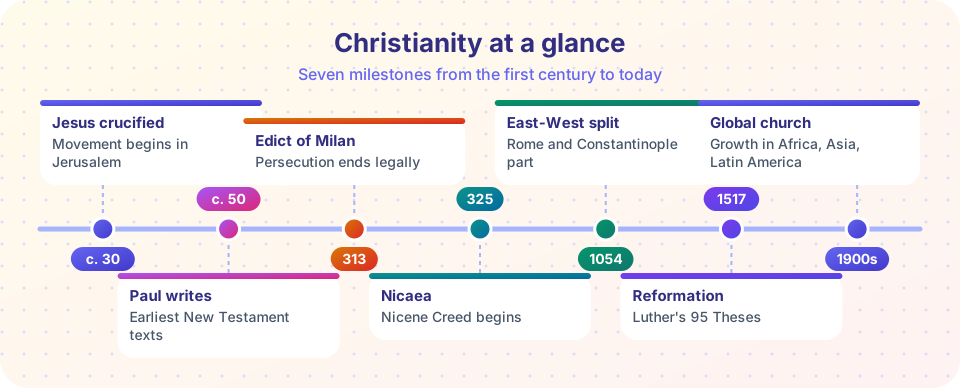
- Origins (about 30 to 100 CE). The first followers gather in Jerusalem, Paul writes letters to young congregations around the Mediterranean (the earliest New Testament texts, from about 50 CE), and the Gospels are written.
- The early church (100 to 500). Christians were sometimes persecuted, and Christianity became legal in 313 under Constantine. Church councils formulated the Nicene Creed (325, 381) and the doctrine of the Trinity.
- Medieval Christianity (500 to 1500). Monasteries preserved learning, cathedrals and universities were built, and the Western (Latin) and Eastern (Greek) churches grew apart, with a formal break often dated 1054.
- Reformation and after (1500 to 1800). Martin Luther's challenge in 1517 started the Protestant Reformation. Catholic reform, wars of religion, missions and the Enlightenment followed.
- The modern global church (1800 to today). Missionary movements, Pentecostalism and independent churches led to rapid growth in the Global South, while religious practice has declined in much of Europe.
Christianity at a glance
Three big branches
The church year
- Origins and scripture: the Jewish background, the Gospels, Paul, the canon and the early church.
- Beliefs and branches: the Trinity, the creeds and the main branches.
- Worship and the church year: sacraments, prayer, the liturgical calendar and the date of Easter.
- Review: recap, flashcards and quiz.
Common misconceptions
"Christianity is a European religion." It began in the Middle East, among Jews in Roman Palestine. Early centers included Jerusalem, Antioch, Alexandria and Syria. Today most Christians live outside Europe.
"All Christians believe the same things." There are agreed core beliefs (such as the Trinity among most Christians), but there are also major differences in authority, sacraments and worship.
"Christianity and the Bible are the same thing." The Bible is central, but Christians use it differently: some emphasize scripture alone, others scripture with tradition and church teaching.
Try it
Press Run (or Ctrl + Enter) to see the result here.
Program input · what you'd type while the program runs
Type the answers before you press Run, one per line. Each time the program reads a line (with input()), it gets the next line from this box.
Check your understanding
Quick check · 4 questions
of 4 answered You scored / 4 · perfect!
-
1. What does 'Christ' mean?
Christ comes from the Greek christos, 'anointed one,' which translates the Hebrew mashiach (Messiah). -
2. What did Constantine's Edict of Milan (313) do?
The edict gave toleration to Christians and others. Christianity later became the favored religion of the empire. -
3. Where do most Christians live today?
The center of gravity of Christianity has moved toward the Global South. -
4. The earliest New Testament writings are:
Paul's letters, from about 50 CE, are earlier than the Gospels.
Summary
- Christianity began as a movement within first-century Judaism centered on Jesus, called the Christ.
- It grew through Paul's missions, became legal in 313 and was shaped by the councils of the 4th century.
- Major branches are Catholic, Orthodox and Protestant, with many other churches.
- Today it is a global faith centered more in the Global South.
Next: Origins and scripture
Track your progress
Create a free account to tick off lessons and pick up where you left off on any device.
of Religious Studies lessons completed