


















Lesson 18 of 46 · Hinduism, Buddhism and Jainism
Hindu Paths and Practice
Learn the Hindu paths of knowledge, devotion and action, everyday worship (puja), festivals and pilgrimage, and the philosophical schools of Advaita and others.
If the last lesson was about what Hindus say, this one is about what they do and how they argue. Hindu life is full of practice: a morning offering at a home shrine, a visit to a temple to see the deity, a festival with lamps or colored powder, a pilgrimage to a sacred river. Alongside the practice runs a long tradition of philosophy, debating the nature of the self and the ultimate. And running through both is the question the traditions answer in many ways: what is the way to liberation?
What you will learn
- The three paths: action, knowledge and devotion, as taught in the Bhagavad Gita.
- What puja, darshan, temples and home worship involve.
- Major festivals and pilgrimages, including the Kumbh Mela.
- The main philosophical schools: Advaita, Vishishtadvaita and Dvaita.
Key terms
Yoga: "union" or "discipline"; any of several spiritual disciplines, including the philosophical system of Patanjali.
Bhakti: loving devotion to a personal deity.
Puja: worship, usually involving offerings, prayer and an image of a deity.
Darshan: seeing and being seen by a deity (or a holy person); also a term for a school of philosophy.
Advaita: "non-dual"; a school teaching that the self and Brahman are ultimately one.
Three paths to liberation
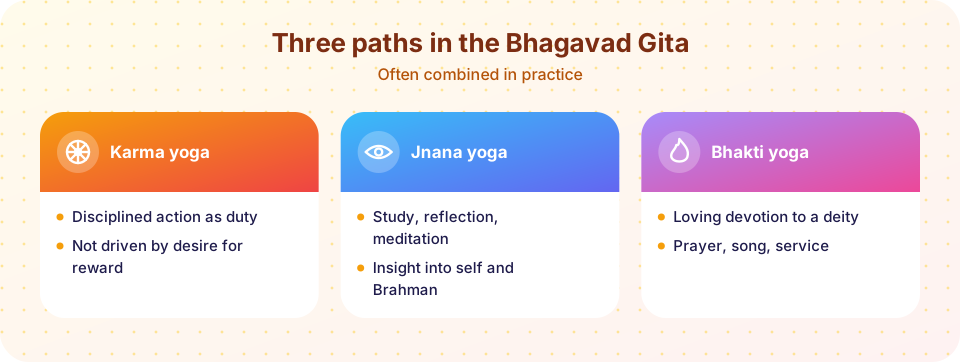
The Bhagavad Gita is the classic source for the idea that there are several paths (margas or yogas) toward the goal.
Karma yoga, the path of action, teaches disciplined action performed as duty without attachment to the results. Arjuna, a warrior, is told to do his duty without being driven by desire for reward. For many Hindus this means working with care and dedicating one's actions to the divine or to the welfare of others.
Jnana yoga, the path of knowledge, seeks liberating insight into the nature of the self and reality, usually through study, reflection and meditation guided by a teacher. It is associated with the Upanishads and especially with Advaita.
Bhakti yoga, the path of devotion, directs love toward a personal deity through prayer, song, remembrance and service. Bhakti movements flourished across India from about the seventh century onward, with poet-saints composing devotional songs in regional languages. Many of these poets, including women and people of lower castes, spoke of the equality of all devotees before God.
Hindus often combine the paths, and traditions give different weight to each. Another meaning of "yoga" is the system of Patanjali in the Yoga Sutras, a text usually dated between the second century BCE and the fourth century CE. It teaches an "eight-limbed" path including ethical restraints and observances, posture, breath regulation, withdrawal of the senses, concentration, meditation and absorption. Modern postural yoga draws on this heritage but developed largely in the twentieth century in India and was popularized internationally. Practices vary between traditional and modern forms.
Everyday worship
Much Hindu religious life centers on the home. Many families keep a small shrine with images or pictures of deities, and perform puja each day: lighting a lamp or incense, offering flowers, fruit or water, and reciting prayers or mantras. Temples (mandir) are understood as houses of the deity. Worshipers go for darshan, the exchange of sight between devotee and image. Priests perform rituals such as arati, waving lamps before the image, and distribute prasad, food that has been offered to the deity and is then shared, which many describe as a blessing. Practices differ by tradition: some temples restrict who may enter the innermost room, while some devotional communities emphasize shared singing (kirtan).
Life-cycle rites, called samskaras, mark important transitions: naming, the first feeding of solid food, initiation, marriage and death rites, usually cremation with ashes immersed in a river.
Festivals and pilgrimage
The Hindu year has many festivals, which vary by region and community.
- Diwali, the festival of lights in autumn, involves lamps, family gatherings and prayers to Lakshmi, goddess of prosperity; in some regions it also commemorates Rama's return, and in others, other stories.
- Holi, in spring, is known for colored powder and a joyful reversal of ordinary rules.
- Navaratri and Dussehra honor the Goddess and the victory of good over evil, including Rama's victory over Ravana in some traditions.
- Ganesh Chaturthi celebrates Ganesha with clay images immersed in water.
Pilgrimage (tirtha-yatra) to holy places is central. Rivers, mountains and cities are regarded as sacred crossings (tirthas). Varanasi on the Ganges is one of the holiest cities; many Hindus hope to bathe in the Ganges or have their ashes placed in it. The Kumbh Mela is a series of massive pilgrimages that rotate among four places, Prayagraj, Haridwar, Ujjain and Nashik, each about every twelve years, associated with the position of the planet Jupiter, whose orbit takes about 11.86 years. UNESCO recognized the Kumbh Mela as an intangible cultural heritage in 2017, and it is often described as among the largest peaceful gatherings of people in the world.
Philosophical schools
Indian philosophy classifies six orthodox systems (darshanas) that accept the Vedas, including Nyaya (logic), Vaisheshika (atomism), Samkhya (dualism of consciousness and matter), Yoga, Mimamsa (ritual interpretation) and Vedanta (the philosophy based on the Upanishads). Vedanta has several schools, which differ over the relation of the self, the world and Brahman:
- Advaita Vedanta, systematized by Shankara (around the eighth century CE), teaches that Brahman alone is ultimately real and that the individual self (atman) is not different from Brahman; the apparent plurality of the world arises from ignorance (avidya), which knowledge dispels.
- Vishishtadvaita ("qualified non-dualism"), taught by Ramanuja (eleventh to twelfth century), holds that the world and selves are real but form the body of God (Vishnu), and that loving devotion is central.
- Dvaita ("dualism"), taught by Madhva (thirteenth century), holds that God and individual selves are eternally distinct.
These are serious philosophical systems with arguments, objections and replies, and they show that "Hinduism" includes many views on basic questions.
Modern developments
In the nineteenth and twentieth centuries, reform movements such as the Brahmo Samaj and Arya Samaj, thinkers such as Swami Vivekananda, and political and social leaders such as Mahatma Gandhi, who drew on Hindu ideas of ahimsa, reinterpreted the tradition in changing circumstances. Millions of Hindus have migrated, building temples in new countries and adapting practices. Questions about the relationship between religion and politics, such as the rise of Hindu nationalism in India, are debated; chapter 8 returns to religion and society.
Common misconceptions
"Yoga is just exercise." Postural yoga is one modern form. In Hindu traditions yoga is a broad set of disciplines aimed at spiritual realization, and many practitioners do not use the postures at all.
"All Hindus believe the world is an illusion." That is the Advaita position, in a particular reading. Other schools hold that the world is real, and bhakti traditions emphasize a real relationship with God.
"Temple worship and philosophy are separate worlds." Many scholars and priests combine them, and devotional traditions have their own sophisticated theologies.
Try it
The first demonstration is a "which path?" quiz. Describe your temperament by moving four sliders, and see which of the three paths the Gita-style summary would highlight first. It is a teaching toy that simplifies how real traditions guide people, and it makes no claim about you.
The second demonstration works out the Kumbh Mela rotation. The festival visits each of four cities roughly every twelve years, which is close to Jupiter's orbital period. The base years are the full Kumbh years in recent decades.
Press Run (or Ctrl + Enter) to see the result here.
Program input · what you'd type while the program runs
Type the answers before you press Run, one per line. Each time the program reads a line (with input()), it gets the next line from this box.
Check your understanding
Quick check · 5 questions
of 5 answered You scored / 5 · perfect!
-
1. Which path emphasizes loving devotion to a personal deity?
Bhakti is devotion; karma is action; jnana is knowledge. -
2. What is darshan in temple worship?
Darshan is the sight exchange between devotee and image. -
3. Advaita Vedanta teaches that
Advaita (non-dual) was systematized by Shankara; Dvaita is dualist and Vishishtadvaita is qualified non-dualist. -
4. Which festival is known as the festival of lights?
Diwali involves lamps and prayers to Lakshmi. -
5. The Kumbh Mela rotates among Prayagraj, Haridwar, Ujjain and
The four sites are Haridwar, Prayagraj, Nashik and Ujjain.
Summary
- The Bhagavad Gita presents paths of action, knowledge and devotion, which many Hindus combine.
- Worship happens at home and in temples through puja, darshan and prasad; life-cycle rites (samskaras) mark transitions.
- Festivals such as Diwali, Holi and Navaratri and pilgrimages such as the Kumbh Mela shape the Hindu year.
- Vedanta includes Advaita (Shankara), Vishishtadvaita (Ramanuja) and Dvaita (Madhva).
- Hindu traditions continue to change through reform, migration and public debate.
Track your progress
Create a free account to tick off lessons and pick up where you left off on any device.
of Religious Studies lessons completed