


















Lesson 14 of 46 · Indigenous and Ancient Traditions
Ancient Greece, Rome and the Norse
Learn how Greek, Roman and Norse religions worked: civic cults, oracles and mysteries, Roman state religion, and the Norse myths and the problems of their sources.
When people say "mythology," they often mean the stories of the Greek, Roman and Norse gods: Zeus hurling thunderbolts, Venus rising from the sea, Odin hanging from the world tree. These stories survive in poetry, theater and film, and they are wonderful, but they are not the whole of the religion. For the people who lived it, religion was mostly something you did: sacrifices, festivals, vows, oracles, household offerings, and civic duties that held cities together. The stories were part of it, but a small part.
This lesson looks at the religions of ancient Greece, Rome and the Norse world as systems of practice and belief, and it pays attention to the special problem of sources: what survives, who recorded it, and when.
What you will learn
- How Greek religion worked: civic cult, myth, oracles, mysteries.
- The character of Roman state religion and how it related to other cults.
- What Norse mythology looks like and why the sources are problematic.
- Why "orthopraxy" and "polytheism" are useful terms here.
Key terms
Polis: the Greek city-state, whose cults were part of civic life.
Oracle: a place or person through whom a god is believed to give answers; Delphi is the most famous.
Mystery cult: a cult with secret initiation, such as the Eleusinian Mysteries.
Pietas: the Roman virtue of dutiful respect toward gods, family and state.
Interpretatio: the habit of identifying foreign gods with one's own (for example, Greek Zeus with Roman Jupiter).
Greek religion
Practice first
Greek religion had no single founder, scripture, creed or church. It was embedded in the polis (city-state): each city had its patron gods, temples, calendar and festivals. The central act was sacrifice: an animal was offered, part burned for the gods, and the rest eaten by the community at a shared feast, so ritual and civic dining were joined. Prayer, libations, vows and the dedication of gifts at sanctuaries were all routine. Festivals such as the Panathenaia in Athens, in honor of Athena, and the Olympic Games, held in honor of Zeus at Olympia, mixed ritual, competition and civic pride.
Gods and myths
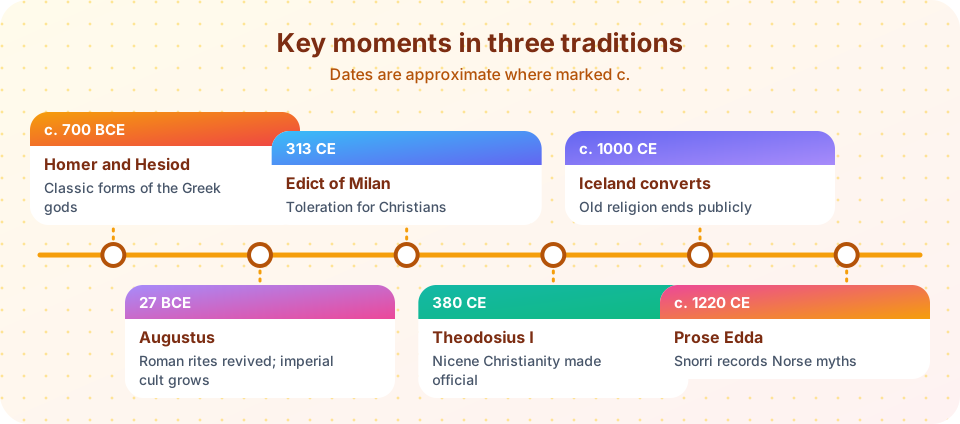
The gods of the Greek pantheon include Zeus (king of the gods, sky and thunder), Hera (marriage), Poseidon (sea), Demeter (grain), Athena (wisdom and war), Apollo (music, prophecy, healing), Artemis (the hunt), Aphrodite (love), Ares (war), Hermes (messenger) and others. The poets Homer and Hesiod, around 700 BCE, gave these gods their classic forms. The Iliad and Odyssey are epics whose gods intervene in human affairs, and Hesiod's Theogony tells how the gods came to power. Since there was no central authority, myths existed in many local versions, and poets, playwrights and artists freely reshaped them.
Oracles and mysteries
At Delphi, a priestess called the Pythia delivered Apollo's responses to questions from individuals and cities, and her answers shaped decisions such as the founding of colonies. The Eleusinian Mysteries, held near Athens for Demeter and her daughter Persephone, offered initiates a secret rite that was believed to bring blessings in this life and the next; because the participants kept the secret, we know little of what happened inside. Other cults, such as those of Dionysus, mixed ecstasy and ritual.
Questioning the gods
Greek thinkers also criticized traditional religion. Xenophanes (around 500 BCE) noted that people picture gods in their own image, and that if horses could draw, they would draw gods like horses. Philosophers such as Plato and Aristotle proposed more abstract accounts of the divine. Yet civic cult continued, and in the trial of Socrates (399 BCE), one of the charges was not honoring the city's gods, which shows how tightly religion and the city were bound.
Roman religion
The Romans honored a large set of gods and spirits, from the great state gods, Jupiter, Juno and Minerva, to household spirits, the lares and penates, who protected the home. Roman religion was strongly about pietas: dutiful care of what was owed to gods and the community, and a contractual attitude summarized in the idea do ut des, "I give so that you may give." State priesthoods, such as the pontifices and augurs, who read signs in the flight of birds, kept the correct forms of ritual, and officials such as consuls took part in public cult. Getting the ritual right mattered more than holding a particular belief.
Rome was open to other cults. Using interpretatio, the Romans linked their gods to Greek ones: Jupiter with Zeus, Juno with Hera, Neptune with Poseidon, Minerva with Athena, Venus with Aphrodite, Mars with Ares. As the empire expanded, cults from elsewhere, such as those of Isis from Egypt and Mithras (a mystery cult popular among soldiers), spread widely. Under the first emperor, Augustus (27 BCE to 14 CE), traditional rites were revived, and later emperors were honored in an imperial cult, in which loyalty to the ruler was expressed in religious forms.
The Romans were suspicious of groups they thought threatened public order. Early Christians and Jews had a complicated position because their exclusive worship of one god conflicted with expectations to honor the state gods. After Constantine, the Edict of Milan (313 CE) granted toleration to Christians, and in 380 CE the emperor Theodosius I declared Nicene Christianity the religion of the empire. Over the following centuries, the traditional cults lost their public support.
Norse religion
The world of the myths
The Norse tradition belongs to the peoples of Scandinavia and the North Atlantic, especially in the Viking Age (roughly 800 to 1050 CE). Its gods include Odin (wisdom, poetry, war and death), Thor (thunder, strength, protection), Freyja and Frey (fertility and prosperity), Frigg, Tyr, Loki (a trickster) and Baldr. The myths describe a world tree, Yggdrasil, linking nine worlds, and a final battle, Ragnarok, in which many gods die and the world is renewed.
The problem of sources
Almost everything we know of Norse myths comes from texts written in Iceland in the thirteenth century. The Poetic Edda is a collection of older poems preserved in a manuscript from about 1270, and the Prose Edda was written by the Icelandic chieftain and poet Snorri Sturluson around 1220 as a guide for poets. Iceland had adopted Christianity around the year 1000, so these texts were written by Christians a couple of centuries after the old religion ended publicly. Some, like Snorri, may have shaped the stories to fit a learned framework. Other sources include runestones, place-names, objects, burials and accounts by outsiders, such as Christian missionaries and Arab travelers. Scholars therefore treat Norse religion with caution: the main stories are well attested, but how people actually practiced, and how much varied by region, is harder to know.
Practice
Evidence suggests that Norse religion included sacrifices, feasts and oaths, seasonal gatherings, and the honoring of gods in sacred places such as groves and halls. Some regions seem to have emphasized specific gods. The days of the week still carry traces: Tuesday, Wednesday, Thursday and Friday are traditionally linked to Tyr, Odin (Woden), Thor and Frigg (or Freyja).
Revival and interpretation
Some people today practice reconstructed or revived forms of these traditions, such as Hellenic and Roman polytheism and Heathenry or Ásatrú. Scholars treat them as modern religious movements that draw on ancient sources, not as unbroken continuations, and approach them with the same fairness as any tradition.
Common misconceptions
"The Greeks believed their myths literally, like a creed." Greek religion had no creed. Myths had many versions, and people debated them. What mattered was participation in cult.
"The Romans just copied the Greek gods." Roman religion had native gods and its own priesthoods and forms; the Romans also identified their gods with Greek ones, but they kept distinct practices.
"Norse mythology is a complete, unchanged ancient book." The sources were written down late by Christians. They are valuable but incomplete and shaped by their authors.
Try it
The first demonstration is a god-equivalent quiz. A Greek god appears and you pick the Roman counterpart. The pairings are the standard ones used by the Romans.
The second demonstration shows how Roman and Germanic gods left traces in English weekday names. The Romans named days after their gods; Germanic speakers replaced several with their own equivalents.
Press Run (or Ctrl + Enter) to see the result here.
Program input · what you'd type while the program runs
Type the answers before you press Run, one per line. Each time the program reads a line (with input()), it gets the next line from this box.
Check your understanding
Quick check · 5 questions
of 5 answered You scored / 5 · perfect!
-
1. What was the central act of Greek civic religion?
Animal sacrifice and communal eating tied ritual to civic life. -
2. Which source gives us much of our knowledge of Norse myths?
The Poetic and Prose Eddas were written in Christian Iceland, which is why scholars treat them with caution. -
3. Roman pietas means
Pietas was a core Roman virtue involving duty to the gods and community. -
4. Which pairing is correct?
Hermes corresponds to Mercury; Athena to Minerva; Hera to Juno. -
5. Why is Norse religion hard to reconstruct?
The surviving narrative texts date from the thirteenth century, after conversion.
Summary
- Greek religion was civic, practice-centered and polytheistic, with oracles, festivals and mysteries but no creed.
- Roman religion stressed pietas, correct ritual and state priesthoods, and absorbed foreign cults until Christianity became the official religion in the fourth century CE.
- Norse myths survive mainly in thirteenth-century Icelandic sources, so scholars use them carefully.
- Orthopraxy and interpretatio help describe how these religions worked.
Next: Chapter 3 Review
Track your progress
Create a free account to tick off lessons and pick up where you left off on any device.
of Religious Studies lessons completed