


















Lesson 21 of 46 · Hinduism, Buddhism and Jainism
Jainism: The Path of Nonviolence
Learn the beliefs and practices of Jainism: Mahavira and the Tirthankaras, the five vows, ahimsa, anekantavada, the soul and karma, and the two main sects.
Jainism is one of the oldest continuous religions of India and is known for a simple and demanding idea: no living being should be harmed. Jains, who number several million, mostly in India, with communities in East Africa, Europe, North America and elsewhere, have shaped Indian culture out of proportion to their numbers, through trade, scholarship, architecture and a long tradition of vegetarianism and charity. Their ideas of nonviolence also influenced Mahatma Gandhi.
This lesson introduces Jain beliefs and practices. Like Buddhism, Jainism arose in the Ganges basin among wandering ascetics. Unlike Buddhism, it teaches that each living being has an eternal soul and that karma is a subtle substance that clings to the soul. The path to freedom is therefore a path of self-discipline and, above all, of nonviolence.
What you will learn
- Who Mahavira and the Tirthankaras are in Jain tradition.
- Jain ideas of the soul, karma and liberation.
- The five vows and the central role of ahimsa.
- Anekantavada, the doctrine of many-sidedness.
- The two main sects and how Jains practice today.
Key terms
Tirthankara: "ford-maker"; one of 24 teachers in each cosmic age who show the way across the ocean of rebirth.
Jiva: the soul or living being; in Jainism every living being has one.
Ahimsa: nonviolence; the principle of avoiding harm to any living being, in thought, word and deed.
Anekantavada: the teaching that reality has many aspects and no single viewpoint grasps all of them.
Kevala: the perfect knowledge of an enlightened soul, attained at liberation.
Origins and founders
Jains regard their religion as eternal, renewed in each cosmic age by 24 Tirthankaras. The first is Rishabhanatha, and the last, in this age, is Mahavira ("great hero"), also called Vardhamana, said to have lived in the sixth century BCE in what is now Bihar. Traditional dates are 599 to 527 BCE; many scholars place him slightly later. He was a contemporary of the Buddha, in the same region and among the same movement of wandering ascetics. The 23rd Tirthankara, Parshvanatha, is considered by many historians a plausible historical figure who lived earlier. Mahavira is said to have given up a princely life at about 30, practiced severe asceticism for twelve years and attained kevala jnana (perfect knowledge), then taught for about thirty years and attained final liberation.
Soul, karma and liberation
Jain metaphysics divides reality into the living (jiva) and the non-living (ajiva). Every living being, from humans to animals, plants and even microscopic organisms, has a soul that is eternal, conscious and, in its pure state, blissful and omniscient. Jains do not believe in a creator god; the universe is understood as eternal and operating by its own laws. Liberated souls (siddhas) and the Tirthankaras are revered as models and are honored in worship, but they do not create or intervene in the world.
Karma in Jainism is not only a moral law but a subtle form of matter that attaches to the soul through activity, especially activity driven by passions such as anger, pride, deceit and greed. The soul weighed down by karma is reborn in one of several realms. Liberation (moksha) comes when the influx of karma is stopped and existing karma is shed through discipline and austerity, after which the soul rises to the top of the universe and dwells in perfect knowledge and bliss, free of rebirth.
The path is summarized as the Three Jewels: right faith (samyag darshana), right knowledge (samyag jnana) and right conduct (samyag charitra). The classical text Tattvartha Sutra by Umaswati (about the second to fifth century CE) is accepted by both main sects as a summary of the doctrine.
The five vows
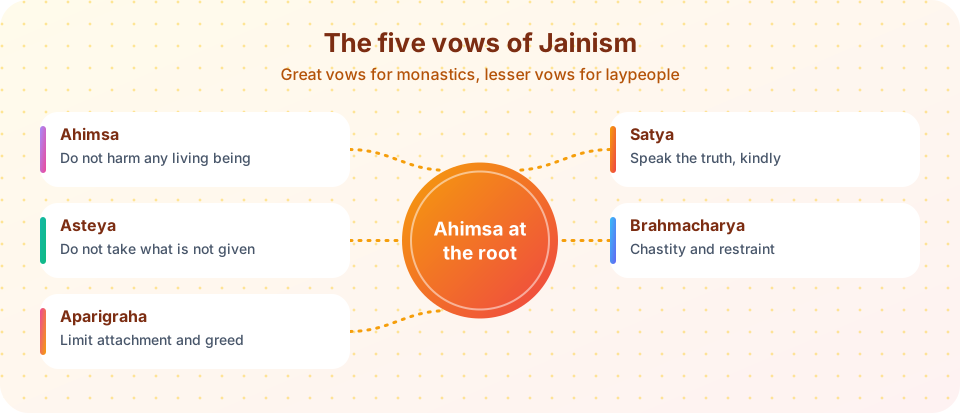
Jain ethics center on five vows. Monks and nuns take them as great vows (mahavratas) and follow them strictly; lay Jains take them as lesser vows (anuvratas) adapted to family and working life.
- Ahimsa (nonviolence): do not harm any living being by thought, word or action.
- Satya (truthfulness): speak the truth, kindly and carefully.
- Asteya (not stealing): do not take what is not given.
- Brahmacharya (chastity): monastics practice celibacy; laypeople practice fidelity and restraint.
- Aparigraha (non-possession): limit attachment to possessions and avoid greed.
Ahimsa is the root of the others, and Jains apply it with great care. Jains follow a vegetarian diet, and many avoid root vegetables such as potatoes and onions, since uprooting them kills the plant and many tiny organisms. Some avoid eating after dark, when insects are hard to see. Monks and nuns may sweep the path before them with a soft broom and wear cloth over the mouth to avoid harming small beings, and they travel on foot except in the rainy season, when many small creatures appear. Jain communities have long run animal shelters. Jain laypeople traditionally avoid occupations that cause great harm, and many have worked in trade, finance and education. Scholars note that this restriction helped shape Jain economic life.
Anekantavada: many-sided truth
Anekantavada ("not one-sided") is the teaching that reality is complex, with many aspects, and any single statement captures only part of it. Jain philosophers developed a method of syadvada, qualifying statements with "in some respect." A well-known illustration, told in several Indian traditions, is of people who touch different parts of an elephant: one touches the leg and says it is a pillar, another touches the trunk and says it is a snake. Each is right about a part and wrong about the whole. Many Jains see this teaching as encouraging intellectual humility and respect for other viewpoints. Philosophers debate its logical details, but its role as an ethic of tolerant dialogue is widely noted.
Two sects and daily life
The main division is between the Digambara ("sky-clad") and the Shvetambara ("white-clad") traditions. Digambara monks traditionally practice complete renunciation of clothing, and Digambaras hold that women must be reborn as men to attain liberation; Shvetambara monks and nuns wear white robes, and Shvetambaras hold that women can attain liberation. The sects also differ over some scriptures and over the details of the life of Mahavira. There are also non-image-worshipping subgroups, such as the Sthanakvasi and Terapanth in the Shvetambara tradition.
Jain worship includes the veneration of images of Tirthankaras in temples, often beautifully carved, as at the marble temples of Mount Abu and the colossal statue of Gommateshwara (Bahubali) at Shravanabelagola. Jains fast on special days, and the eight-to-ten-day festival of Paryushana is devoted to fasting, study and forgiveness, ending with the ritual of asking for forgiveness from others. Jains also celebrate Mahavira's birth (Mahavir Jayanti) and mark Diwali as the anniversary of his liberation.
Some Jains observe a voluntary fast at the end of life (sallekhana or santhara), understood by practitioners as a spiritual discipline and not as suicide. This practice has been debated in Indian courts, with differing rulings, and shows the tension between religious practice and state law that chapter 8 discusses.
Common misconceptions
"Jainism is a branch of Hinduism or Buddhism." It has its own founders, scriptures, philosophy and community. It shares vocabulary with other Indian traditions, but it is distinct and, in the view of its followers, very ancient.
"Jains believe in a god who punishes." Jainism has no creator god. The consequences of actions come from the working of karma, not divine judgment.
"Jain nonviolence means weakness." Jains describe ahimsa as a demanding discipline of the self. Some Jain kings and generals, historically, fought wars, which shows the tension between ideal and conduct.
Try it
The first demonstration illustrates anekantavada. Touch each part of the "elephant" to see what a single viewpoint would say, then press the button to reveal the whole. The point is to show how partial views combine; it is not a Jain ritual.
The second demonstration turns census-style numbers into a share of the population, to show how small the Jain community is compared with its influence. The figures are approximate (India's 2011 census counted about 4.45 million Jains among about 1.21 billion people).
Press Run (or Ctrl + Enter) to see the result here.
Program input · what you'd type while the program runs
Type the answers before you press Run, one per line. Each time the program reads a line (with input()), it gets the next line from this box.
Check your understanding
Quick check · 5 questions
of 5 answered You scored / 5 · perfect!
-
1. Who is the last Tirthankara of the present age in Jain tradition?
Mahavira is the 24th and last Tirthankara of this age; Parshvanatha is the 23rd. -
2. What is anekantavada?
Anekantavada means 'not one-sided' and underlies Jain humility about viewpoints. -
3. Which vow is the root of the others?
Ahimsa, nonviolence, is the central principle. -
4. How do Jains understand karma?
In Jainism karma is a subtle material that binds the soul. -
5. The two main Jain sects are
Digambara (sky-clad) and Shvetambara (white-clad) are the main sects.
Summary
- Jainism teaches eternal souls, subtle karma and liberation through discipline; there is no creator god.
- Mahavira, a contemporary of the Buddha, is the last of 24 Tirthankaras.
- The five vows center on ahimsa; Jain diet, travel and occupations reflect it.
- Anekantavada teaches that truth is many-sided.
- Digambara and Shvetambara sects differ on monastic dress, the status of women and some texts.
Next: Chapter 4 Review
Track your progress
Create a free account to tick off lessons and pick up where you left off on any device.
of Religious Studies lessons completed