


















Lesson 29 of 46 · Christianity
Christianity: Beliefs, Creeds and Branches
What Christians believe about God, Jesus, salvation and the afterlife, how the Nicene Creed was formed, and how Catholic, Orthodox and Protestant churches differ.
Christians share a set of core beliefs, but they hold and express them in different ways. A Catholic bishop, an Ethiopian Orthodox deacon, a Lutheran pastor and a Pentecostal congregation in Lagos would all recite much of the same creed, and yet differ on how the church is led, how many sacraments there are, what authority the Bible has and how salvation works. This lesson separates what is widely shared from what divides.
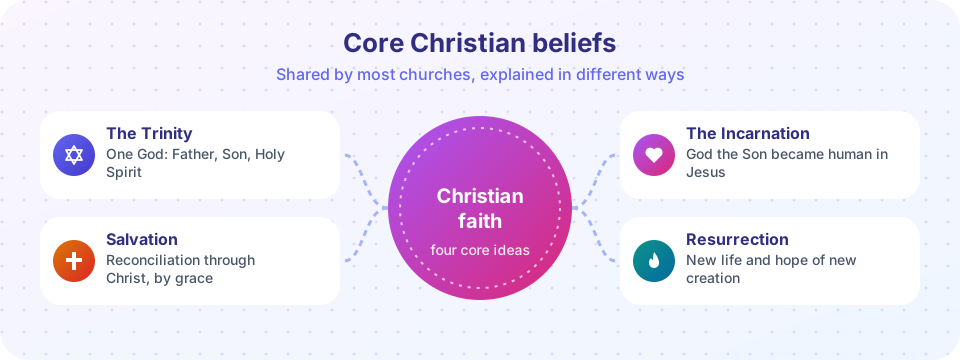
You will meet the main doctrines (the Trinity, the Incarnation, salvation, resurrection), see how they were settled at early councils, and then see how the church divided into three great families. Remember that this is a description of beliefs, attributed to those who hold them, and that scholars of religion do not judge which is right.
What you will learn
- The doctrines of the Trinity, the Incarnation, atonement and resurrection.
- How the Nicene, Apostles' and Chalcedonian formulas arose.
- The main branches: Roman Catholic, Eastern Orthodox, Oriental Orthodox and Protestant.
- How the Reformation produced Lutheran, Reformed, Anglican, Baptist, Methodist and Pentecostal traditions.
- Where the world's Christians live today.
Key terms
Trinity: the belief that the one God exists eternally as three persons, Father, Son and Holy Spirit.
Incarnation: the belief that God the Son became human in Jesus.
Atonement: the way in which Christ's death is understood to reconcile people with God.
Creed: a concise statement of belief used in worship and teaching.
Schism: a formal division in the church.
Core beliefs
One God in three persons. Christians inherit the Jewish conviction that there is one God. Early Christians also worshipped Jesus and spoke of the Spirit, and in the 3rd and 4th centuries they worked out the doctrine of the Trinity: God is one being in three persons, equal and eternal. The doctrine is expressed in creeds, not in one single Bible verse, and some Christian groups (Unitarians, and Jehovah's Witnesses, for example) reject it and are not regarded as part of mainstream Christianity by most other churches, though they consider themselves Christian.
Jesus Christ: fully God and fully human. In 325 the Council of Nicaea, responding to the teaching of Arius (who held that the Son was created and therefore not equal with the Father), declared the Son "of one substance" (homoousios) with the Father. The Council of Chalcedon in 451 declared that Christ has two natures, divine and human, united in one person. Most Christians accept this formula. The Oriental Orthodox churches (Coptic, Ethiopian, Armenian, Syriac and others) did not accept the Chalcedonian wording and went separate ways, though modern dialogues suggest that the dispute was partly one of terminology.
Salvation. Christians believe that human beings are separated from God by sin and need to be reconciled. The New Testament speaks of Christ's death in several images: a sacrifice, a ransom, a victory over evil. Later thinkers developed "theories of atonement": the Christus Victor idea (Christ conquers evil, stressed by the early church fathers and revived by Gustaf Aulén), Anselm of Canterbury's satisfaction theory (around 1098) and Peter Abelard's moral influence theory. The Western debate on grace and effort was shaped by Augustine (354 to 430) and then by the Reformation, when Luther and Calvin taught that people are saved by grace through faith; the Catholic Church, at the Council of Trent, taught that faith works through love and good deeds alongside grace. These are today less strict opponents than they once were, and Lutheran and Catholic churches issued a Joint Declaration on Justification in 1999.
Resurrection and hope. Christians affirm that Jesus rose from the dead and that believers will share new life. Views about the end of time vary widely: some stress the return of Christ and a final judgment, some the renewal of creation, and some focus on present life in the "kingdom of God."
Creeds
The Nicene Creed (325, with the Constantinople additions of 381) is the most widely accepted statement of faith, used by Catholic, Orthodox and many Protestant churches. The Apostles' Creed, a shorter statement that grew out of an old Roman baptismal confession, is common in the West. One famous dispute concerns the filioque ("and the Son"): the Western church added to the creed that the Spirit proceeds "from the Father and the Son," a change that Eastern churches rejected as both a doctrinal error and an unauthorized alteration. Not all Christians use creeds: many Baptists, Quakers and others hold that scripture alone is the authority and prefer to avoid formal creeds.
The great branches
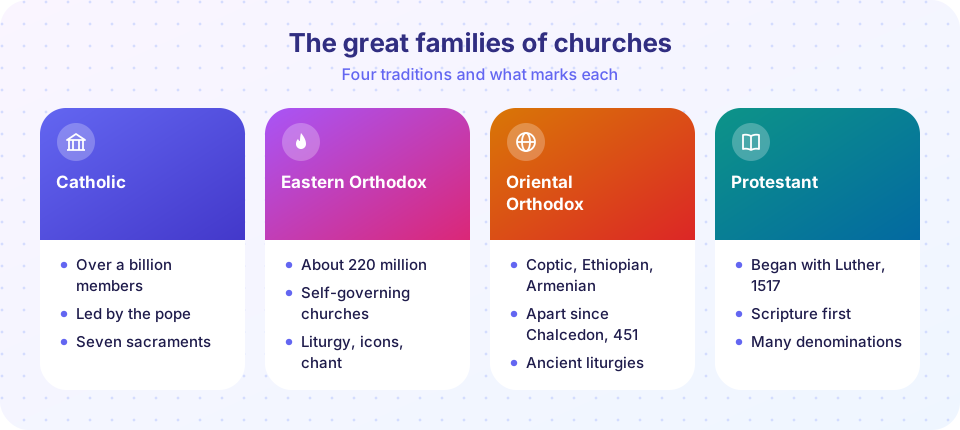
Roman Catholic Church. The largest single body, with more than a billion members (the church itself counts about 1.4 billion baptized people, while surveys of self-identified Catholics give lower figures). It is led by the pope, the bishop of Rome, whom Catholics regard as the successor of the apostle Peter, with authority over the whole church. It recognizes seven sacraments, draws on scripture and tradition together, and has a hierarchy of bishops, priests and deacons. Priests in the Latin church are normally celibate men. Some Eastern Catholic churches, which keep Eastern rites but are in communion with Rome, allow married priests.
Eastern Orthodox churches. About 220 million Christians, mainly in Eastern Europe, the Middle East and the Caucasus, belong to self-governing churches such as the Greek, Russian, Serbian and Romanian churches. They recognize the honorary primacy of the Patriarch of Constantinople but not the authority of the pope. Worship emphasizes the liturgy, icons, hymnody and mystery. The traditional date of the East-West split is 1054, when legates of Rome and the patriarch of Constantinople excommunicated one another, though historians stress that the break developed over centuries, with the sack of Constantinople in 1204 by Western crusaders deepening it.
Oriental Orthodox churches. Coptic (Egypt), Ethiopian, Eritrean, Armenian, Syriac and Malankara (India) churches separated after Chalcedon (451). They are among the oldest Christian communities, with their own languages and liturgies.
Protestant churches. Protestantism began with the Reformation. In 1517 Martin Luther (1483 to 1546), a German monk and professor, publicized his 95 Theses against the sale of indulgences. Reformers stressed sola scriptura (scripture alone), sola fide (faith alone) and the priesthood of all believers. Main branches include Lutheran, Reformed (Calvinist, after John Calvin, 1509 to 1564), Anglican (the Church of England broke with Rome under Henry VIII in 1534), Anabaptist (Mennonites, Amish), Baptist (17th century), Methodist (from John Wesley, 18th century) and Pentecostal (early 20th century, with the Azusa Street revival in Los Angeles, 1906, often cited as a starting point). Protestants usually recognize two sacraments, baptism and the Lord's Supper, and vary greatly in how they organize and govern their churches.
Global picture. In round numbers, about half of Christians are Catholic, a little over a third Protestant or independent, and about an eighth Orthodox. In 1900 most Christians lived in Europe; today a majority live in the Global South, with large and growing communities in sub-Saharan Africa, Latin America and Asia. Pentecostal and charismatic churches, which emphasize the Holy Spirit, healing and personal experience, are among the fastest-growing.
Common misconceptions
"Catholics worship Mary and the saints." Official Catholic teaching distinguishes worship, which is due to God alone, from veneration and asking saints to pray for us, in the way one might ask a friend. Critics, including some Protestants, disagree about whether these practices are legitimate.
"Protestants all believe the same things." There are thousands of denominations, and they disagree on baptism, church government, worship style and more.
"The Trinity means three gods." The doctrine says that there is one God, existing as three persons. How to express this has been debated for centuries.
Try it
Check your understanding
Quick check · 5 questions
of 5 answered You scored / 5 · perfect!
-
1. What does the doctrine of the Trinity say?
The Trinity affirms one God in three persons, formulated mainly in the 4th century. -
2. Which council declared that Christ has two natures, divine and human, in one person?
Chalcedon in 451 set out this formula. The Oriental Orthodox churches did not accept the wording. -
3. What is the filioque?
The filioque clause became a major point of dispute between Western and Eastern churches. -
4. Who published the 95 Theses in 1517?
Luther's 95 Theses criticized indulgences and started the Reformation. -
5. About how are the world's Christians divided?
These are round figures, and different surveys produce slightly different numbers.
Summary
- Core Christian beliefs: one God in three persons, the Incarnation, salvation through Christ and resurrection hope.
- The creeds of the 4th and 5th centuries (Nicaea 325, Constantinople 381, Chalcedon 451) fixed these beliefs.
- The great divisions: Oriental Orthodox after 451, Catholic and Orthodox (traditionally 1054), and Protestant after 1517.
- Christianity today is global, with the majority in the Global South.
Track your progress
Create a free account to tick off lessons and pick up where you left off on any device.
of Religious Studies lessons completed