


















Lesson 28 of 46 · Christianity
Christianity: Origins, the Bible and the Early Church
How Christianity began within first-century Judaism, what the Gospels and Paul's letters are, how the New Testament canon formed, and how the early church grew.
To understand Christianity you need two perspectives at once. One is the believer's view: Jesus is the Son of God, who lived, died and rose again for the salvation of the world, and the Bible is the inspired record that tells this story. The other is the historian's view, which studies the first-century Jewish world, the documents that survive, how they were written and collected, and how a small movement became a world religion. This lesson keeps both in view and labels which is which.
The central lesson is that Christianity grew out of Judaism. Jesus, his earliest followers and Paul were all Jews, and the first Christian scriptures were Jewish texts. Seeing that context makes the Gospels, the New Testament and the early church much easier to understand.
What you will learn
- The Jewish and Roman context of Jesus' life.
- The four Gospels, Acts, Paul's letters and the rest of the New Testament.
- How the biblical canon was settled and why Christian Bibles differ in size.
- How the church grew, from persecution to legal recognition and a council at Nicaea.
Key terms
Canon: the list of books accepted as scripture by a community.
Synoptic Gospels: Matthew, Mark and Luke, which share much material and a similar outline.
Apostle: "one who is sent"; a messenger commissioned by Jesus, including Paul.
Septuagint: the Greek translation of the Hebrew scriptures made from about the 3rd century BCE.
Epistle: a letter, such as the letters of Paul.
The world of Jesus
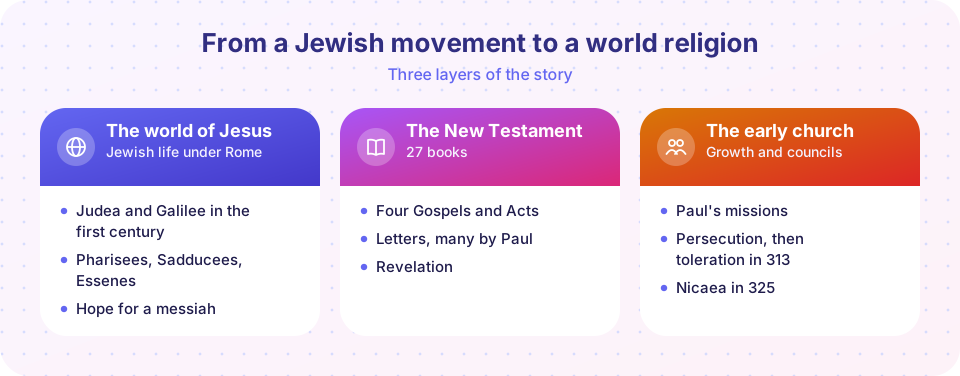
In the first century CE the land of Israel (then called Judea, with Galilee to the north) was part of the Roman Empire. Jews there held many views about how to live faithfully under foreign rule. Pharisees emphasized interpreting the law for everyday life, Sadducees were connected with the Temple in Jerusalem, Essenes withdrew to communal settlements (and, many scholars think, produced the Dead Sea Scrolls), and some groups hoped for a messiah who would restore Israel. In that environment, itinerant teachers and healers drew followers. The Gospels portray Jesus as a Galilean Jew who taught about the "kingdom of God," told parables, welcomed outcasts and clashed with some religious and political authorities.
Christians believe Jesus is the promised Messiah and the Son of God. Historians generally agree on a few facts: Jesus was baptized by John the Baptist, taught in Galilee, gathered followers and was crucified in Jerusalem under Pontius Pilate (the Roman historian Tacitus, writing around 116 CE, mentions the execution). The Gospels' reports of miracles and the resurrection are central to Christian belief but are matters of faith rather than historical demonstration.
The New Testament
The New Testament has 27 books, in four groups.
- The four Gospels (Matthew, Mark, Luke, John) give different portraits of Jesus. Most scholars date Mark to about 70 CE and consider that Matthew and Luke used Mark and a shared collection of sayings, which explains why the first three, the Synoptic Gospels, are so similar. John, usually dated slightly later, is quite different in style and emphasis. The existence of four accounts, with differences in detail, is something that Christians have long discussed.
- Acts of the Apostles, written by the same author as Luke, narrates the early spread of the movement from Jerusalem across the Mediterranean.
- Letters (epistles). Thirteen carry Paul's name; scholars agree that Romans, 1 and 2 Corinthians, Galatians, Philippians, 1 Thessalonians and Philemon were written by him, and debate the authorship of others. Other letters are attributed to figures such as James, Peter and John, and Hebrews is anonymous.
- Revelation, an apocalyptic vision of the end of the age, usually dated to the late first century.
Paul (known earlier as Saul of Tarsus) is the most influential figure after Jesus. A Pharisee who first opposed the movement, he reported an encounter with the risen Jesus, and became a missionary to non-Jews. His letters, written about 50 to 60 CE, are the earliest Christian writings that survive. A central question in his letters is whether non-Jewish believers must keep the Jewish law. The tradition describes a meeting in Jerusalem (often dated about 49 CE) that decided they need not be circumcised; Paul's phrase is that people are made right with God through faith.
The Bible and its canon
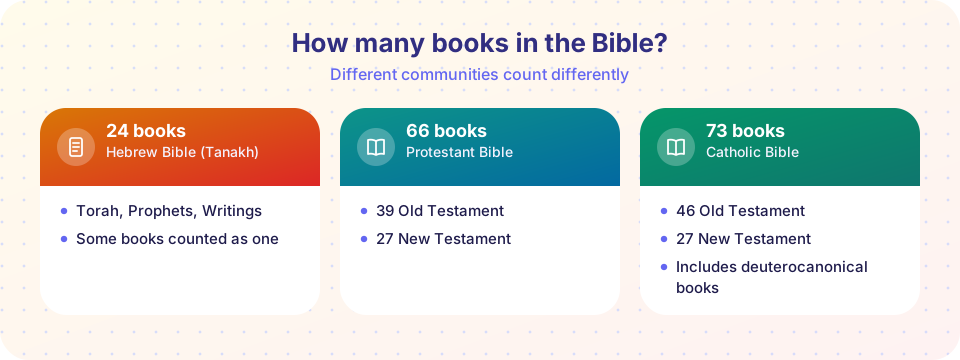
Christians read the Old Testament, which they take over from Jewish scripture, alongside the New Testament. Early Greek-speaking Christians often used the Septuagint, which includes some books not in the Hebrew Bible. As a result, Christian Bibles differ: Protestants have 66 books (39 in the Old Testament, 27 in the New); Catholics have 73, including seven additional Old Testament books and parts of others called the deuterocanonical books; Orthodox churches accept a still wider set. Protestants call the extra books "Apocrypha" and generally do not treat them as scripture.
The New Testament canon was not decided on one day. Early churches used various writings. The first known list of exactly the 27 books we have today appears in a letter of Athanasius of Alexandria in 367 CE, and later regional councils such as Carthage (397) endorsed the same list. Many scholars describe this as a gradual process of recognition within communities, though believers often describe it as the church recognizing what was already inspired.
Translation also shaped Christianity: Jerome's Latin Vulgate (late 4th century) was the standard in the West for a thousand years; Gutenberg printed his Bible around 1455; Luther's German New Testament appeared in 1522; the King James Version in 1611. Today the Bible is translated in whole or part into thousands of languages.
The early church
The early Christians met in homes, shared meals, read letters and scripture, baptized new members and cared for the poor and sick. They sometimes faced local hostility and occasional state persecution: Nero blamed Christians for the fire of Rome in 64 CE, and there were empire-wide persecutions in the 3rd century and the early 4th, under Decius and Diocletian. Yet the movement grew, helped by networks of cities, their care for others in epidemics and the appeal of their message.
In 313 the emperors Constantine and Licinius issued the Edict of Milan, ending legal persecution. Constantine called the Council of Nicaea in 325 to settle a dispute over the Son's relationship to the Father, which led to the Nicene Creed. In 380 the emperor Theodosius made Nicene Christianity the official religion of the empire. Meanwhile, Christianity spread beyond Rome's borders: Armenia is traditionally said to have adopted Christianity as a state religion around 301, and the kingdom of Aksum (in what is now Ethiopia and Eritrea) in the 4th century.
Common misconceptions
"Constantine invented Christianity or wrote the Bible at Nicaea." Nicaea dealt with the question of Christ's nature. It did not decide the canon, and Christianity existed for nearly three centuries before Constantine.
"Jesus founded a new religion called Christianity." Jesus lived and taught as a Jew. The separation between the Jesus movement and other Judaism happened gradually over the first and second centuries.
"The Gospels are eyewitness minutes." They are theological narratives written decades after the events, from sources that include oral tradition. Believers see them as inspired testimony; historians read them with attention to sources and purpose.
Try it
Press Run (or Ctrl + Enter) to see the result here.
Program input · what you'd type while the program runs
Type the answers before you press Run, one per line. Each time the program reads a line (with input()), it gets the next line from this box.
Check your understanding
Quick check · 5 questions
of 5 answered You scored / 5 · perfect!
-
1. Which are the Synoptic Gospels?
Matthew, Mark and Luke share much material and outline; John is quite different. -
2. When does the first known list of exactly 27 New Testament books appear?
Athanasius' 367 CE Easter letter lists the 27 books; later councils agreed. -
3. How many books are in the Catholic Bible?
Catholic Bibles have 73 books because they include the deuterocanonical books. -
4. What did the Edict of Milan (313) do?
It granted toleration. Nicaea (325) produced the creed. -
5. Who wrote the earliest surviving Christian writings?
Paul's letters, from about 50 CE, are earlier than the Gospels.
Summary
- Christianity began among Jews in Roman Palestine, centered on Jesus, whom Christians call the Christ.
- The New Testament has 27 books: Gospels, Acts, letters and Revelation. Paul's letters are the earliest.
- Canons differ: Protestant 66, Catholic 73, Orthodox wider; the 27-book New Testament list is first attested in 367 CE.
- The church grew despite persecution, became legal in 313 and held councils such as Nicaea in 325.
Next: Beliefs and branches
Track your progress
Create a free account to tick off lessons and pick up where you left off on any device.
of Religious Studies lessons completed