


















Lesson 1 of 46 · Getting Started
Course Map: How This Religious Studies Course Works
Meet the nine chapters of this religious studies course, learn how the subject differs from belief, and set up a fair, curious way to study every tradition.
Religion is one of the oldest and most widespread parts of human life. Burial sites with grave goods, cave paintings, temples, scriptures, festivals, food rules, prayers, pilgrimages and moral codes all point to people asking the same large questions: where did we come from, how should we live, what happens when we die, and is there more to reality than we can see? Today, billions of people answer those questions through a religious tradition, and billions of others answer them in non-religious ways. Whatever you believe, understanding religion helps you read history, news, art, law, music and the people next to you.
This course is an introduction to religious studies, the academic study of religion. It is written for learners of about 11 to 18 and for adults who want a clear, fair refresher, and it follows the common core of international courses (Cambridge, IB and US AP-style world religions and humanities syllabi) without being tied to any one exam board. You need no background and no particular beliefs. You need only a willingness to describe what other people hold in their own terms before you judge it.
Educational information only. This course describes what religious traditions teach and how scholars study them. It does not advocate for or against any belief, and it is not a substitute for guidance from a tradition's own teachers. Descriptions follow what believers themselves say, with attribution ("Muslims believe...", "Buddhists teach..."). Traditions are internally diverse, so any short summary leaves out variety.
What you will learn
- What religious studies is, and how it differs from preaching, theology and criticism.
- What the nine chapters of this course cover and how they build on each other.
- A study routine suited to a subject full of unfamiliar words, dates and names.
- How to hold your own views steady while you describe views you do not share.
Key terms
Religious studies: the academic, comparative and non-sectarian study of religions, using history, texts, social science and philosophy.
Tradition: a religion or religious movement seen as a long, changing stream of beliefs, practices and communities.
Worldview: an overall way of understanding reality, values and the purpose of life; religious and non-religious worldviews both count.
Emic and etic: the insider's account of a tradition (emic) and the outsider's analytical account (etic).
The nine chapters
The course starts with ideas about the subject, then moves through the world's traditions roughly in the order they appear in history, and ends with questions that cut across all of them.
Foundations first
- Getting Started
- Studying Religion
- Indigenous and Ancient
- Hinduism, Buddhism, Jainism
The Abrahamic traditions and more
- Judaism
- Christianity
- Islam and Others
Living with religion
- Religion and Society
- Projects and Practice
Chapters 1 to 4 are in this half of the course.
Chapters 1 and 2 are about how to think: what counts as a religion, how to describe a tradition fairly, and the toolkit scholars use (history, sociology, psychology, comparative methods). Chapters 3 to 7 are about what traditions teach and do, each built around the same questions: what is the ultimate reality or goal, how do believers understand the human problem, what texts and practices carry the tradition, and how has it changed? Chapter 8 asks how religion interacts with politics, law, science, ethics and a world that is increasingly plural. Chapter 9 gives you case studies and practice.
How each lesson is built
Every lesson has the same rhythm so you always know where you are. You start with outcomes and key terms, read the main ideas with an illustration, meet the usual misunderstandings, play with an interactive demonstration, and finish with a quiz and a summary. The demonstrations are teaching toys, such as a timeline explorer or a comparison table. They are labelled as such and none of them is a test of anyone's faith.
A study routine that suits this subject
Religious studies has a lot of vocabulary, and much of it comes from other languages: dharma, halakha, sunna, kami. Learners who struggle usually try to memorize lists. Learners who do well do three things.
- Anchor every term to a story or a practice. "Sabbath" is easier to remember as "the weekly day of rest that Jews mark from Friday evening to Saturday evening" than as a definition.
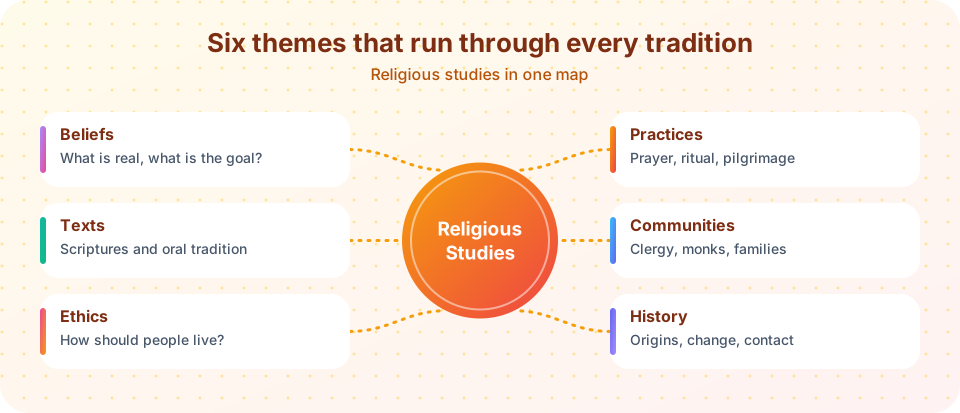
- Compare as you go. After each tradition, write one line for each of the six themes in the picture above. Differences show up quickly once you have a grid.
- Retrieve before you reread. Close the page and write down what you remember. Research on learning (the testing effect) finds that this beats rereading. The quizzes are there for this reason.
Starting points: what do you bring?
Everyone arrives with a starting position, and honest study begins by noticing it. You may belong to a tradition, you may have left one, you may have been raised without one, or you may know religion only from the news. None of these disqualifies you, and none gives you a head start in understanding other people's lives. The demonstration below asks six reflective questions and then reminds you which habits help each starting point. It is a reflection tool, not a measurement.
The second demonstration is a tiny planner. It spreads the nine chapters across the weeks you choose, so you can see how little time per week the course needs if you pace it.
Press Run (or Ctrl + Enter) to see the result here.
Program input · what you'd type while the program runs
Type the answers before you press Run, one per line. Each time the program reads a line (with input()), it gets the next line from this box.
Common misconceptions
"Studying religion means being religious (or trying to convert)." Religious studies is non-sectarian: it explains traditions without asking you to accept or reject them. Some courses are run by believers and some by non-believers, and good ones treat students of every view with equal respect.
"Religions are all the same underneath." Many people feel that, and some thinkers argue for it, but traditions disagree about basic matters such as whether there is a creator, whether the self persists, and what the human problem is. Careful comparison shows both similarities and genuine differences.
Check your understanding
Quick check · 4 questions
of 4 answered You scored / 4 · perfect!
-
1. Which description fits religious studies best?
Religious studies explains traditions with history, texts and social science without asking learners to accept or reject their claims. -
2. What does 'emic' mean in the study of religion?
Emic means the insider's perspective; the outsider's analytical perspective is called etic. -
3. Which study habit does research on learning favor?
Retrieval practice, also called the testing effect, usually beats rereading for long-term memory. -
4. Why does the course describe beliefs with attribution, such as 'Buddhists teach'?
Attribution reports what believers hold in their own terms without the course endorsing or disparaging it.
Summary
- Religious studies is the fair, academic study of religions, open to believers and non-believers alike.
- The nine chapters move from method, through the world's traditions, to ethics, society and practice.
- Six themes (beliefs, practices, texts, communities, ethics, history) tie every tradition together.
- Describe first, in believers' own terms; evaluate later and with care.
- Retrieve and compare as you study; do not just reread.
Next: What Is Religion?
Track your progress
Create a free account to tick off lessons and pick up where you left off on any device.
of Religious Studies lessons completed