Apply what you learned to five cases: a school timetable, clashing calendars, a disputed verse, a shared sacred city and food laws, with guiding questions and model answers.
Facts matter, but the skill that a religious studies course really builds is analysis: taking a concrete situation, asking good questions and giving a balanced answer. This lesson offers five case studies. Each has a short description, a set of guiding questions and a model approach that you can compare with your own. Try each case before you open the answer.
The cases are realistic scenarios or descriptions of well-known situations. They are meant to practice reasoning, not to settle legal or political disputes, and where something is contested the model answers say so.
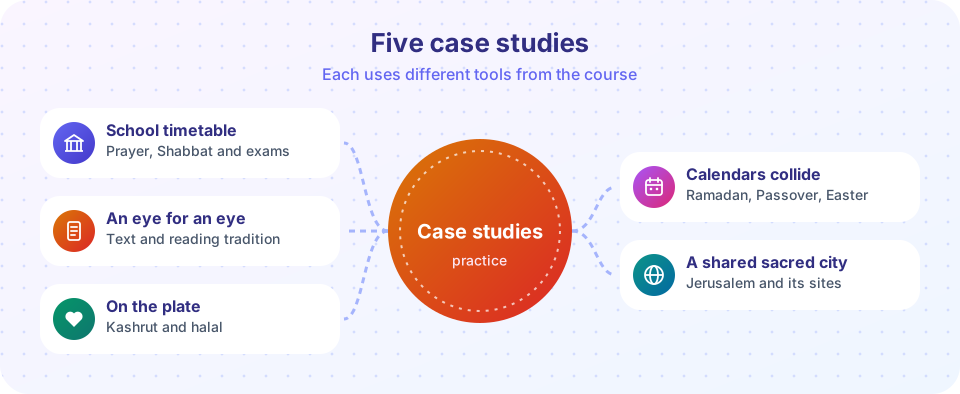
Caption: Five cases, each using a different set of tools from the course.
Case 1: the school timetable. A school plans exams on a Friday afternoon, a Saturday morning and the first day of a spring festival. Students include Muslims who attend Friday congregational prayer (jumu'a), Jews who observe Shabbat, and Christians and Jews who observe Easter or Passover. Guiding questions: What is the practice in each case, and how strict is the obligation? How do different movements within a tradition differ? What are the interests of the students, of the school and of the other students? What compromise might be fair?
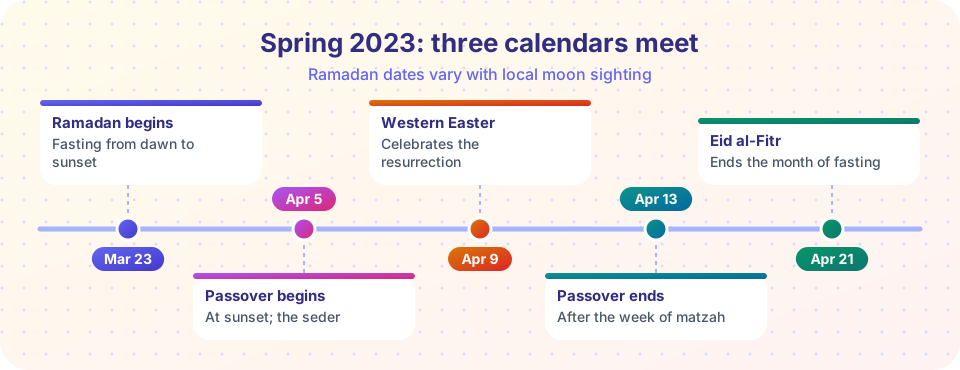
Case 2: calendars in collision. In some years Ramadan, Passover and Easter fall in the same few weeks. Guiding questions: Why do the dates of these festivals move through the Gregorian calendar? Which of the three calendars are lunar, which lunisolar and which fixed to the sun? What practical problems might a community or workplace face?
Case 3: an "eye for an eye." A speaker claims that the Torah teaches harsh literal revenge, and that Judaism is therefore "primitive." Guiding questions: Where does the phrase occur and in what context? How did the rabbis interpret it, and what does the Talmud do with it? What is the difference between the text and its reading tradition? How might you respond in an attributed way?
Case 4: a shared sacred city. Jerusalem contains the Western Wall and the Temple Mount, which is also the Haram al-Sharif with the Dome of the Rock and al-Aqsa Mosque, and the Church of the Holy Sepulchre. Guiding questions: Why is the city sacred to Jews, Christians and Muslims? How is access to the sites arranged? What does the arrangement of the Church of the Holy Sepulchre among several Christian denominations illustrate? How should a writer discuss the political aspects fairly?
Case 5: what's on the plate. A catering company wants to serve a conference with Jewish, Muslim and Hindu guests. Guiding questions: What are the basic ideas of kashrut and halal? Where do they overlap and where do they differ? What other dietary traditions might apply? What is the difference between a rule observed by all members of a tradition and one that varies?
Caption: In spring 2023 Ramadan, Passover and Easter overlapped (Ramadan dates vary by local moon sighting).
Use the same routine each time and your answers will become faster and sharper.
Describe the facts. Say what is happening, who is involved and what is known. Separate what is certain (a calendar rule) from what is disputed (a legal or political claim).
Identify the tradition's own view. Use primary sources or authoritative statements, and say which movement or school you are describing. Remember that practice varies within every tradition.
Apply a tool. Pick the lens that fits: the seven dimensions for a practice, a theory of society for a community question, a model such as Barbour's for a science question, or a calendar rule for a date question.
Weigh the interests and values. Who is affected, and what do they stand to gain or lose? Name competing goods, such as religious freedom and equal treatment, without pretending they never conflict.
Conclude with a clear, attributed claim. State what the evidence shows and what remains uncertain. Avoid phrases that smuggle in judgments.
Give yourself a point for each of the following: you stated the facts correctly; you attributed beliefs; you noted variation within the tradition; you used at least one idea from the course by name; and you avoided loaded language. Four points out of five is a strong answer.
Open each card in the first activity below after you have written your own answer. These models show the style of reasoning, not the only valid answer.
"A balanced answer means refusing to say anything." A balanced answer makes clear claims about what traditions say, supports them with evidence and explains where disagreements lie.
"Every case has one right answer." Some cases have settled facts (calendar rules) and others involve values and law (accommodation), where reasonable people disagree.
"If I know the tradition's rule, I know what every member does." Practice varies by movement, region and individual.
<style>:root{--ink:#1e1b4b;--mut:#475569;--bg1:#faf5ff;--bg2:#eff6ff;--ac:#6366f1;--ac2:#ec4899}@media(prefers-color-scheme:dark){:root{--ink:#e0e7ff;--mut:#a5b4fc;--bg1:#1e1b4b;--bg2:#1e293b}}*{box-sizing:border-box}body{margin:0;padding:14px;font-family:system-ui,-apple-system,'Segoe UI',sans-serif;color:var(--ink);background:linear-gradient(135deg,var(--bg1),var(--bg2));min-height:100vh}h3{margin:0 0 4px;font-size:17px}.sub{margin:0 0 12px;color:var(--mut);font-size:13px}.card{background:#fff;color:#1e1b4b;border-radius:18px;padding:16px 18px;box-shadow:0 10px 24px rgba(67,56,202,.15)}button{font:inherit;cursor:pointer;border:0;border-radius:999px;padding:8px 14px;background:linear-gradient(135deg,#6366f1,#4338ca);color:#fff;font-weight:600;font-size:14px}button.ghost{background:#eef2ff;color:#312e81}button.on{background:linear-gradient(135deg,#a855f7,#db2777);color:#fff}.row{display:flex;flex-wrap:wrap;gap:8px;margin-bottom:12px}.muted{color:#475569;font-size:14px}.big{font-size:19px;font-weight:700}</style><h3>Model answers</h3><pclass="sub">Think about your answer first, then open the card to compare.</p><divid="l"></div><script>varI=[["Case 1: the school timetable","Identify the practice (Friday congregational prayer is expected of Muslims at midday; Shabbat for Jews runs from Friday sunset to Saturday nightfall, so Friday afternoon exams can conflict in winter). Note that strictness varies: Orthodox Jews do not write on Shabbat, while other Jews may; many Muslim students pray jumu'a, with local arrangements. Then weigh interests: a fair solution might offer alternative exam times or short breaks for prayer, applied equally to all faiths and with notice from the school."],["Case 2: calendars in collision","Ramadan follows a purely lunar calendar of about 354 days, so it moves about 11 days earlier each year. The Jewish calendar is lunisolar with a leap month in 7 of 19 years, keeping Passover in spring. Easter is calculated from the spring equinox and the moon. They can fall near each other when Ramadan drifts into March or April. Practical issues include fasting during exams, shared public holidays and long working days."],["Case 3: an eye for an eye","The phrase appears in Exodus 21, Leviticus 24 and Deuteronomy 19 in the context of limiting punishment to be proportionate. Rabbinic tradition, recorded in the Talmud (Bava Kamma), interpreted it as monetary compensation, with detailed categories of damage. A balanced response attributes: 'The Torah text says X; rabbinic tradition has historically read it as Y.' It also points out that a reading tradition is part of the religion, and that calling a tradition primitive is a judgment, not a description."],["Case 4: a shared sacred city","Jews venerate the site of the ancient Temples and the Western Wall; Muslims revere the Haram al-Sharif, where the Dome of the Rock and al-Aqsa Mosque stand, as associated with Muhammad's night journey; Christians honor sites of Jesus' crucifixion and resurrection, centered on the Church of the Holy Sepulchre, shared by several denominations under a 19th-century status quo arrangement. A balanced account describes each community's attachments in its own terms and attributes political claims to the parties making them."],["Case 5: what's on the plate","Kashrut forbids pork and shellfish, requires prescribed slaughter and separates meat from dairy. Halal forbids pork and alcohol and requires prescribed slaughter, with no meat-dairy separation. They overlap but are not identical, so food that is kosher is not automatically halal (for example if it contains alcohol), and many Muslims accept kosher meat in some circumstances while others do not. Hindu guests may be vegetarian. A fair plan offers clearly labelled vegetarian options and asks guests about requirements."]];var l=document.getElementById('l');I.forEach(function(it){var d=document.createElement('div');d.className='card';d.style.marginBottom='10px';var q=document.createElement('div');q.className='big';q.style.fontSize='15px';q.textContent=it[0];var a=document.createElement('div');a.style.cssText='display:none;margin-top:8px;font-size:14px;color:#475569';a.textContent=it[1];var b=document.createElement('button');b.className='ghost';b.style.marginTop='8px';b.textContent='Show a model answer';b.onclick=function(){var s=a.style.display==='none';a.style.display=s?'block':'none';b.textContent=s?'Hide the answer':'Show a model answer'};d.appendChild(q);d.appendChild(b);d.appendChild(a);l.appendChild(d)});</script>
Which of Smart's dimensions?
<style>:root{--ink:#1e1b4b;--mut:#475569;--bg1:#faf5ff;--bg2:#eff6ff;--ac:#6366f1;--ac2:#ec4899}@media(prefers-color-scheme:dark){:root{--ink:#e0e7ff;--mut:#a5b4fc;--bg1:#1e1b4b;--bg2:#1e293b}}*{box-sizing:border-box}body{margin:0;padding:14px;font-family:system-ui,-apple-system,'Segoe UI',sans-serif;color:var(--ink);background:linear-gradient(135deg,var(--bg1),var(--bg2));min-height:100vh}h3{margin:0 0 4px;font-size:17px}.sub{margin:0 0 12px;color:var(--mut);font-size:13px}.card{background:#fff;color:#1e1b4b;border-radius:18px;padding:16px 18px;box-shadow:0 10px 24px rgba(67,56,202,.15)}button{font:inherit;cursor:pointer;border:0;border-radius:999px;padding:8px 14px;background:linear-gradient(135deg,#6366f1,#4338ca);color:#fff;font-weight:600;font-size:14px}button.ghost{background:#eef2ff;color:#312e81}button.on{background:linear-gradient(135deg,#a855f7,#db2777);color:#fff}.row{display:flex;flex-wrap:wrap;gap:8px;margin-bottom:12px}.muted{color:#475569;font-size:14px}.big{font-size:19px;font-weight:700}</style><h3>Which of Smart's dimensions?</h3><pclass="sub">Choose the best category for each item. You get feedback straight away.</p><divclass="card"><divclass="big"id="q"></div><divclass="row"id="b"style="margin-top:12px"></div><divid="f"class="muted"></div></div><divclass="muted"style="margin-top:10px"id="sc"></div><script>varCA=["Ritual","Experiential","Narrative","Doctrinal","Ethical","Social","Material"],IT=[["Muslims pray five times a day facing Mecca","Ritual","A repeated practice."],["A Sikh describes feeling God's presence while singing hymns","Experiential","A feeling or experience."],["The story of the exodus is retold at the seder","Narrative","A story at the heart of a festival."],["The Nicene Creed says the Son is of one substance with the Father","Doctrinal","A statement of teaching."],["Halakha requires honest weights and measures","Ethical","A legal and ethical rule."],["Baha'i communities elect Spiritual Assemblies","Social","How the community is organized."],["A torii gate marks the entrance to a Shinto shrine","Material","A sacred object or place."]],i=0,ok=0,done=false;var b=document.getElementById('b');CA.forEach(function(c){var x=document.createElement('button');x.className='ghost';x.textContent=c;x.onclick=function(){pick(c)};b.appendChild(x)});functionshow(){if(i>=IT.length){document.getElementById('q').textContent='Finished';b.style.display='none';document.getElementById('f').textContent='You matched '+ok+' of '+IT.length+'. Reload the preview to try again.';return}
document.getElementById('q').textContent=IT[i][0];document.getElementById('f').textContent='';document.getElementById('sc').textContent='Item '+(i+1)+' of '+IT.length+' | Correct so far: '+ok;done=false}functionpick(c){if(done)return;done=true;var right=IT[i][1];if(c===right){ok++;document.getElementById('f').textContent='Correct: '+right+'. '+(IT[i][2]||'')}else{document.getElementById('f').textContent='Not quite. Best answer: '+right+'. '+(IT[i][2]||'')}
document.getElementById('sc').textContent='Correct so far: '+ok;setTimeout(function(){i++;show()},1700)}show();</script>