


















Lesson 16 of 46 · Hinduism, Buddhism and Jainism
Chapter 4 Overview: Hinduism, Buddhism and Jainism
Overview of chapter 4: how Hinduism, Buddhism and Jainism arose in South Asia, what they share (karma, rebirth, liberation) and where they differ.
South Asia, the land of the Indus and Ganges rivers and the peninsula beyond, is the birthplace of several of the world's major religious traditions. Hinduism, Buddhism and Jainism (and, as you will see in chapter 7, Sikhism) share a world of ideas: actions have consequences (karma), beings are reborn (samsara), and the highest goal is release from that cycle (called moksha, nirvana or kevala in different traditions). Yet they disagree about much else, including whether there is a permanent self, whether a creator god matters, and what the best path to liberation is.
What you will learn
- What the five lessons of chapter 4 cover.
- Key ideas that the three traditions share, and where they part.
- How to avoid describing one tradition through another's categories.
Key terms
Karma: action and its consequences, usually understood to shape future experience, including rebirth.
Samsara: the cycle of birth, death and rebirth.
Liberation: release from samsara; called moksha in Hinduism and Jainism and nirvana in Buddhism (with differences in meaning).
Dharma: a many-sided word meaning law, duty, teaching or the way things are.
The chapter at a glance
Shared world, different answers
Three traditions
Lessons in this chapter
What each lesson covers
- Hinduism: Foundations introduces the Vedas, Upanishads, epics, gods and the core ideas of dharma, karma, samsara and moksha.
- Hindu Paths and Practice covers the paths of knowledge, devotion and action, worship, festivals, pilgrimage and the main philosophical schools.
- Buddhism: Life and Teachings tells the story of the Buddha and explains the Four Noble Truths, the Eightfold Path and the three marks of existence.
- Buddhism: Schools and Practice covers Theravada, Mahayana and Vajrayana, meditation, monastic life and how Buddhism spread.
- Jainism explains nonviolence, many-sidedness and the Jain path.
- Chapter 4 Review recaps the chapter.
Shared ideas, different meanings
It is tempting to say these traditions "believe in reincarnation and karma" and leave it there. But the same words mean different things. In many Hindu schools, an eternal self (atman) is reborn and is ultimately identified with, or related to, the ultimate reality (Brahman). Buddhist teaching, by contrast, says there is no permanent self (anatta): what continues is a stream of causally linked events, and liberation is the end of craving, not the escape of an eternal soul. Jainism holds that each living being has an eternal soul (jiva) and that karma is a kind of subtle matter that binds it, so that liberation requires stopping and shedding it. Compare traditions through such precise differences, not through a general phrase.
Where did they come from?
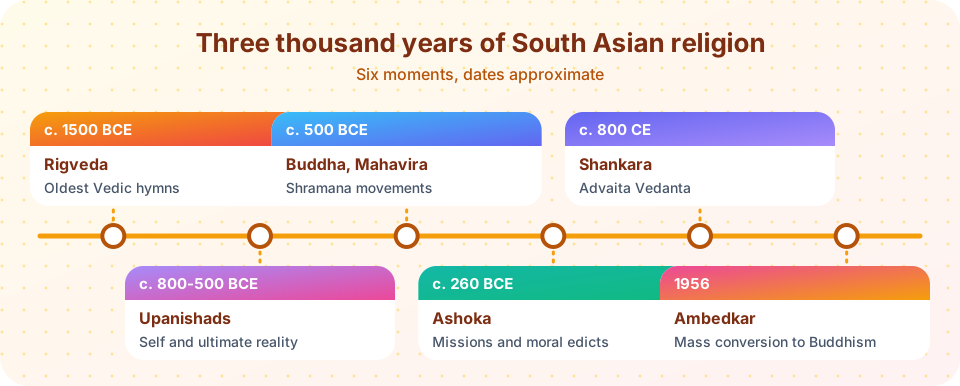
Scholars locate the origins of Hindu traditions in the religion of the Vedic peoples, whose oldest hymns (the Rigveda) were composed in the second millennium BCE, perhaps around 1500 BCE or later. The Upanishads developed from about 800 to 500 BCE. Buddhism and Jainism arose in the middle Ganges basin in the sixth to fifth centuries BCE, among wandering ascetics (called shramanas) who questioned the authority of the Vedic priesthood and its sacrifices. The three traditions have been in conversation ever since, borrowing, disputing and influencing each other. The word "Hinduism" is a modern term for a family of traditions that has no single founder, and many Hindus prefer Sanatana Dharma, the "eternal way."
"Buddhism is a branch of Hinduism." Buddhism emerged in the same region and shares vocabulary, but it rejects the authority of the Vedas and has its own founder, texts, monastic order and doctrines. Scholars treat it as a distinct tradition.
"These religions are peaceful and otherworldly." They have also been entangled with kings, politics, art, science and, at times, conflict. Study the traditions' teachings and their histories together.
Try it
The first demonstration is a three-way sorter. Read each statement and decide which tradition it describes: Hinduism, Buddhism, Jainism, or all three. The statements are short summaries of ideas covered in this chapter.
The second demonstration turns approximate follower counts into shares of the world population. The figures are rounded estimates from surveys around 2020 and vary by source; the point is the order of magnitude.
Press Run (or Ctrl + Enter) to see the result here.
Program input · what you'd type while the program runs
Type the answers before you press Run, one per line. Each time the program reads a line (with input()), it gets the next line from this box.
Check your understanding
Quick check · 3 questions
of 3 answered You scored / 3 · perfect!
-
1. Which idea do Hinduism, Buddhism and Jainism broadly share?
All three teach karma and samsara, though they interpret them differently. Buddhism and Jainism do not accept Vedic authority. -
2. Buddhism differs from many Hindu schools in teaching that
Buddhism teaches anatta, no-self, while many Hindu schools teach an eternal atman. -
3. Who were the shramanas?
Buddhism and Jainism arose among the shramana movements.
Summary
- Hinduism, Buddhism and Jainism arose in South Asia and share concepts of karma, samsara and liberation.
- They differ on the self, the role of gods, the authority of the Vedas and the path to liberation.
- Hinduism is a family of traditions without a single founder; Buddhism and Jainism arose among wandering ascetics around the sixth to fifth centuries BCE.
- Compare with precision: the same word can mean different things in each tradition.
Next: Hinduism: Foundations
Track your progress
Create a free account to tick off lessons and pick up where you left off on any device.
of Religious Studies lessons completed