


















Lesson 44 of 46 · Projects and Practice
Glossary of Religious Studies Terms (Judaism to Society)
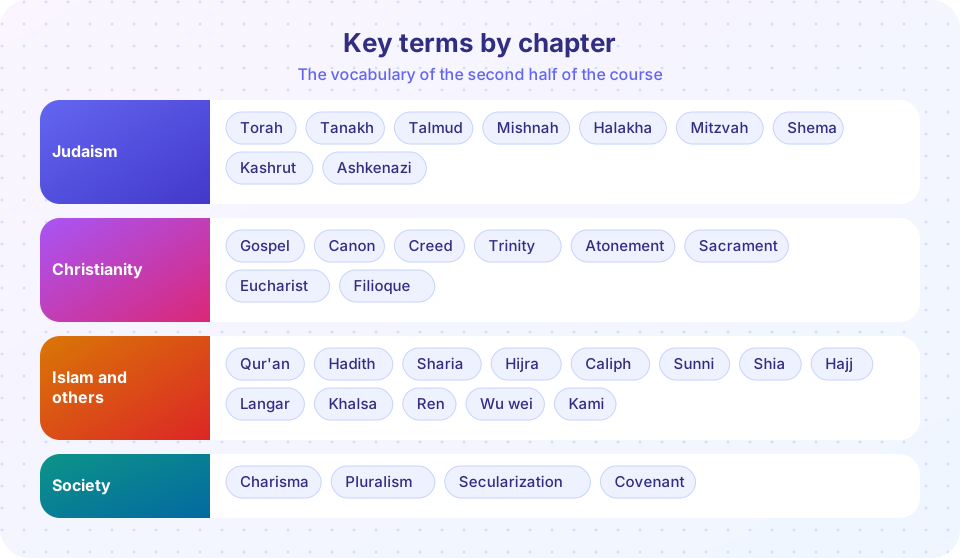
A glossary of key terms from the whole course: ritual and myth, South Asian religions, Judaism, Christianity, Islam, Sikhism, the Baha'i Faith, East Asian traditions and religion in society, with flashcards.
Every field has its own vocabulary, and religious studies borrows words from many languages: Hebrew, Greek, Latin, Arabic, Punjabi, Chinese and Japanese. This glossary gathers the terms from the second half of the course in one place, with plain definitions. Use it as a reference while you read, and as a source for flashcards when you revise.
Definitions describe how each tradition or scholar uses the word. Spellings of non-English terms vary in English; this course uses common forms.
What you will learn
- The meaning of the main terms from the chapters on Judaism, Christianity, Islam and other traditions, and religion and society.
- How terms in different languages express related ideas.
- How to use the glossary to revise.
Key terms
Glossary: an alphabetical list of terms with definitions.
Transliteration: writing a word from one script in the letters of another; spellings vary.
Loanword: a word taken from another language, such as kosher or karma.
Technical term: a word with a precise meaning in a field.
Cognate: a word related to another by common origin, such as Hebrew shalom and Arabic salam.
A to Z of terms
| Term | Meaning |
|---|---|
| Ashkenazi | Jews descended from communities in Central and Eastern Europe |
| Atonement | The way Christ's death is understood to reconcile people with God; also reconciliation in Yom Kippur |
| Bar/bat mitzvah | The coming of age at which a Jewish young person becomes responsible for the commandments |
| Caliph | A successor to Muhammad as leader of the Muslim community |
| Canon | The list of books accepted as scripture by a community |
| Charisma | Weber's term for exceptional personal authority |
| Covenant | A binding relationship between God and a people, central in Judaism |
| Creed | A concise formal statement of belief, such as the Nicene Creed |
| Dao | "The Way": the pattern of the universe in Daoism |
| Eucharist | The Christian rite of bread and wine, also called Communion or the Mass |
| Filioque | "And the Son": the Western addition to the Nicene Creed that the East rejected |
| Five pillars | Shahada, salat, zakat, sawm and hajj in Islam |
| Gospel | "Good news"; one of the four New Testament accounts of Jesus |
| Gurdwara | A Sikh place of worship, "door of the Guru" |
| Hadith | A report of the sayings or actions of Muhammad |
| Hajj | The pilgrimage to Mecca |
| Halakha | Jewish law, "the way of walking" |
| Hijra | The migration from Mecca to Medina in 622, year 1 of the Islamic calendar |
| Imam | A prayer leader; in Shia Islam, a divinely guided successor of Muhammad |
| Kami | Sacred powers or spirits in Shinto |
| Kashrut | The Jewish dietary laws; permitted food is kosher |
| Khalsa | The Sikh order of committed initiated members founded in 1699 |
| Langar | The free communal meal at a gurdwara |
| Li | Ritual propriety in Confucian thought |
| Mishnah | The first great written collection of Jewish oral law, about 200 CE |
| Mitzvah | A commandment in Judaism; in everyday speech a good deed |
| Pluralism | The existence of many religions and worldviews side by side |
| Qur'an | The book Muslims regard as God's word; "recitation" |
| Ramadan | The Islamic month of fasting from dawn to sunset |
| Ren | Humaneness or benevolence, the main Confucian virtue |
| Sacrament | A rite understood as a sign or means of grace |
| Secularization | The idea that religion's social or personal role declines as societies modernize |
| Sharia | "The path": God's guidance for life, as understood by Muslims |
| Shema | The Jewish declaration that God is one (Deuteronomy 6:4) |
| Shia | The branch of Islam that holds leadership belongs to Ali and his family |
| Sufism | The mystical dimension of Islam |
| Sunni | The largest branch of Islam, which holds the community chose Abu Bakr |
| Talmud | The Mishnah together with the Gemara |
| Tanakh | The Hebrew Bible: Torah, Nevi'im and Ketuvim |
| Torah | The Five Books of Moses; also the wider body of Jewish teaching |
| Trinity | One God in three persons: Father, Son and Holy Spirit |
| Wu wei | Acting in harmony with the Dao, without forcing |
| Zakat | Obligatory almsgiving in Islam, usually 2.5 percent of qualifying savings |
More terms: studying religion, myth and South Asian traditions
The earlier chapters introduced the study of religion, ritual and myth, indigenous and ancient traditions, and the religions of South Asia. Their terms are listed here.
| Term | Meaning |
|---|---|
| Ahimsa | Non-harming; a central ethical principle in Jainism and important in Hindu and Buddhist ethics |
| Animism | The view that animals, plants, places and objects have a spirit or life of their own |
| Anatta | The Buddhist teaching that there is no permanent, unchanging self |
| Atman | In Hindu thought, the self or soul, often understood as one with Brahman |
| Avatar | The descent of a deity to earth in a bodily form, as in Vishnu's avatars |
| Bodhisattva | In Mahayana Buddhism, a being who delays final liberation to help others |
| Brahman | The ultimate reality in many Hindu traditions |
| Dharma | Law, duty or right order in Hindu thought; the Buddha's teaching in Buddhism |
| Dukkha | Suffering, unsatisfactoriness; the first of the Four Noble Truths |
| Emic and etic | An insider's own description of a belief (emic) and an outside observer's analysis of it (etic) |
| Eightfold Path | The Buddhist path to the end of suffering: right view, intention, speech, action, livelihood, effort, mindfulness and concentration |
| Karma | Action and its consequences, which shape future rebirths in Indian traditions |
| Moksha | Liberation from the cycle of rebirth in Hindu and Jain thought |
| Myth | A traditional story that expresses a community's deeper beliefs; not a synonym for "false" |
| Nirvana | In Buddhism, the end of craving and suffering; literally "blowing out" |
| Oral tradition | Teachings, stories and laws handed down by speaking rather than writing |
| Puja | Worship of a deity with offerings, often at a home shrine or temple |
| Rite of passage | A ritual that marks a change of status, such as birth, adulthood, marriage or death |
| Ritual | A set of actions performed in a prescribed way, with symbolic meaning |
| Sacred and profane | Durkheim's pair of terms for what a community sets apart as special and what is ordinary |
| Samsara | The cycle of birth, death and rebirth |
| Shaman | A specialist who is believed to contact the spirit world on behalf of a community |
| Symbol | An object or action that stands for a meaning beyond itself |
| Totem | An animal, plant or object that is a symbol of a group and linked to its identity |
| Veda | The oldest sacred texts of Hinduism, composed in Sanskrit |
| Yoga | A set of disciplines, physical, mental and ethical, aimed at union or liberation |
Words that travel
Some words appear in several traditions with related but not identical meanings. Torah means "teaching" in Hebrew and refers to the Five Books of Moses and, more widely, to all Jewish learning; in Sikhism the Guru Granth Sahib plays a comparable role as the central scripture. Hajj and pilgrimage describe journeys to sacred places in Islam, Christianity, Hinduism and other religions, but their rules differ. The Arabic salam and the Hebrew shalom are cognate words for peace; both are used in greetings. Sacrament is a Christian word; applying it to rituals in other traditions requires care, because it carries Christian ideas about grace. When you use such a word for another tradition, say what you mean and note that it is an analytical term.
Common misconceptions
"There is one correct spelling." Transliteration varies: Qur'an, Quran and Koran; Baha'i and Bahai; Sikh and Sikhi. Choose a consistent form and explain if needed.
"Translations are exact equivalents." Dao is not just "path," and kami is not simply "god." A translation is an approximation.
Try it
Press Run (or Ctrl + Enter) to see the result here.
Program input · what you'd type while the program runs
Type the answers before you press Run, one per line. Each time the program reads a line (with input()), it gets the next line from this box.
Check your understanding
Quick check · 4 questions
of 4 answered You scored / 4 · perfect!
-
1. What does 'halakha' mean?
Halakha is the body of Jewish law. -
2. Which term refers to the migration from Mecca to Medina in 622?
The Hijra marks year 1 of the Islamic calendar; hajj is the pilgrimage. -
3. What is the filioque?
Filioque means 'and the Son.' -
4. Which word refers to Weber's concept of exceptional personal authority?
Weber described charismatic authority, as in a prophet.
Summary
- The glossary lists the key terms of the second half of the course.
- Many terms come from other languages and have no exact English equivalent.
- Use technical terms carefully, and say what you mean when applying one to another tradition.
Next: Cheat sheet
Track your progress
Create a free account to tick off lessons and pick up where you left off on any device.
of Religious Studies lessons completed