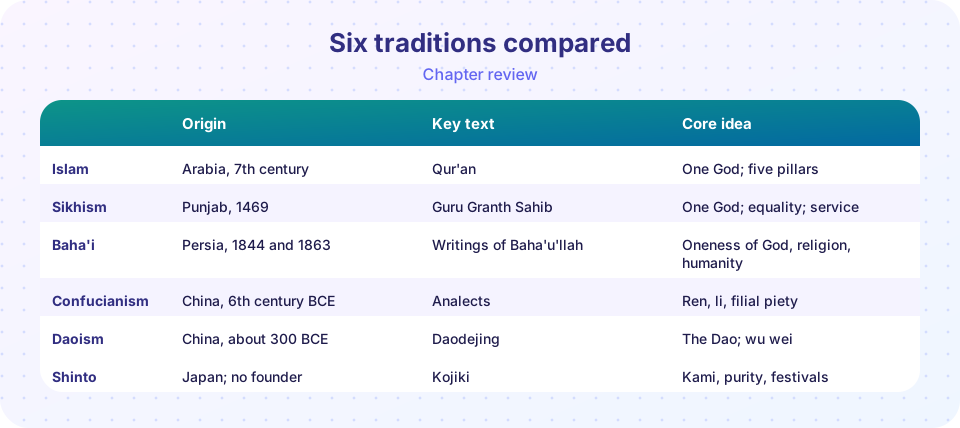
Review the chapter on Islam, Sikhism, the Baha'i Faith, Confucianism, Daoism and Shinto with a comparison table, flashcards, a sorting game and a ten-question quiz.
This chapter covered a wide range: a world religion of about two billion people, two independent religions from recent centuries, and three East Asian traditions that blur the line between religion, philosophy and culture. The review pulls them into one comparison and then asks you to recall facts and use them.
Caption: Six traditions compared on origin, key text and core idea.
Revelation, teaching and tradition. Islam and the Baha'i Faith are based on revelation through messengers, and each treats its scripture as the central authority. Sikhism rests on the experience and teaching of ten Gurus, and then on a scripture treated as the living Guru. Confucianism and Daoism rest on teachers and classic texts, and Shinto on ritual practice rather than doctrine.
Community and equality. Sikh and Baha'i teachings both stress equality and service, and both have distinctive institutions: the langar and gurdwara in Sikhism, the Nineteen Day Feast and elected councils in the Baha'i Faith. Islam's mosque and Friday prayer, and Confucian family rituals, bind communities in other ways.
Calendars. Islam's purely lunar calendar moves through the seasons; the Baha'i calendar is solar with nineteen months; Sikhs use a calendar of their own, and many East Asian festivals follow a lunisolar calendar. When you meet a festival date, ask which calendar it follows.
Describing fairly. For each tradition, try to state what its followers hold, in their words, and attribute it: "Muslims believe the Qur'an is..."; "Baha'is teach that..."; "Sikhs describe..." This habit keeps your writing accurate and respectful.
"Islam, Sikhism and the Baha'i Faith are all offshoots of one another." Each is independent. They arose in related regions and times, which is not the same as being derived from each other.
"Confucianism, Daoism and Shinto are rival religions." In practice they often coexist in people's lives.
<style>:root{--ink:#1e1b4b;--mut:#475569;--bg1:#faf5ff;--bg2:#eff6ff;--ac:#6366f1;--ac2:#ec4899}@media(prefers-color-scheme:dark){:root{--ink:#e0e7ff;--mut:#a5b4fc;--bg1:#1e1b4b;--bg2:#1e293b}}*{box-sizing:border-box}body{margin:0;padding:14px;font-family:system-ui,-apple-system,'Segoe UI',sans-serif;color:var(--ink);background:linear-gradient(135deg,var(--bg1),var(--bg2));min-height:100vh}h3{margin:0 0 4px;font-size:17px}.sub{margin:0 0 12px;color:var(--mut);font-size:13px}.card{background:#fff;color:#1e1b4b;border-radius:18px;padding:16px 18px;box-shadow:0 10px 24px rgba(67,56,202,.15)}button{font:inherit;cursor:pointer;border:0;border-radius:999px;padding:8px 14px;background:linear-gradient(135deg,#6366f1,#4338ca);color:#fff;font-weight:600;font-size:14px}button.ghost{background:#eef2ff;color:#312e81}button.on{background:linear-gradient(135deg,#a855f7,#db2777);color:#fff}.row{display:flex;flex-wrap:wrap;gap:8px;margin-bottom:12px}.muted{color:#475569;font-size:14px}.big{font-size:19px;font-weight:700}</style><h3>Chapter 7 flashcards</h3><pclass="sub">Click the card to flip it. Mark whether you knew it.</p><divid="c"class="card"style="min-height:130px;cursor:pointer;display:flex;flex-direction:column;justify-content:center;text-align:center"><divid="t"class="muted"></div><divid="x"class="big"></div></div><divclass="row"style="margin-top:12px"><buttonclass="ghost"id="p">Previous</button><buttonclass="ghost"id="n">Next</button><buttonclass="ghost"id="s">Shuffle</button><buttonid="k">I knew it</button></div><divclass="muted"id="st"></div><script>varD=[["What are the five pillars of Islam?","Shahada, salat, zakat, sawm and hajj"],["What is the Hijra?","The migration to Medina in 622; year 1 of the Islamic calendar"],["Sunni and Shia differ mainly over...","Leadership after Muhammad's death in 632"],["Who founded Sikhism?","Guru Nanak (1469 to 1539)"],["What is the Khalsa?","The order of initiated Sikhs founded in 1699 by Guru Gobind Singh"],["What is langar?","The free communal meal at a gurdwara"],["Who is Baha'u'llah?","The founder of the Baha'i Faith, declared in 1863"],["What is wu wei?","Acting in harmony with the Dao, without forcing"],["What is ren?","Confucian benevolence or humaneness"],["What are kami?","Sacred powers or spirits in Shinto"]],i=0,f=false,known=0,seen={};functionshow(){document.getElementById('t').textContent=(f?'Answer':'Question')+' '+(i+1)+' of '+D.length;document.getElementById('x').textContent=D[i][f?1:0];document.getElementById('st').textContent='Marked as known: '+known+' of '+D.length;}
document.getElementById('c').onclick=function(){f=!f;show()};
document.getElementById('n').onclick=function(){i=(i+1)%D.length;f=false;show()};
document.getElementById('p').onclick=function(){i=(i+D.length-1)%D.length;f=false;show()};
document.getElementById('s').onclick=function(){for(var a=D.length-1;a>0;a--){var b=Math.floor(Math.random()*(a+1));var t=D[a];D[a]=D[b];D[b]=t}i=0;f=false;show()};
document.getElementById('k').onclick=function(){if(!seen[D[i][0]]){seen[D[i][0]]=1;known++}show()};show();</script>
Which tradition?
<style>:root{--ink:#1e1b4b;--mut:#475569;--bg1:#faf5ff;--bg2:#eff6ff;--ac:#6366f1;--ac2:#ec4899}@media(prefers-color-scheme:dark){:root{--ink:#e0e7ff;--mut:#a5b4fc;--bg1:#1e1b4b;--bg2:#1e293b}}*{box-sizing:border-box}body{margin:0;padding:14px;font-family:system-ui,-apple-system,'Segoe UI',sans-serif;color:var(--ink);background:linear-gradient(135deg,var(--bg1),var(--bg2));min-height:100vh}h3{margin:0 0 4px;font-size:17px}.sub{margin:0 0 12px;color:var(--mut);font-size:13px}.card{background:#fff;color:#1e1b4b;border-radius:18px;padding:16px 18px;box-shadow:0 10px 24px rgba(67,56,202,.15)}button{font:inherit;cursor:pointer;border:0;border-radius:999px;padding:8px 14px;background:linear-gradient(135deg,#6366f1,#4338ca);color:#fff;font-weight:600;font-size:14px}button.ghost{background:#eef2ff;color:#312e81}button.on{background:linear-gradient(135deg,#a855f7,#db2777);color:#fff}.row{display:flex;flex-wrap:wrap;gap:8px;margin-bottom:12px}.muted{color:#475569;font-size:14px}.big{font-size:19px;font-weight:700}</style><h3>Which tradition?</h3><pclass="sub">Choose the best category for each item. You get feedback straight away.</p><divclass="card"><divclass="big"id="q"></div><divclass="row"id="b"style="margin-top:12px"></div><divid="f"class="muted"></div></div><divclass="muted"style="margin-top:10px"id="sc"></div><script>varCA=["Islam","Sikhism","Baha'i Faith","East Asian"],IT=[["Salat five times a day facing Mecca","Islam","The second pillar."],["The five Ks","Sikhism","Marks of the Khalsa."],["The Nineteen Day Feast","Baha'i Faith","A regular community gathering."],["Torii gates and kami","East Asian","These belong to Shinto."],["The month of Ramadan","Islam","A month of fasting from dawn to sunset."],["Universal House of Justice","Baha'i Faith","An elected nine-member council in Haifa."],["Guru Granth Sahib","Sikhism","The scripture treated as the Guru."],["The Analects","East Asian","Sayings of Confucius."]],i=0,ok=0,done=false;var b=document.getElementById('b');CA.forEach(function(c){var x=document.createElement('button');x.className='ghost';x.textContent=c;x.onclick=function(){pick(c)};b.appendChild(x)});functionshow(){if(i>=IT.length){document.getElementById('q').textContent='Finished';b.style.display='none';document.getElementById('f').textContent='You matched '+ok+' of '+IT.length+'. Reload the preview to try again.';return}
document.getElementById('q').textContent=IT[i][0];document.getElementById('f').textContent='';document.getElementById('sc').textContent='Item '+(i+1)+' of '+IT.length+' | Correct so far: '+ok;done=false}functionpick(c){if(done)return;done=true;var right=IT[i][1];if(c===right){ok++;document.getElementById('f').textContent='Correct: '+right+'. '+(IT[i][2]||'')}else{document.getElementById('f').textContent='Not quite. Best answer: '+right+'. '+(IT[i][2]||'')}
document.getElementById('sc').textContent='Correct so far: '+ok;setTimeout(function(){i++;show()},1700)}show();</script>