


















Lesson 3 of 46 · Getting Started
Studying Religion Fairly: Insiders, Outsiders and Bias
Learn the habits of fair-minded religious studies: emic and etic views, methodological agnosticism, attribution, avoiding stereotypes and checking sources.
Religion is personal, and it is political. People have fought wars over it, built hospitals and universities in its name, and lost friends over it at dinner. A subject this charged needs ground rules, or discussion turns into either an argument or a polite fog in which nobody says anything real. The ground rules of religious studies are simple to state and hard to follow: describe accurately, attribute claims, separate description from evaluation, and avoid stereotypes.
This lesson teaches those habits through concrete techniques you will use in every later chapter. None of them requires you to hide your own view. They only ask you to notice when you are describing and when you are judging.
What you will learn
- The difference between emic (insider) and etic (outsider) accounts, and why you need both.
- What methodological agnosticism and "bracketing" mean.
- How to describe beliefs with attribution and avoid loaded words.
- How to avoid treating a tradition as one uniform block.
- How to judge the reliability of a source about a religion.
Key terms
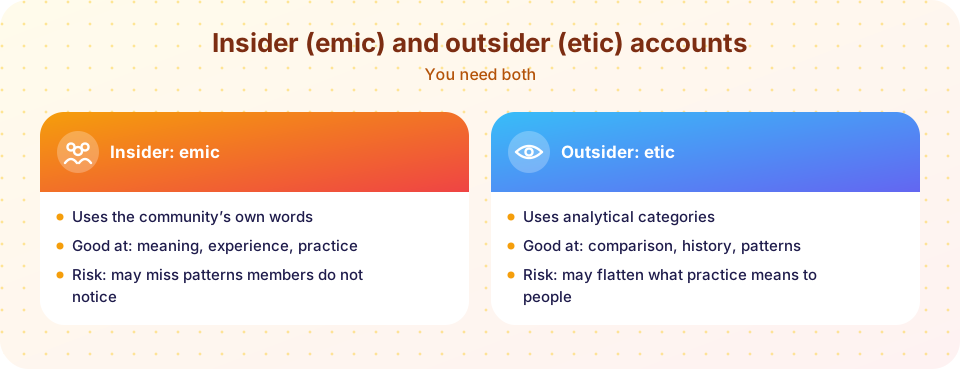
Emic: an account in the categories and words of insiders.
Etic: an account in the categories of an outside analyst, such as a historian or sociologist.
Methodological agnosticism: setting aside the question "is this true?" for the purpose of study, without denying or affirming it.
Epoché: a term borrowed from phenomenology meaning "bracketing" your own judgments so you can describe what appears.
Essentialism: the mistake of assuming a group has one fixed, unchanging nature.
Insider and outsider
Imagine two descriptions of Sunday worship in a church. A member says: "We gather to praise God, hear the Word and share communion; Christ is present among us." A sociologist writes: "About one hundred people gather weekly, follow a fixed liturgical order, and participate in a ritual meal that reinforces group identity." Both are true as far as they go. The first is emic, in the participants' own terms and meanings. The second is etic, in the observer's analytical terms.
Neither is the whole picture. The emic account captures what the practice means to those who do it, but may overlook patterns the members do not notice, such as how age and class shape who attends. The etic account can spot patterns and compare across traditions, but may flatten or miss the meaning. The best scholarship moves between the two, and the first test of any description is whether an insider could recognize it: "Yes, that is how we would put it, even if you do not share our view."
Methodological agnosticism and bracketing
Ninian Smart, whom you met in the last lesson, called the working stance of the field methodological agnosticism. The word methodological matters: the scholar is not claiming that nobody can know whether a religion's claims are true, only that this classroom method does not try to settle it. Theologians, who work inside a tradition, do ask what is true and how doctrine should be understood. Philosophers of religion ask whether the arguments for and against belief succeed. Religious studies does a different job: it asks what traditions teach, how they began and changed, how people live them, and what they do in societies.
A related idea comes from the philosopher Edmund Husserl and the phenomenology of religion: epoché, or bracketing. You put your own convictions in brackets, as you might put aside a heavy bag so you can use both hands, and then you describe the experience or practice as it presents itself. Critics point out that nobody can bracket everything, because every observer carries assumptions. Fair-minded scholars therefore try to name their assumptions rather than pretend to have none.
Habits of fair description
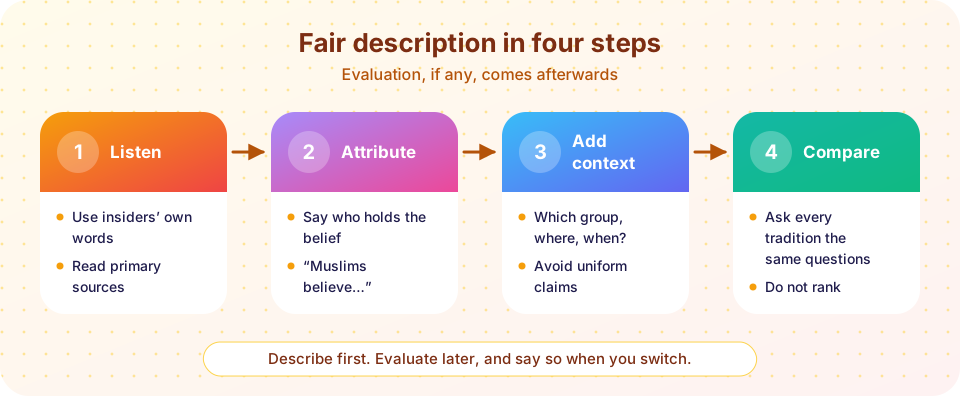
Attribute claims
Compare these two sentences: "The Qur'an was revealed to Muhammad" and "Muslims believe the Qur'an was revealed by God to Muhammad." The first asserts a theological claim as if it were neutral fact. The second reports what a community holds. Attribution is not a sign of doubt. It is accuracy about who is saying what. The same rule applies to every tradition and to secular claims: "Christians believe Jesus rose from the dead" and "Many historians argue that the Gospels were written decades after the events."
Watch loaded words
Some words carry judgments. Calling another group's practices "superstition," "cult," "primitive," "fanatic" or "pagan" announces a verdict. Scholars use neutral alternatives: "folk practice," "new religious movement," "oral tradition," "strongly committed," "polytheistic traditions." A few words also changed over time: scholars now generally use Hebrew Bible or Tanakh for Jewish scripture when speaking neutrally across traditions, and BCE and CE ("before the common era" and "common era") for dates. Use the name a community uses for itself when you know it.
Resist uniformity
"Hindus believe," "Muslims do," "Christians think": such sentences are useful shorthand and dangerous. Every large tradition has many branches, regions, centuries and personal styles. Buddhists in Sri Lanka, Tibet and Japan practice quite differently. Catholics, Orthodox and Protestants disagree about church authority. When you write a general statement, ask yourself: "Which Muslims, where, and when?" The same warning covers women and men in a tradition, young and old, scholars and ordinary families.
Study lived religion, not only texts
A book is not a community. The official teaching of a tradition and what its members actually do can differ: a village festival may blend local customs with the scripture-based religion; a person may pray daily but disagree with a doctrine. Scholars of lived religion look at practice in homes, kitchens, markets and phones, not just at scripture and doctrine. Use both kinds of evidence.
Compare without ranking
Comparison is the engine of the field, but it fails when it turns into a league table. A fair comparison asks the same questions of each tradition (the six themes and seven dimensions) and notes both likenesses and differences. It does not reward the tradition that resembles your own.
Judging sources
Not all sources are equal. Ask four questions.
- Is it primary or secondary? A primary source is from the tradition or period itself, such as a scripture, a sermon or a prayer. A secondary source is analysis by someone writing later.
- Who is speaking? An insider, an outsider, an opponent? Each has a different view and a different possible bias.
- What is the purpose? A conversion pamphlet, a news report, a scholarly article and a government pamphlet have different aims.
- Does the evidence match the claim? Look for named sources, dates, and a range of voices, and be careful with quotations that have no citation.
Common misconceptions
"Neutral means having no opinion." You are allowed opinions. Neutrality in this subject means being accurate and fair in description, and being open about when you move from describing to evaluating.
"If I describe a belief I am endorsing it." Reporting what a group holds is not agreeing with it. A historian describes ancient Roman religion without being a worshipper of Jupiter.
"Only members can understand a religion." Insiders have valuable knowledge, but they are not the only ones. Outsiders, and former members, contribute different kinds of insight, and insiders themselves disagree.
Try it
The first demonstration is a language checker. Paste a short passage about a religion and it flags loaded words and over-general phrases, then suggests alternatives. It uses a small word list, so it will miss things and sometimes flag a word that is fine in context. Treat it as a prompt for your own judgment.
The second demonstration sorts sources by type, to practice the four questions above. The categories are simplified teaching labels.
Press Run (or Ctrl + Enter) to see the result here.
Program input · what you'd type while the program runs
Type the answers before you press Run, one per line. Each time the program reads a line (with input()), it gets the next line from this box.
Check your understanding
Quick check · 5 questions
of 5 answered You scored / 5 · perfect!
-
1. A believer explains what a ritual means to her. This is an example of which kind of account?
An emic account uses the insider's own terms and meanings. -
2. What does methodological agnosticism mean?
It is a working method: the scholar neither affirms nor denies the truth claims while describing and explaining the tradition. -
3. Which sentence best follows the habit of attribution?
The first reports what a community holds without endorsing or disparaging it. -
4. Why is 'Christians believe X' sometimes a risky general statement?
Large traditions are diverse across denominations, regions and periods, so generalizations need qualification. -
5. A sermon from 1850 is best described as
A source from the period and community under study is primary; it shows what people said, not a later analysis.
Summary
- Use both emic (insider) and etic (outsider) accounts; test your description against whether an insider could recognize it.
- Methodological agnosticism and bracketing help you describe without settling truth claims.
- Attribute beliefs to groups, avoid loaded words, and resist describing any tradition as uniform.
- Look at lived practice as well as texts, and compare traditions without ranking them.
- Judge sources by type, author, purpose and evidence.
Next: Chapter 1 Review
Track your progress
Create a free account to tick off lessons and pick up where you left off on any device.
of Religious Studies lessons completed