


















Lesson 9 of 46 · Studying Religion
Chapter 2 Review: Studying Religion
Review chapter 2: scholarly approaches, sacred texts and interpretation, ritual, myth and symbol, with a recap table, a true-or-false round and a ten-question quiz.
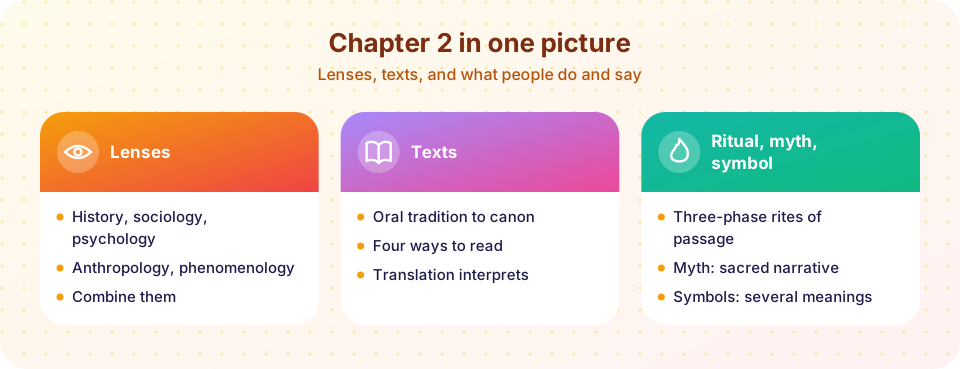
Chapter 2 gave you the working tools of the field: a set of lenses for asking questions about religion, a way of thinking about how texts become scripture and get read, and a vocabulary for ritual, myth and symbol. In the next chapters you will use these tools on real traditions, starting with indigenous and ancient religions where oral tradition, ritual and myth are especially prominent.
What you will learn
- How the three lessons of chapter 2 connect.
- Which terms, names and works to recall.
- How to choose a tool for a given question.
Recap table
| Lesson | Big idea | Terms and names |
|---|---|---|
| Approaches | Historical, sociological, psychological, anthropological and phenomenological lenses give different views | Tylor 1871, James 1902, Weber 1905, Durkheim 1912, Otto 1917, Geertz 1966; reductionism |
| Sacred texts | Scriptures move from oral tradition to canon and commentary; interpretation is communal | shruti, smriti, Tanakh, Talmud, Tipitaka, hermeneutics, PaRDeS |
| Ritual, myth, symbol | Rituals mark time and status; myths are sacred narratives; symbols carry several meanings | van Gennep, Turner, liminality, communitas, Malinowski, Geertz |
How the pieces fit together
Imagine a Passover seder. The historian asks how the meal developed from older practices and texts. The sociologist asks how it holds a family and community together across generations. The anthropologist asks what the foods and gestures mean to the people at the table. The text scholar looks at the Haggadah and how it interprets earlier scripture. The psychologist might ask how participation shapes memory and identity. A single event needs several tools, which is why the chapter is built the way it is.
The same logic works for a Buddhist chant, a Muslim pilgrimage or a Christian baptism: ask first what the participants say they are doing, then bring in the lens that fits your question.
Common misconceptions
"The lenses are rival theories and only one can be right." They answer different questions. Disagreements between them are useful when they sharpen the evidence.
"A text means one thing." Every community reads its texts through traditions of interpretation, and meanings change over time.
"Rituals are just symbols of beliefs." Rituals often do things: they create status, build bonds, and mark time. Treating them only as illustrations of belief misses much of what they do.
Try it
The first demonstration is a lightning round of true or false statements covering the chapter. Click a verdict; the explanation appears at once.
The second demonstration turns your quiz score into a next step, using a simple rule. It is a study aid, not an assessment.
Press Run (or Ctrl + Enter) to see the result here.
Program input · what you'd type while the program runs
Type the answers before you press Run, one per line. Each time the program reads a line (with input()), it gets the next line from this box.
Check your understanding
Quick check · 9 questions
of 9 answered You scored / 9 · perfect!
-
1. Which pairing of thinker and idea is correct?
Weber linked Protestant ideas of vocation to capitalism and described disenchantment; Otto wrote on the numinous and Tylor on animism. -
2. The genetic fallacy is the mistake of
Origins and truth are separate questions. -
3. Which tradition's scripture is called the Tanakh?
Tanakh stands for Torah, Nevi'im and Ketuvim, the three parts of the Jewish Bible. -
4. Shruti and smriti are terms in
Shruti means 'heard' (the Vedas) and smriti 'remembered' (later texts). -
5. Which lens best fits 'What do these gestures mean to the villagers?'
Anthropology uses participant observation to understand meaning. -
6. Liminality refers to
Turner developed van Gennep's middle phase as liminality. -
7. Orthopraxy means
Orthopraxy emphasizes correct practice; orthodoxy emphasizes correct belief. -
8. Why do scholars compare several translations of a scripture?
A translation is the translator's reading, so comparison reveals choices. -
9. Malinowski described myth as
Malinowski argued myths ground customs and institutions in a founding story.
Summary
- Use several lenses; choose by question type, and combine them for rich cases.
- Scriptures grow from oral tradition into canon and commentary; reading is communal and changes over time.
- Rites of passage have a three-phase shape; myths are sacred narratives; symbols carry layered meanings.
- Explanations of origins and function do not by themselves settle truth claims.
- Chapter 3 applies these tools to indigenous and ancient traditions.
Track your progress
Create a free account to tick off lessons and pick up where you left off on any device.
of Religious Studies lessons completed