


















Lesson 33 of 46 · Islam and Other Traditions
Islam: Muhammad, the Qur'an and Early History
Learn how Islam began with Muhammad in Mecca and Medina, what the Qur'an and hadith are, how Islamic law developed, and how the early caliphates shaped the Muslim world.
Islam is the religion of about two billion people, roughly a quarter of the world, living on every continent. The largest Muslim populations are in Asia: Indonesia, Pakistan, India and Bangladesh together hold far more Muslims than the Arab world, and Arabs make up only a minority of Muslims worldwide. The word Islam means "submission" to God, and a Muslim is one who submits.
This lesson tells the story of Islam's beginnings as Muslims tell it and as historians study it, introduces the Qur'an and the Prophet's example, explains how Islamic law developed and sketches the first centuries of Muslim history. Muslims hold the Qur'an to be the word of God; the course describes this as their belief and does not judge it.
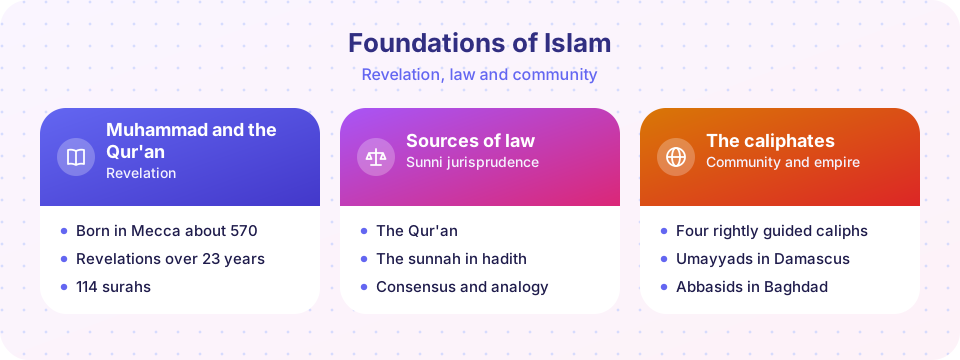
What you will learn
- The key events in the life of Muhammad: revelation, the Hijra and the return to Mecca.
- What the Qur'an is, how it is organized and how Muslims treat it.
- What hadith, sunnah, sharia and fiqh mean, and the four sources of law in Sunni thought.
- The early caliphates and the spread of Islam.
Key terms
Qur'an: the book that Muslims believe is the word of God, revealed to Muhammad; the word means "recitation."
Hadith: a report of the sayings or actions of Muhammad.
Sunnah: the example or practice of Muhammad, known mainly through hadith.
Sharia: "the path"; the divine way for human life, which jurists seek to understand.
Fiqh: Islamic jurisprudence, the human science of working out sharia rulings.
Caliph: a successor to Muhammad as leader of the Muslim community.
Muhammad and the beginning of Islam
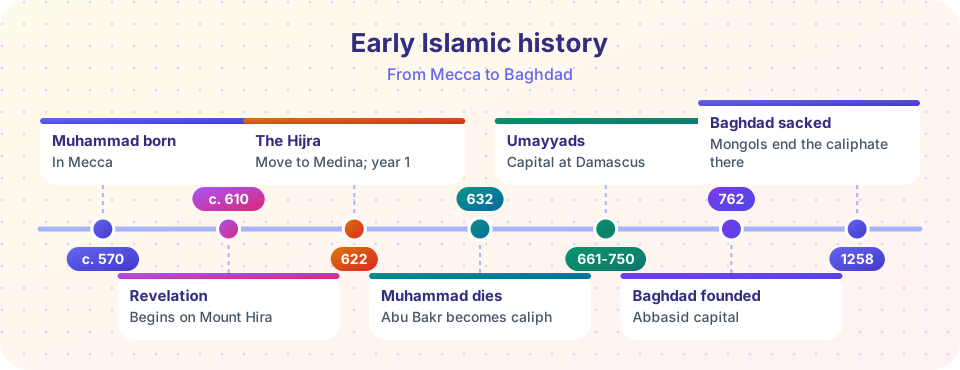
Muhammad was born around 570 CE in Mecca, a trading town in western Arabia, into the Quraysh tribe. Mecca was home to the Kaaba, a cube-shaped shrine that Muslims believe was built by Abraham and his son Ishmael, though at that time it was a center for many tribal gods. Orphaned young, Muhammad became a merchant and was known for honesty.
According to Muslim tradition, in about 610 CE, while meditating in a cave on Mount Hira near Mecca, he received the first revelation through the angel Jibril (Gabriel): "Recite!" The revelations continued over about twenty-three years. Muhammad began to preach the worship of one God, justice for the poor and the coming Day of Judgment. His message challenged the leading Meccan families, and his followers faced pressure and persecution.
In 622 Muhammad and his community migrated to the oasis town of Yathrib, later called Medina ("the city"). This migration, the Hijra, is so important that it marks the first year of the Islamic calendar. In Medina Muhammad led a community with Muslims, Jews and others bound by agreements (often called the Constitution of Medina), and conflict with Mecca continued with battles such as Badr (624). In 630 he returned to Mecca, which largely submitted peacefully, and the Kaaba was cleared of idols. In 632 he made a farewell pilgrimage and died in Medina. By then most of Arabia had joined his community.
Historians study these events using early Muslim sources, many written down generations later, and also outside records. Scholars debate details such as the exact chronology and the origin of the traditions, while most accept the broad outline above.
The Qur'an
The Qur'an has 114 chapters (surahs), divided into verses (ayat); the standard count is 6,236 verses. Apart from the short opening chapter, al-Fatiha, the surahs are arranged roughly from longest to shortest, not by date. It is also divided into thirty parts (juz') so it can be read in a month, especially during Ramadan. Muslims believe it is God's speech, preserved in Arabic, and they recite it in prayer, memorize it (a person who has memorized all of it is called a hafiz) and treat the printed book with respect, for instance by washing before touching it. Translations are considered interpretations, not the Qur'an itself.
Muslim tradition says the revelations were memorized and written down during Muhammad's lifetime. After his death the first caliph, Abu Bakr, had them gathered, and the third caliph, Uthman, had a standard text copied and sent to major cities around 650 CE. Today's printed Qur'an follows that tradition of text, with some recognized variations in recitation. Its themes include the oneness of God, prophets such as Abraham, Moses and Jesus, moral and legal guidance, stories, and reflection on creation and the afterlife. Interpretation (tafsir) is a large field of scholarship, and Muslims read the text in the light of commentary, context and tradition.
Hadith, sunnah and law
For Muslims, Muhammad is the model of how to live the Qur'an. His sunnah (example) is known through hadith, reports transmitted by chains of narrators. Scholars developed a science of evaluating chains and content, grading hadith as sound, good or weak. The major Sunni collections include Sahih al-Bukhari (compiled by al-Bukhari, who died in 870) and Sahih Muslim (Muslim ibn al-Hajjaj, died 875). Shia Muslims have their own collections, such as al-Kafi by al-Kulayni (died about 941), and also preserve reports from the Prophet's family.
Sharia means "the path" or the way to water. Muslims hold that God's guidance for life is sharia, while fiqh is the human work of understanding it. In classical Sunni jurisprudence the sources of law are, in order, the Qur'an, the sunnah, ijma (the consensus of scholars) and qiyas (reasoning by analogy), with other principles such as public interest used by some schools. Four Sunni schools of law (madhhabs) emerged, named after early jurists: Hanafi (Abu Hanifa, died 767), Maliki (Malik ibn Anas, died 795), Shafi'i (al-Shafi'i, died 820) and Hanbali (Ahmad ibn Hanbal, died 855). The main Shia school is the Ja'fari (after Ja'far al-Sadiq, died 765). The schools agree on core matters and differ on details, and in modern states, sharia has been applied in very different ways. The word is used in the news to mean many things, from personal ethics to criminal law, so it helps to ask which meaning is intended.
The early caliphates
After Muhammad's death in 632, the community chose Abu Bakr as its leader, the first caliph. The first four caliphs, called the "rightly guided" (Rashidun), were Abu Bakr, Umar, Uthman and Ali (632 to 661). In just over a century, Muslim-led armies and settlers had taken Syria, Egypt, Iraq, Iran and North Africa and, by 711, parts of Spain. These conquests are understood differently by historians and believers, and conversion to Islam was generally gradual rather than immediate.
The Umayyad dynasty (661 to 750), based in Damascus, was followed by the Abbasid dynasty (750 to 1258), which founded Baghdad in 762. Under the Abbasids, Baghdad became a center of learning: scholars translated Greek, Persian and Indian works, developed algebra (al-Khwarizmi, about 780 to 850), medicine (Ibn Sina, or Avicenna, 980 to 1037) and optics (Ibn al-Haytham, about 965 to 1040). The Mongols sacked Baghdad in 1258. Later empires, such as the Ottoman, Safavid and Mughal, carried Islamic civilization across three continents. Traders and Sufi preachers spread Islam along the Indian Ocean to Indonesia and Malaysia and across the Sahara to West Africa.
Common misconceptions
"Muslims worship Muhammad." Muslims honor Muhammad as the final prophet but worship only God. Muhammad is regarded as a human being.
"All Muslims are Arabs, and all Arabs are Muslim." Arabs are a minority of Muslims, and there are millions of Arab Christians and others. The Arabic word Allah simply means "God" and is also used by Arabic-speaking Christians.
"Jihad means holy war." The word means "striving." Muslim scholars use it for many forms of effort, including moral struggle and, within strict conditions, armed defense. Most Muslim scholars and organizations reject the claims of violent extremist groups to act under it.
Try it
Check your understanding
Quick check · 5 questions
of 5 answered You scored / 5 · perfect!
-
1. What event does year 1 of the Islamic calendar mark?
The Hijra, the migration to Medina in 622, is the starting point of the Hijri calendar. -
2. How are the Qur'an's surahs mainly arranged?
After al-Fatiha, surahs are arranged roughly by length, longest first. -
3. In classical Sunni jurisprudence, which is the list of sources in order?
The Qur'an and sunnah come first, followed by consensus and analogy. -
4. Which dynasty founded Baghdad in 762?
The Abbasids founded Baghdad in 762 as their capital. -
5. What does 'jihad' literally mean?
Jihad means striving. Its uses range from personal moral effort to, under conditions, armed defense.
Summary
- Muhammad (about 570 to 632) received the Qur'an over about twenty-three years, according to Muslim belief; the Hijra of 622 begins the Islamic calendar.
- The Qur'an has 114 surahs; hadith record the sunnah of the Prophet.
- Sharia is the divine path; fiqh is human legal reasoning, with four Sunni schools and a main Shia school.
- The Rashidun, Umayyad and Abbasid caliphates carried Islamic civilization from Spain to Central Asia.
Track your progress
Create a free account to tick off lessons and pick up where you left off on any device.
of Religious Studies lessons completed