


















Lesson 24 of 46 · Judaism
Judaism: Sacred Texts and Core Beliefs
How Jews read the Tanakh and the Talmud, what halakha and the 613 mitzvot are, and what Judaism teaches about God, covenant, study, the Messiah and the afterlife.
Judaism is a tradition of reading. Its central practice is not only prayer or ritual but study: studying a text, arguing about its meaning, and applying it to a new situation. That is why you cannot understand Jewish belief without first understanding the library in which it lives, and why Jewish teaching tends to come as a conversation among generations rather than as a single list of doctrines.
In this lesson you will meet the Hebrew Bible and the Oral Torah, see how the Talmud is built, learn what halakha is, and then ask what Jews have held about God, the covenant, the Messiah and the afterlife. You will also see that Jewish thinkers disagree about many of these topics, and that disagreement is itself treated as a sign of a living tradition.
What you will learn
- The three parts of the Tanakh and how it differs from the Christian Old Testament.
- What the Oral Torah, the Mishnah, the Gemara and the Talmud are.
- How halakha works and what the 613 mitzvot are.
- The core ideas of Jewish belief: one God, covenant, study, repair of the world and views of the Messiah and the afterlife.
Key terms
Tanakh: the Hebrew Bible, a name made from the first letters of Torah, Nevi'im (Prophets) and Ketuvim (Writings).
Oral Torah: teaching that the tradition says was handed down alongside the written Torah and later written down.
Talmud: the Mishnah together with its discussion, the Gemara.
Midrash: rabbinic interpretation that explains, expands and applies scriptural verses.
Covenant (brit): the binding relationship between God and the Jewish people.
The written Torah: the Tanakh
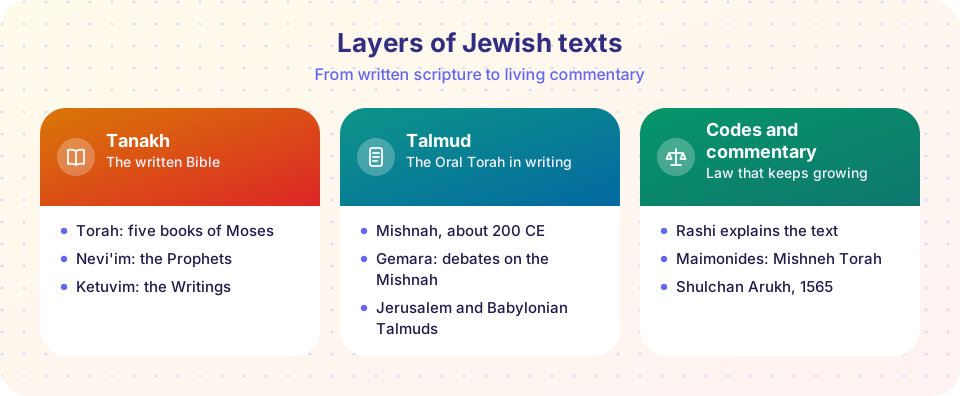
The Tanakh has three parts. The Torah ("teaching" or "instruction") consists of five books: Genesis, Exodus, Leviticus, Numbers and Deuteronomy. These are also called the Five Books of Moses or the Pentateuch. Jewish tradition holds that the Torah is the most sacred part, and it is read aloud in the synagogue on a yearly cycle from a handwritten parchment scroll. The Nevi'im (Prophets) include the historical books such as Joshua, Judges, Samuel and Kings, and the prophetic books such as Isaiah, Jeremiah, Ezekiel and the Twelve Minor Prophets. The Ketuvim (Writings) include Psalms, Proverbs, Job, the Five Scrolls (such as Ruth, Esther and Ecclesiastes), Daniel, Ezra-Nehemiah and Chronicles.
The books are the same as most of the Protestant Old Testament but arranged in a different order, and the Christian reading usually ends with the prophets, pointing forward, while the Tanakh ends with Chronicles. Jews do not call the Tanakh "the Old Testament," since the phrase implies a new one that replaces it. Instead the Hebrew Bible is regarded as complete in itself.
The Oral Torah and the Talmud
According to rabbinic tradition, Moses received at Sinai not only the written text but also an oral explanation of how to apply it. The written Torah says "remember the Sabbath day" and "do no work," but does not define work; the Oral Torah says what counts. For centuries these explanations were passed on by memory. After the destruction of the Second Temple in 70 CE and the disruptions that followed, scholars decided to write them down.
The Mishnah (from a word meaning "repetition," or study) was edited around 200 CE, according to tradition by Rabbi Judah ha-Nasi (Judah the Prince). It is divided into six orders covering agriculture, festivals, family law, civil and criminal law, holy things and ritual purity. The Mishnah is terse: it often records a ruling and then the differing opinions of rival rabbis.
The Gemara is the next layer: centuries of discussion of the Mishnah by rabbis in the land of Israel and in Babylonia. The Mishnah plus the Gemara is the Talmud. There are two: the Jerusalem Talmud (also called the Talmud Yerushalmi, edited around 400 CE) and the larger and more influential Babylonian Talmud (Talmud Bavli), which reached its main form around the 5th to 6th centuries CE. When people say "the Talmud," they normally mean the Babylonian Talmud.
A page of Talmud looks unlike an ordinary page. The central text sits in the middle, surrounded by medieval commentary (such as Rashi, 1040 to 1105) and later notes. This layout visually shows a conversation across time. Talmud also records minority opinions, even when the final ruling goes against them, because the tradition values preserving disagreement. The Talmud's phrase for a respectable dispute is a machloket (argument) "for the sake of heaven."
Midrash deserves a mention too. Midrashic texts retell and explain biblical stories, fill in gaps in the narrative and draw moral lessons. For example, when the Torah leaves out why Abraham first set out from home, the Midrash tells of Abraham smashing his father's idols. Midrash is not meant as history in the modern sense; it is a way of reading.
Halakha and the 613 mitzvot
Halakha, "the way of walking," is the body of law that grows from these texts. It covers prayer and holiday observance, but also business ethics, marriage and divorce, how to treat animals, and how to settle disputes. A rabbi issues a ruling called a teshuvah (a "responsum," literally "an answer") on a new question, reasoning from earlier cases the way a judge reasons from precedent.
Tradition counts 613 mitzvot (commandments) in the Torah, a number mentioned in the Talmud and later listed by scholars such as Maimonides. Of these, 248 are "positive" (things to do) and 365 are "negative" (things not to do), according to the traditional count. Many cannot be kept today because they relate to the Temple or to farming in the land of Israel. The most widely used law code is the Shulchan Arukh ("Set Table"), compiled by Rabbi Joseph Karo and published in 1565, which became standard for many communities.
Ethics are an essential part of this system: laws about charity (tzedakah, a word related to justice rather than simply "giving"), honest weights and measures, fair wages and care for the stranger sit side by side with ritual rules. The tradition does not treat these as separate departments.
Core beliefs
Jewish thinkers have articulated beliefs in different ways, and Judaism has often emphasized practice over doctrine. Still, several ideas run through the tradition.
One God. The central declaration is the Shema ("Hear, O Israel: the Lord our God, the Lord is one," Deuteronomy 6:4), recited twice daily. God is understood as the creator, without form or body, and just and merciful. Many Jewish writers use the term "God" cautiously and refrain from pronouncing the four-letter divine name written in the Bible.
Covenant and the Jewish people. The Torah tells of covenants with Noah, Abraham and the whole people at Sinai. The idea that Israel is a "chosen" people is old and contested. Many Jewish writers read it as a responsibility rather than a privilege: a task to live by the commandments and be a "light" in the world. Some modern Jewish thinkers have reinterpreted or rejected the concept; others defend it in the sense of vocation.
Study and action. The tradition places a high value on learning (talmud Torah) and on acts of justice and kindness. The Mishnah in Pirkei Avot says that the world stands on three things: Torah, worship and acts of kindness. A concept from Kabbalah, tikkun olam ("repairing the world"), is widely used today for social action, though how much the phrase meant in earlier eras and what exactly it implies are discussed by scholars.
Maimonides' thirteen principles. In the 12th century Moses Maimonides (1138 to 1204) listed thirteen principles of faith, including God's unity and incorporeality, prophecy, the divine origin of the Torah, reward and punishment, the coming of the Messiah and the resurrection of the dead. Many Jews accept the list, some accept parts of it, and some objected to the idea of fixing a creed at all.
Messiah. Jews traditionally hope for a future messianic age: a descendant of King David (the mashiach, "anointed one") who will usher in an era of peace and justice. This differs from Christian belief about Jesus; Jewish tradition does not recognize Jesus as the Messiah. Understandings of the messianic age range from a literal person to a symbol of a better world achieved by human effort.
Afterlife. The Tanakh says little about what happens after death. Later rabbinic literature develops ideas of a world to come (olam ha-ba), resurrection of the dead and, in some sources, a period of purification (gehinnom). Jewish views vary a great deal, and the emphasis is nearly always on how to live in this world.
Kabbalah and gematria
A mystical tradition called Kabbalah (from "receiving") developed in medieval Europe; its central text, the Zohar, appeared in Spain in the late 13th century. Kabbalah gave rise to ideas such as the ten divine emanations (sefirot). One technique of interpretation associated with Jewish thought is gematria, which adds up the numerical values of Hebrew letters in a word to link words that share a total. For example, the word chai ("life") equals 18, which is why gifts to charity are often made in multiples of 18. Not all Jews regard gematria as authoritative, but its use shows how the language itself is treated as meaningful.
Common misconceptions
"An eye for an eye" means literal retaliation. The phrase appears in the Torah, but rabbinic tradition interpreted it as monetary compensation for harm, and the Talmud discusses how to calculate the payments.
"Jews do not believe in an afterlife." The Tanakh is reticent, but rabbinic literature speaks about a world to come and resurrection. Modern Jews hold many views.
"The Talmud is a rule book of absurd regulations." The Talmud is a record of debate. Its form preserves arguments and minority opinions, and its content ranges from law to stories, medicine and ethics.
Try it
Press Run (or Ctrl + Enter) to see the result here.
Program input · what you'd type while the program runs
Type the answers before you press Run, one per line. Each time the program reads a line (with input()), it gets the next line from this box.
Check your understanding
Quick check · 5 questions
of 5 answered You scored / 5 · perfect!
-
1. Which pair makes up the Talmud?
The Talmud is the Mishnah (about 200 CE) together with the Gemara, the later discussion of the Mishnah. -
2. What does the Shema declare?
The Shema, from Deuteronomy 6:4, declares that the Lord our God, the Lord is one. It is recited twice daily. -
3. Where is the book of Daniel in the Jewish canon?
In the Tanakh Daniel belongs to the Ketuvim (Writings); many Christian Bibles place it among the prophets. -
4. How did rabbinic tradition generally interpret 'an eye for an eye'?
The Talmud treats the phrase as requiring compensation, and discusses how to assess it. -
5. What is a teshuvah?
A teshuvah (responsum) is a legal answer from a rabbi that reasons from earlier sources.
Summary
- The Tanakh has three parts: Torah, Nevi'im and Ketuvim. Jews do not call it the Old Testament.
- The Oral Torah was written down in the Mishnah (about 200 CE) and discussed in the Gemara; together they form the Talmud.
- Halakha is Jewish law; tradition counts 613 mitzvot, and the Shulchan Arukh is a widely used code.
- Core ideas: one God, covenant, study, justice and kindness, a hoped-for messianic age and varied views on the afterlife.
- Jewish tradition preserves disagreement as part of learning.
Next: Movements and practice
Track your progress
Create a free account to tick off lessons and pick up where you left off on any device.
of Religious Studies lessons completed