


















Lesson 19 of 46 · Hinduism, Buddhism and Jainism
Buddhism: Life and Teachings
Learn the life story of Siddhartha Gautama, the Four Noble Truths, the Eightfold Path, the three marks of existence, karma, rebirth and the Three Jewels.
Buddhism began with a question about suffering. According to Buddhist tradition, a prince in northern India was shaken to find that sickness, old age and death come to everyone, and he set out to find a way beyond them. After years of seeking, he is said to have awakened to the truth about the human condition, and spent the rest of his life teaching what he had found. Around 2,500 years later, roughly half a billion people identify as Buddhists, and Buddhist ideas, such as mindfulness and compassion, have spread well beyond Buddhist communities.
This lesson tells the traditional story of the Buddha's life and explains his core teachings. As always, it reports what Buddhists hold: the story below is the traditional biography, and historians treat many details as later elaborations.
What you will learn
- The traditional story of the Buddha's life and what historians can say about it.
- The Four Noble Truths and the Eightfold Path.
- The three marks of existence and dependent origination.
- The Three Jewels and basic Buddhist ethics.
Key terms
Buddha: "awakened one"; a title for someone who has awakened to the truth. "The Buddha" usually means Siddhartha Gautama.
Dukkha: suffering, unsatisfactoriness or stress; the first noble truth.
Nirvana: "blowing out"; the ending of craving, hatred and delusion, and so of rebirth.
Anatta: no-self; the teaching that there is no permanent, unchanging self.
Sangha: the community of monks and nuns, and in a wider sense all Buddhists.
The life of the Buddha
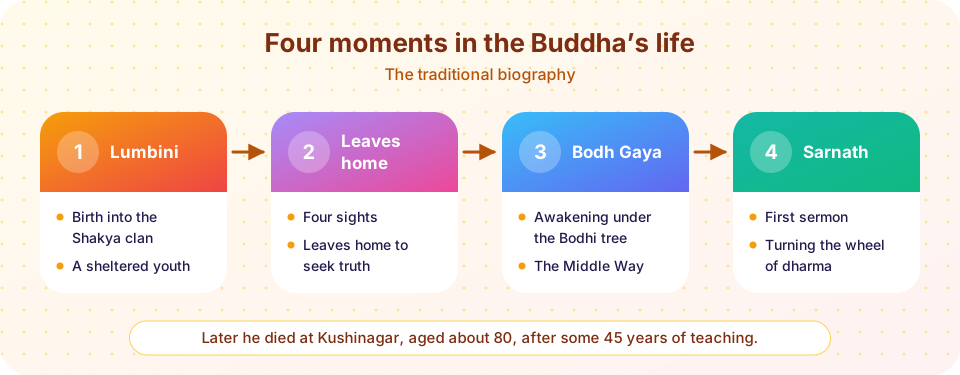
Tradition says that Siddhartha Gautama was born into the Shakya clan at Lumbini (in present-day Nepal). Traditional dates are 563 to 483 BCE, but many scholars now place his lifetime a bit later, with his death around 410 to 400 BCE; the exact dates are uncertain. In the traditional story his father, a ruler, shielded him from the world's hardships in palaces. At about the age of 29, he ventured out and saw, in succession, an old man, a sick man, a corpse and a wandering ascetic, the four sights. Disturbed, he left his family and princely life in the Great Renunciation and sought teachers and practiced strict asceticism.
When severe fasting did not bring the answer, he adopted what became known as the Middle Way between indulgence and self-torment. Sitting beneath a fig tree, later called the Bodhi tree, at Bodh Gaya in the present Indian state of Bihar, he is said to have attained awakening (bodhi), at about age 35, seeing how suffering arises and ends. He then gave his first sermon to five former companions in the Deer Park at Sarnath near Varanasi, "turning the wheel of the dharma." For about forty-five years he taught across the Ganges plain, founding a community of monks and later nuns, and died at Kushinagar at about 80. His last teaching is traditionally reported as encouraging his followers to strive diligently, for all conditioned things pass away.
Historians agree that a teacher of this kind probably lived in this region and era, but the earliest texts were written down centuries after his death, and stories of miracles, such as his birth, are typically understood by scholars as later devotional additions.
The Four Noble Truths
The Buddha's first sermon is traditionally summarized in four statements, often compared to the structure of a medical diagnosis.
- Dukkha: life includes suffering, dissatisfaction and impermanence. Birth, aging, sickness and death are painful, and even pleasant experiences are unstable.
- The cause: suffering arises from craving (tanha), a clinging desire for pleasure, for existence, for non-existence, rooted in ignorance.
- Cessation: when craving ends, suffering ends. This ending is nirvana.
- The path: there is a way to that ending, the Eightfold Path.
The Eightfold Path
The Eightfold Path is usually arranged in three groups.
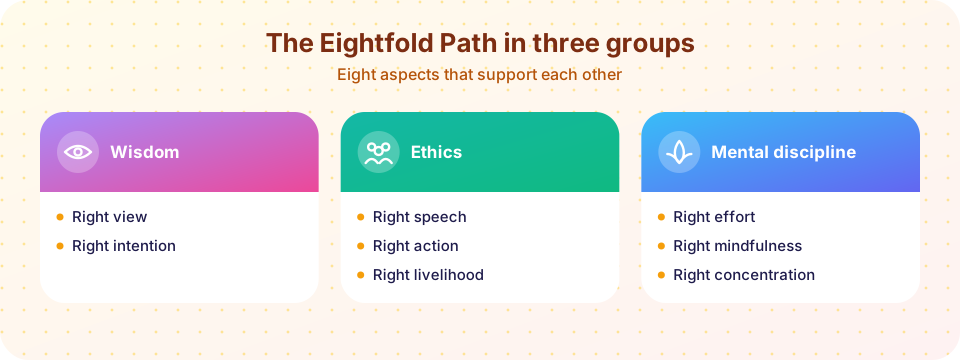
- Wisdom (prajna): right view (seeing things as they are, including the Four Noble Truths) and right intention (renunciation, goodwill, harmlessness).
- Ethics (sila): right speech, right action and right livelihood.
- Mental discipline (samadhi): right effort, right mindfulness and right concentration.
"Right" here translates a word meaning something like skillful, complete or well-directed. The path is not a sequence of steps taken one at a time, but eight aspects that support each other.
Three marks of existence
Buddhist thought describes all conditioned things by three marks:
- Impermanence (anicca): everything changes.
- Dukkha: because things change, clinging to them leads to dissatisfaction.
- Non-self (anatta): there is no permanent, independent self behind experience; what we call a person is a stream of physical and mental processes (often grouped as five "aggregates": form, feeling, perception, mental formations and consciousness).
Anatta distinguishes Buddhism from many Hindu schools that teach an eternal self (atman). It raises a famous question: if there is no permanent self, what is reborn? Buddhist thinkers answer that what continues is a causal stream, like a flame passed from one candle to another, in which the later is neither identical to nor wholly separate from the earlier.
Karma, rebirth and dependent origination
Buddhists understand karma as intentional action, which shapes future experience. Rebirth, in most Buddhist traditions, is the continuation of the causal stream in one of several realms of existence, such as human, animal, ghost or heavenly realms, until nirvana is attained. Dependent origination (pratityasamutpada) is the teaching that all phenomena arise in dependence on conditions: nothing exists on its own, and a chain of causes explains how ignorance leads to craving, clinging, rebirth and suffering, and how the chain can be broken.
The Three Jewels and ethics
Buddhists "take refuge" in the Three Jewels: the Buddha (the teacher and the awakened state), the Dharma (the teaching) and the Sangha (the community). Lay Buddhists commonly undertake five precepts: to refrain from taking life, from taking what is not given, from sexual misconduct, from false speech and from intoxicants that cloud the mind. Monks and nuns follow many more rules. Cultivating generosity (dana), loving-kindness (metta) and compassion (karuna) are central, and in many traditions, giving to monks and supporting temples is a way of making merit.
Common misconceptions
"The Buddha is a god." The Buddha is not regarded as a creator god, and early Buddhist teaching does not center on one. Many Buddhists revere him greatly and offer him devotion, but he is understood as a human being who awakened.
"Buddhism says life is only suffering." The first noble truth says suffering is a feature of conditioned life, but the teaching is a path toward its ending, and Buddhist life emphasizes joy, kindness and equanimity.
"Nirvana is a heaven." It is described as the end of craving and rebirth, not a place; descriptions are cautious and mostly in negative terms.
"Buddhism is atheistic." Many Buddhist traditions acknowledge gods or other beings in the cosmos but do not treat them as creators or as saviors from samsara. Scholars describe Buddhism as non-theistic or as taking gods to be unimportant for liberation, though practice varies widely.
Try it
The first demonstration is an Eightfold Path explorer. Click each of the eight factors to read a short explanation grouped under wisdom, ethics or mental discipline.
The second demonstration writes the Four Noble Truths in the form of a diagnostic pattern: the problem, its cause, the prognosis and the treatment. It is a teaching structure used by Buddhist commentators and modern teachers, so it makes the logical shape of the teaching visible.
Press Run (or Ctrl + Enter) to see the result here.
Program input · what you'd type while the program runs
Type the answers before you press Run, one per line. Each time the program reads a line (with input()), it gets the next line from this box.
Check your understanding
Quick check · 5 questions
of 5 answered You scored / 5 · perfect!
-
1. Where is the Buddha traditionally said to have attained awakening?
Awakening is placed at Bodh Gaya under the Bodhi tree; Lumbini is the birthplace and Kushinagar the place of death. -
2. What is the second noble truth?
The origin of suffering is craving rooted in ignorance. -
3. Anatta means
Anatta, no-self, is the teaching that there is no permanent unchanging self. -
4. The Three Jewels are
Buddhists take refuge in the teacher, the teaching and the community. -
5. In the Eightfold Path, right mindfulness belongs to
Right effort, mindfulness and concentration make up the mental discipline group.
Summary
- The traditional life of the Buddha moves from Lumbini through the Great Renunciation to awakening at Bodh Gaya, the first sermon at Sarnath, and death at Kushinagar; dates are uncertain.
- The Four Noble Truths diagnose suffering, its cause, its ending and the path.
- The Eightfold Path groups into wisdom, ethics and mental discipline.
- The three marks are impermanence, dukkha and no-self; dependent origination explains causes.
- Buddhists take refuge in the Buddha, the Dharma and the Sangha, and keep ethical precepts.
Track your progress
Create a free account to tick off lessons and pick up where you left off on any device.
of Religious Studies lessons completed