


















Lesson 5 of 46 · Studying Religion
Chapter 2 Overview: Studying Religion
Overview of chapter 2: the scholarly lenses (history, sociology, psychology, anthropology), how sacred texts are read, and how rituals, myths and symbols work.
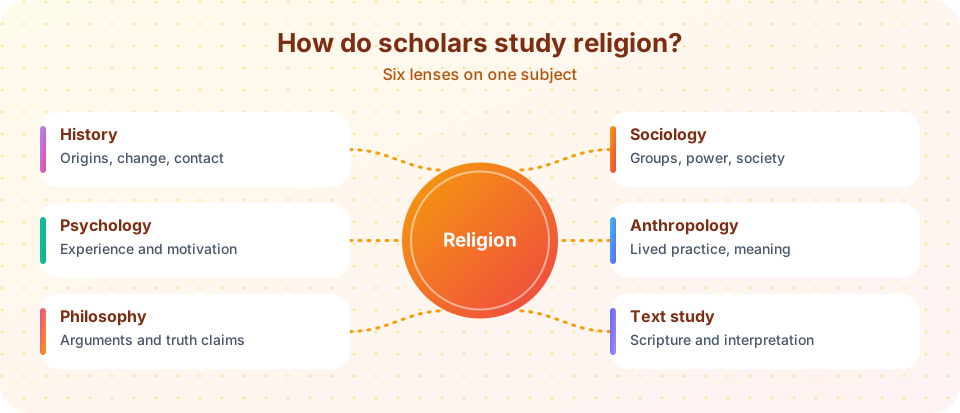
Chapter 1 taught you how to describe a tradition fairly. Chapter 2 gives you the instruments scholars use to understand it. Religion is not one kind of thing, so no single method can explain it. A historian asks how a movement began and changed. A sociologist asks how it shapes, and is shaped by, the society around it. A psychologist asks what happens in the minds of believers, and an anthropologist asks what people do when they live it. A literary scholar asks how texts are made and read. Put together, these questions give you a picture with depth.
What you will learn
- Why religion needs several methods, not one.
- What the four lessons of this chapter cover.
- How to choose a lens for a given question.
Key terms
Method: a disciplined way of asking questions and checking answers.
Lens: a perspective that highlights some features of a subject and leaves others in the background.
Reductionism: explaining something only in terms of one factor (for example, society or psychology) and ignoring other levels.
The chapter at a glance
Why many lenses?
Lessons in this chapter
What each lesson covers
- Approaches to the Study of Religion introduces the main scholarly lenses through the people who shaped them: Tylor, William James, Weber, Durkheim, Otto and Geertz. You will see how each defined the question, what each contributed, and what critics say.
- Sacred Texts and Interpretation asks how scriptures are formed, translated and read, and why one passage can be read in many ways within a single tradition.
- Ritual, Myth and Symbol looks at what believers do and say: rites of passage, sacred stories and symbols, and what scholars such as van Gennep, Turner and Geertz made of them.
- Chapter 2 Review pulls the ideas together with a recap table and a ten-question quiz.
How to use the lenses
You will need to be able to pick a lens for a question. A good habit is to ask what kind of question you have. "When did this movement appear, and what changed?" is historical. "Why do some societies have strong religious participation and others do not?" is sociological. "What does a person experience during prayer or meditation?" is psychological and phenomenological. "What does this festival mean to the people who hold it?" is anthropological. "Are the arguments for this belief sound?" is philosophical. Many questions need two lenses together.
"One lens explains religion away." Some thinkers have argued that religion is nothing but a social tool or nothing but a psychological habit. Others reply that explaining how something arises in society or the brain does not show whether its claims are true or false. Scholars call the first move reductionism, and it is debated. In this course, lenses describe and explain; they do not settle truth claims.
Try it
The first demonstration poses six research questions. Pick the lens you think fits best and the demo tells you which lens is most often used, and why more than one may apply. The answers are teaching simplifications.
The second demonstration is a small decision aid in code. Type a keyword into the list and see which lens usually asks that question.
Press Run (or Ctrl + Enter) to see the result here.
Program input · what you'd type while the program runs
Type the answers before you press Run, one per line. Each time the program reads a line (with input()), it gets the next line from this box.
Check your understanding
Quick check · 3 questions
of 3 answered You scored / 3 · perfect!
-
1. Why do scholars use several lenses to study religion?
Religion involves history, society, mind, text and practice, so different methods highlight different features. -
2. Which lens best fits the question 'What does this festival mean to its participants?'
Anthropology studies lived practice and meaning through fieldwork and close observation. -
3. Reductionism in this context means
Reductionism treats one level of explanation (such as society or psychology) as the whole story.
Summary
- Religion has many sides, so scholars use many lenses.
- The chapter covers scholarly approaches, sacred texts, and ritual, myth and symbol.
- Choose a lens by asking what kind of question you have; often combine two.
- Explaining how religion works in society or minds does not by itself settle truth claims.
Track your progress
Create a free account to tick off lessons and pick up where you left off on any device.
of Religious Studies lessons completed