


















Lesson 4 of 46 · Getting Started
Chapter 1 Review: Getting Started
Review the key ideas of chapter 1: course map, definitions of religion, Smart's seven dimensions and fair-minded study, with flashcards and a ten-question quiz.
Chapter 1 gave you the toolkit for everything that follows. You met the shape of the course, learned why religion resists a single definition, picked up a practical checklist of seven dimensions, and practiced the habits of fair description. This review pulls those pieces together in one picture, one table and one quiz.
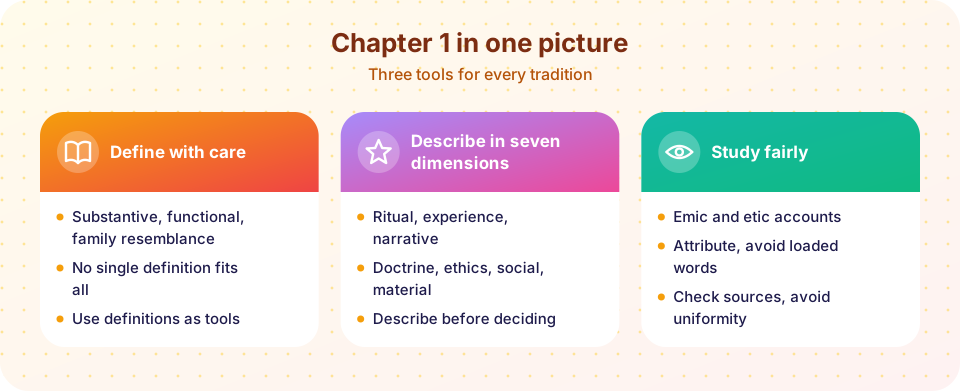
What you will learn
- How the three main ideas of chapter 1 fit together.
- Which terms and names to be able to recall.
- Whether you can apply them to a short case.
Recap table
| Lesson | Big idea | Terms and names |
|---|---|---|
| Course map | Religious studies is the fair, academic study of religions in nine chapters | emic, etic, worldview, retrieval practice |
| What is religion? | No single definition fits every case; use several lenses and the seven dimensions | Tylor, Durkheim, Wittgenstein, Smart, substantive, functional, family resemblance |
| Studying religion fairly | Describe in insiders' terms, attribute claims, avoid stereotypes, judge sources | methodological agnosticism, epoché, lived religion, essentialism |
Ideas worth connecting
Three links make the chapter more than a list. First, definition affects description. If you define religion as belief in a creator, you will describe Buddhism as an exception. If you use the seven dimensions, you can describe it on its own terms and compare it with others. Second, fairness is a method, not a mood. Attribution, emic and etic accounts, and source checking are techniques you can apply to any tradition. Third, diversity inside traditions is as important as differences between them: a rule such as "which Christians, where and when?" will serve you in every chapter.
A worked example
Suppose someone tells you, "Buddhism is not really a religion because Buddhists don't believe in God." Use the chapter's tools. First, definition: this claim assumes a substantive definition that requires belief in a creator god. Under a functional definition, Buddhism clearly provides a community, ethics and meaning; under Smart's seven dimensions it has strong ritual, narrative, doctrinal, ethical, social and material dimensions. Second, fair study: "Buddhists don't believe in God" is a generalization; many Buddhist traditions honor gods and other beings, but they do not treat a creator as central. Attribute and qualify the claim. Third, sources: ask who is speaking and what evidence supports them. In a few sentences you have turned an argument about labels into a clearer description.
Common misconceptions
"If scholars cannot define religion, the subject is meaningless." Many useful fields, such as biology (what is life?) and physics (what is time?), work well without a perfect definition. Working definitions are tools.
"Fairness means never saying a claim is wrong." Fairness means separating description from evaluation. Historical and logical claims within religion can be tested, and scholars do test them; they just show their reasoning.
Try it
Use the flashcards to retrieve the key terms before you check the answers. Flip a card, mark whether you knew it, and see your score.
The second demonstration works out a simple review schedule: when to revisit each lesson so the ideas stay fresh. The gaps follow the spacing effect (reviewing at growing intervals).
Press Run (or Ctrl + Enter) to see the result here.
Program input · what you'd type while the program runs
Type the answers before you press Run, one per line. Each time the program reads a line (with input()), it gets the next line from this box.
Check your understanding
Quick check · 9 questions
of 9 answered You scored / 9 · perfect!
-
1. Which pairing is correct?
Durkheim linked religion to sacred things and a moral community; Tylor proposed belief in spiritual beings; Smart offered seven dimensions. -
2. 'Hindus believe...' is a risky statement because
Large traditions contain many schools, regions and practices, so claims need qualifiers. -
3. An account that uses the categories of an outside analyst is called
Etic accounts use outside analytical categories. -
4. The dimension that asks 'What stories are told?' is
Narrative and mythic covers stories such as creation accounts and the lives of founders. -
5. Which is an example of a loaded word?
'Superstition' is an evaluation, not a neutral description. -
6. Which statement shows attribution?
Attribution reports who holds the belief without endorsing it. -
7. A family-resemblance view of religion says
Like 'games,' religions overlap in many ways but no single trait defines every case. -
8. A village festival that mixes local customs with scripture-based religion is best studied through
Lived religion looks at practice and everyday life, not only at official texts. -
9. Which is a primary source?
A text from within the tradition itself is a primary source.
Summary
- A good working definition of religion is a tool; combine substantive, functional and family-resemblance thinking.
- Smart's seven dimensions give a fair checklist for describing any tradition.
- Fair study means attribution, emic and etic views, careful words and sources.
- You are ready for chapter 2, which introduces the scholarly lenses (history, sociology, psychology and more).
Track your progress
Create a free account to tick off lessons and pick up where you left off on any device.
of Religious Studies lessons completed