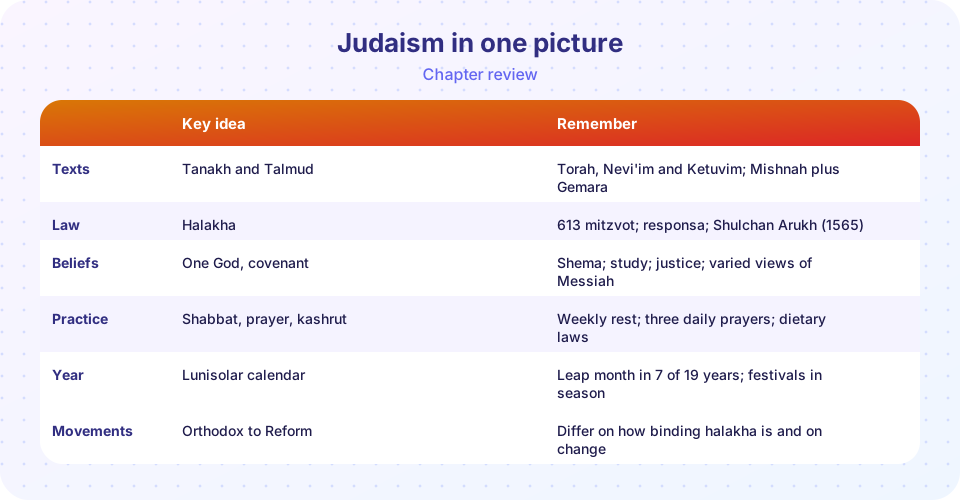
Review the Judaism chapter with a one-picture summary, a recap table, flashcards and a ten-question quiz covering texts, beliefs, movements, practice and the Jewish year.
You have now covered the main shape of Judaism: a long history, a library of texts that grows by interpretation, a system of law and ethics, several modern movements and a rhythm of life that runs through the week, the year and the life cycle. This review pulls the chapter together so that you can see how the parts connect, and tests whether you can recall them.
Caption: The chapter in one picture: what to remember about each part of Judaism.
Three threads tie the chapter together. First, interpretation: the written Torah led to the Oral Torah, which led to the Talmud, which led to codes and responsa. Judaism is a tradition that keeps reading itself. Second, practice and belief together: the same system of halakha governs prayer, food and business ethics, which is why Jewish identity is often discussed in terms of what people do. Third, adaptation: the Temple's destruction led to rabbinic Judaism, and modern emancipation led to the movements. Each shift changed the shape of Judaism while keeping continuity with the past. When you meet any new Jewish topic, ask which of these threads it belongs to.
Try answering these in a few sentences each, using only what you can recall. Then check the lessons.
Why did the destruction of the Second Temple in 70 CE change Judaism so much, and what took the place of the Temple?
How do the Mishnah, the Gemara and a later code such as the Shulchan Arukh fit together, and why does the Talmud keep minority opinions?
Two Jews can both call themselves Jewish while disagreeing about God. What does that tell you about how Jewish identity works?
Pick one festival and describe what it commemorates, how it is kept and what season it falls in.
Which movement would you expect to adopt a new ruling fastest, and which most slowly? What reasons would each give?
A good answer names the people, texts and dates involved and attributes beliefs to the groups that hold them ("Orthodox Jews hold that...") instead of stating them as facts about all Jews.
<style>:root{--ink:#1e1b4b;--mut:#475569;--bg1:#faf5ff;--bg2:#eff6ff;--ac:#6366f1;--ac2:#ec4899}@media(prefers-color-scheme:dark){:root{--ink:#e0e7ff;--mut:#a5b4fc;--bg1:#1e1b4b;--bg2:#1e293b}}*{box-sizing:border-box}body{margin:0;padding:14px;font-family:system-ui,-apple-system,'Segoe UI',sans-serif;color:var(--ink);background:linear-gradient(135deg,var(--bg1),var(--bg2));min-height:100vh}h3{margin:0 0 4px;font-size:17px}.sub{margin:0 0 12px;color:var(--mut);font-size:13px}.card{background:#fff;color:#1e1b4b;border-radius:18px;padding:16px 18px;box-shadow:0 10px 24px rgba(67,56,202,.15)}button{font:inherit;cursor:pointer;border:0;border-radius:999px;padding:8px 14px;background:linear-gradient(135deg,#6366f1,#4338ca);color:#fff;font-weight:600;font-size:14px}button.ghost{background:#eef2ff;color:#312e81}button.on{background:linear-gradient(135deg,#a855f7,#db2777);color:#fff}.row{display:flex;flex-wrap:wrap;gap:8px;margin-bottom:12px}.muted{color:#475569;font-size:14px}.big{font-size:19px;font-weight:700}</style><h3>Judaism flashcards</h3><pclass="sub">Click the card to flip it. Mark whether you knew it.</p><divid="c"class="card"style="min-height:130px;cursor:pointer;display:flex;flex-direction:column;justify-content:center;text-align:center"><divid="t"class="muted"></div><divid="x"class="big"></div></div><divclass="row"style="margin-top:12px"><buttonclass="ghost"id="p">Previous</button><buttonclass="ghost"id="n">Next</button><buttonclass="ghost"id="s">Shuffle</button><buttonid="k">I knew it</button></div><divclass="muted"id="st"></div><script>varD=[["What does Tanakh stand for?","Torah, Nevi'im (Prophets) and Ketuvim (Writings)"],["What is the Talmud?","The Mishnah together with the Gemara, its later discussion"],["Who is credited with editing the Mishnah?","Rabbi Judah ha-Nasi, about 200 CE"],["What is halakha?","Jewish law, 'the way of walking'"],["How many mitzvot does tradition count?","613 (248 positive, 365 negative)"],["What is the Shema?","The declaration that the Lord is one (Deuteronomy 6:4)"],["What is kashrut?","The dietary laws; food that meets them is kosher"],["When does Shabbat begin?","At sunset on Friday"],["Why does the calendar add a leap month?","To keep the lunar months aligned with the solar seasons: 7 leap years in 19"],["Who began Hasidism?","The Baal Shem Tov, in 18th-century Eastern Europe"]],i=0,f=false,known=0,seen={};functionshow(){document.getElementById('t').textContent=(f?'Answer':'Question')+' '+(i+1)+' of '+D.length;document.getElementById('x').textContent=D[i][f?1:0];document.getElementById('st').textContent='Marked as known: '+known+' of '+D.length;}
document.getElementById('c').onclick=function(){f=!f;show()};
document.getElementById('n').onclick=function(){i=(i+1)%D.length;f=false;show()};
document.getElementById('p').onclick=function(){i=(i+D.length-1)%D.length;f=false;show()};
document.getElementById('s').onclick=function(){for(var a=D.length-1;a>0;a--){var b=Math.floor(Math.random()*(a+1));var t=D[a];D[a]=D[b];D[b]=t}i=0;f=false;show()};
document.getElementById('k').onclick=function(){if(!seen[D[i][0]]){seen[D[i][0]]=1;known++}show()};show();</script>
Which movement?
<style>:root{--ink:#1e1b4b;--mut:#475569;--bg1:#faf5ff;--bg2:#eff6ff;--ac:#6366f1;--ac2:#ec4899}@media(prefers-color-scheme:dark){:root{--ink:#e0e7ff;--mut:#a5b4fc;--bg1:#1e1b4b;--bg2:#1e293b}}*{box-sizing:border-box}body{margin:0;padding:14px;font-family:system-ui,-apple-system,'Segoe UI',sans-serif;color:var(--ink);background:linear-gradient(135deg,var(--bg1),var(--bg2));min-height:100vh}h3{margin:0 0 4px;font-size:17px}.sub{margin:0 0 12px;color:var(--mut);font-size:13px}.card{background:#fff;color:#1e1b4b;border-radius:18px;padding:16px 18px;box-shadow:0 10px 24px rgba(67,56,202,.15)}button{font:inherit;cursor:pointer;border:0;border-radius:999px;padding:8px 14px;background:linear-gradient(135deg,#6366f1,#4338ca);color:#fff;font-weight:600;font-size:14px}button.ghost{background:#eef2ff;color:#312e81}button.on{background:linear-gradient(135deg,#a855f7,#db2777);color:#fff}.row{display:flex;flex-wrap:wrap;gap:8px;margin-bottom:12px}.muted{color:#475569;font-size:14px}.big{font-size:19px;font-weight:700}</style><h3>Which movement?</h3><pclass="sub">Choose the best category for each item. You get feedback straight away.</p><divclass="card"><divclass="big"id="q"></div><divclass="row"id="b"style="margin-top:12px"></div><divid="f"class="muted"></div></div><divclass="muted"style="margin-top:10px"id="sc"></div><script>varCA=["Orthodox","Conservative","Reform","Reconstructionist"],IT=[["Halakha is divinely revealed and binding on all Jews","Orthodox","This is the central claim of Orthodoxy."],["Developed by Mordecai Kaplan, who spoke of an evolving religious civilization","Reconstructionist","Kaplan lived from 1881 to 1983."],["Called Masorti outside North America","Conservative","Masorti means traditional."],["Began in early 19th-century Germany with an emphasis on ethical monotheism","Reform","Individuals choose which rituals to keep."],["Halakha is binding but can develop through rabbinic scholarship","Conservative","Zecharias Frankel's positive-historical approach lies behind it."]],i=0,ok=0,done=false;var b=document.getElementById('b');CA.forEach(function(c){var x=document.createElement('button');x.className='ghost';x.textContent=c;x.onclick=function(){pick(c)};b.appendChild(x)});functionshow(){if(i>=IT.length){document.getElementById('q').textContent='Finished';b.style.display='none';document.getElementById('f').textContent='You matched '+ok+' of '+IT.length+'. Reload the preview to try again.';return}
document.getElementById('q').textContent=IT[i][0];document.getElementById('f').textContent='';document.getElementById('sc').textContent='Item '+(i+1)+' of '+IT.length+' | Correct so far: '+ok;done=false}functionpick(c){if(done)return;done=true;var right=IT[i][1];if(c===right){ok++;document.getElementById('f').textContent='Correct: '+right+'. '+(IT[i][2]||'')}else{document.getElementById('f').textContent='Not quite. Best answer: '+right+'. '+(IT[i][2]||'')}
document.getElementById('sc').textContent='Correct so far: '+ok;setTimeout(function(){i++;show()},1700)}show();</script>