


















Lesson 15 of 46 · Indigenous and Ancient Traditions
Chapter 3 Review: Indigenous and Ancient Traditions
Review chapter 3: Indigenous worldviews and oral tradition, animism, shamanism and ancestors, Egypt and Mesopotamia, Greece, Rome and the Norse, with flashcards and a ten-question quiz.
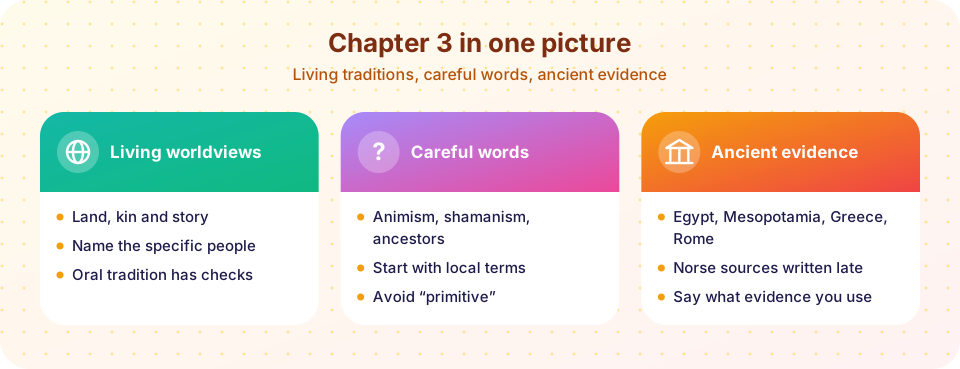
Chapter 3 took you through two big families of traditions. Among living Indigenous peoples you met land, kin and story as the base of religious life, with examples such as the Dreaming and songlines of Aboriginal Australians and whakapapa, tapu and mana among the Māori. You examined three loaded terms, animism, shamanism and ancestor veneration. And you toured ancient Egypt, Mesopotamia, Greece, Rome and the Norse world, where temples, kings, oracles and sacrifices carried religious life.
What you will learn
- How the lessons of chapter 3 fit together.
- Which terms, names and places to remember.
- How to describe the evidence for each tradition honestly.
Recap table
| Lesson | Big idea | Terms and names |
|---|---|---|
| Indigenous worldviews | Land, kin and story are central; there is no single Indigenous religion | Dreaming, songlines, whakapapa, tapu, mana, NAGPRA |
| Shamanism, animism, ancestors | Three useful but loaded terms; start from local names | Tylor, Hallowell, Eliade, Egungun, Qingming |
| Egypt and Mesopotamia | Temple-and-text civilizations with royal religion and rich afterlife or underworld ideas | maat, Pyramid Texts, Akhenaten, Enuma Elish, Gilgamesh |
| Greece, Rome, Norse | Practice-centered polytheism; Norse sources written late | polis, Delphi, pietas, interpretatio, Eddas |
Ideas worth connecting
Practice before belief. In almost every tradition of this chapter, doing came first: ceremony, sacrifice, festival, offering. Doctrines, where they exist, are secondary. This links to the orthodoxy and orthopraxy distinction from chapter 2.
Religion and the rest of life. Land, law, kinship, kingship and civic life were intertwined with the sacred. The idea of "religion" as a separate department is a later arrival, as you saw in lesson 2 of chapter 1.
Evidence shapes what we can say. Living traditions can speak for themselves; ancient traditions are known through elite texts and objects; Norse myths come from Christian Iceland. A careful statement always says where the information comes from.
Language matters. Terms like "primitive," "ancestor worship" and "shamanism" carry assumptions. Use the local term and the specific people when you can.
Common misconceptions
"These traditions are all alike." Hunting societies, river-valley states, Greek cities and Viking Age chiefdoms each had their own forms. Similarities exist but must be shown, not assumed.
"Ancient religions were crude and are now replaced." They were complex systems that shaped art, science, law and later religions, and many Indigenous traditions are very much alive.
Try it
Use the flashcards to recall key terms from the chapter. Flip each card and mark whether you knew it.
The second demonstration is a table of evidence types: what each can show and what it cannot. It prints a quick guide you can copy into your notes.
Press Run (or Ctrl + Enter) to see the result here.
Program input · what you'd type while the program runs
Type the answers before you press Run, one per line. Each time the program reads a line (with input()), it gets the next line from this box.
Check your understanding
Quick check · 9 questions
of 9 answered You scored / 9 · perfect!
-
1. Which statement about Indigenous traditions is accurate?
Indigenous traditions are numerous, distinct and living. -
2. Shaman as a term comes from
It entered European languages from accounts of Siberian peoples. -
3. Maat is best described as
Maat was the principle of cosmic and social order. -
4. The Enuma Elish was recited at
The Akitu festival included a recitation of this creation epic. -
5. What was the Delphic oracle?
The Pythia spoke for Apollo at Delphi. -
6. Which pair is correct?
Zeus corresponds to Jupiter; Ares to Mars; Hera to Juno. -
7. Why do scholars treat Norse myths with caution?
The Eddas post-date the conversion of Iceland. -
8. 'Interpretatio' refers to
Romans and others matched foreign gods with their own. -
9. A good first step when describing an Indigenous ceremony is to
Start with the specific people and their own terms and consent.
Summary
- Indigenous traditions are living, diverse and relational; name the specific people.
- Animism, shamanism and ancestor veneration are comparison terms with limits.
- Egypt and Mesopotamia built temple-and-text civilizations; Greece and Rome built civic, practice-centered religions; Norse myths come from late sources.
- Always state what evidence you rely on.
- Chapter 4 turns to South Asian traditions: Hinduism, Buddhism and Jainism.
Track your progress
Create a free account to tick off lessons and pick up where you left off on any device.
of Religious Studies lessons completed