


















Lesson 25 of 46 · Judaism
Judaism: Movements, Practice and the Jewish Year
Compare Orthodox, Conservative, Reform and other Jewish movements, then follow Jewish life through Shabbat, kosher food, prayer, the festival year and the life cycle.
Judaism is practiced in many ways, and no single description fits every Jew. Some communities follow halakha in every detail of daily life; others focus on ethics, culture and a few rituals; others combine them differently. Understanding the main movements shows how Jews have answered one question across modern times: how should an ancient legal and religious tradition relate to the modern world?
After surveying the movements, this lesson follows Jewish life through a week (Shabbat), a day (prayer and food rules), a year (the festivals and a lunisolar calendar) and a lifetime (birth, coming of age, marriage and death). The labels below are general; real communities and individuals are more varied than any list suggests.
What you will learn
- The origins and main ideas of Orthodox, Conservative, Reform, Reconstructionist and Hasidic Judaism.
- The ethnic and cultural groups called Ashkenazi, Sephardi and Mizrahi.
- How Shabbat, kosher food and daily prayer work.
- The festivals of the Jewish year and the lunisolar calendar.
- The main life-cycle rituals.
Key terms
Shabbat: the weekly day of rest, from Friday sunset to Saturday nightfall.
Kashrut: the dietary laws; food that meets them is kosher.
Minyan: a quorum of ten adults for certain prayers.
Synagogue: the Jewish house of prayer, study and community.
Ketubah: the Jewish marriage contract.
The movements
Until the 18th century most Jews lived under traditional rabbinic law. The Enlightenment and emancipation in Europe gave many Jews citizenship and new opportunities, and they raised the question of how to remain Jewish in a modern society. Several movements arose in response.
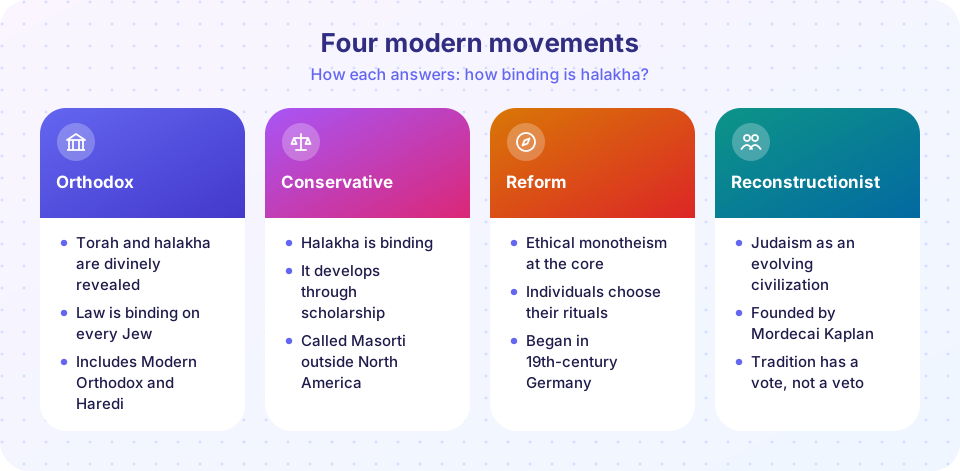
Orthodox Judaism holds that the Torah and halakha are divinely revealed and binding, and that the rabbinic process is the way to apply them. Orthodoxy has many forms. Modern Orthodox Jews combine strict observance with participation in secular education and public life. Haredi (sometimes called "ultra-Orthodox") communities emphasize separation from the surrounding culture and detailed observance. In Orthodox synagogues men and women usually sit separately, and rabbinical ordination has traditionally been for men, though some modern Orthodox communities have created new roles for women as teachers and legal advisers.
Reform Judaism began in early 19th-century Germany (with figures such as Israel Jacobson and later Abraham Geiger) and grew strongly in the United States. Reform sees Judaism as an evolving tradition with ethical monotheism at its core; individuals and communities decide which ritual laws to keep. Reform congregations use vernacular language in worship, have men and women sit together, ordain women rabbis (the first was Regina Jonas in Germany, 1935; the first in the United States, Sally Priesand, in 1972) and in many places accept patrilineal descent.
Conservative Judaism (called Masorti outside North America) arose in the 19th century from the "positive-historical" approach of Zecharias Frankel. It holds that halakha is binding but can develop through scholarly study and rabbinic decision. Conservative communities generally keep Shabbat and kosher laws, use Hebrew in worship and have, since the 1980s, ordained women as rabbis.
Reconstructionist Judaism was developed by Rabbi Mordecai Kaplan (1881 to 1983), who described Judaism as "an evolving religious civilization." Reconstructionists emphasize community, culture and ethical action, and view tradition as having "a vote, not a veto."
Hasidism is a revival movement that began in 18th-century Eastern Europe with Israel ben Eliezer, the Baal Shem Tov (about 1698 to 1760). It stresses joyful devotion, prayer, music and the spiritual leadership of a rebbe. Today Hasidic groups such as Chabad-Lubavitch and Satmar form part of the Orthodox world, with distinct customs and dress.
Other groups exist: Karaites, who reject the rabbinic Oral Torah and rely on the written Bible alone; Humanistic Judaism, which emphasizes Jewish culture and ethics without a belief in God; and many Jews who describe themselves as secular, cultural or "just Jewish."
Ethnic divisions. Ashkenazi Jews descend from communities in Central and Eastern Europe, and traditionally spoke Yiddish. Sephardi Jews descend from Spain and Portugal (Ladino was their traditional language), and Mizrahi Jews from the Middle East and North Africa. These labels describe heritage and customs such as pronunciation, food and prayer melodies, not a religious movement.
The Jewish week: Shabbat
Shabbat is a day of rest that begins at sunset on Friday and ends at nightfall on Saturday. It is based on the biblical commandment to remember the seventh day, which echoes the story of creation, in which God rests on the seventh day. Observant Jews light candles before sunset, share a festive meal with wine and braided bread (challah), attend synagogue and avoid labor. The rabbis defined thirty-nine categories of forbidden "work" (melakhot) from the activities used to build the Tabernacle in the desert: cooking, writing, building, carrying objects in public areas and, in most Orthodox interpretations, using electricity. The aim is not to make life harder but to create time for rest, family, study and rest from the pressure of production. A common saying, from the essayist Ahad Ha'am, is that "more than the Jews have kept the Sabbath, the Sabbath has kept the Jews."
The Jewish day: prayer and food
Traditional Jews pray three times a day: Shacharit (morning), Mincha (afternoon) and Maariv (evening). Prayer can be said alone, but some prayers require a minyan, which in Orthodox practice means ten adult men and in many other movements ten adults of any gender. Men often wear a kippah (skullcap), a tallit (prayer shawl with fringes) and, on weekday mornings, tefillin (small leather boxes containing scriptural passages, bound to the arm and head). Many liberal communities invite women to wear them too. The central prayers are the Shema and the Amidah ("standing prayer").
Kashrut includes rules drawn from the Torah and expanded by the rabbis. Permitted land animals must chew cud and have split hooves (so pork is forbidden); fish must have fins and scales (so shellfish are forbidden); meat must come from animals slaughtered in a prescribed way; and meat and dairy products are not eaten together, based on the verse "do not boil a kid in its mother's milk." Observant homes often keep separate dishes for meat and dairy. Reasons are discussed in many ways: obedience, discipline, holiness and identity. The Torah itself presents the rules as part of holiness rather than as health advice.
The Jewish year
Jewish months follow the moon, with each month starting at the new moon. A purely lunar year (about 354 days) would drift against the seasons, so the Jewish calendar adds a leap month, Adar I, in seven years out of every nineteen. This makes it lunisolar and keeps festivals in their seasons, with Passover always in spring. Years are counted from a traditional date for the creation of the world, so the year that began in autumn 2025 was 5786.
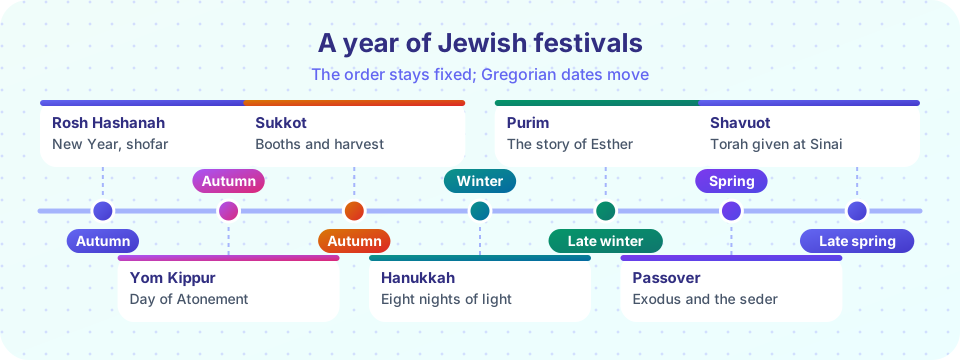
- Rosh Hashanah (New Year, in autumn) opens ten "Days of Awe" of reflection and repentance, marked by blowing the shofar (a ram's horn).
- Yom Kippur, the Day of Atonement, is the most solemn day: a fast of about 25 hours with prayer.
- Sukkot is a harvest festival recalling the wandering in the desert; families eat in a temporary booth (sukkah). It is followed by Simchat Torah, which celebrates finishing the yearly Torah reading and starting again.
- Hanukkah (December in most years) lasts eight nights and commemorates the rededication of the Temple after the Maccabean revolt in the 2nd century BCE; candles are lit on a menorah. It is a relatively minor festival in religious law, but it became widely known.
- Purim retells the story of Esther in Persia; people read the Scroll of Esther, give gifts and celebrate.
- Passover (Pesach) commemorates the exodus from Egypt. The seder meal tells the story with symbolic foods, and no leavened bread is eaten for the week.
- Shavuot falls seven weeks after Passover, and marks the giving of the Torah at Sinai and the grain harvest.
The life cycle
- Birth. Boys are circumcised on the eighth day (brit milah); naming ceremonies for girls vary by community.
- Coming of age. At 13 (or 12 for girls in some communities) a young person becomes bar or bat mitzvah ("subject to the commandments"), often by reading from the Torah. The first public bat mitzvah in the United States is usually dated to 1922, for Judith Kaplan.
- Marriage. The couple stand under a canopy (chuppah), a ketubah is signed and a glass is broken, which many interpret as a reminder of the Temple's destruction.
- Death. Burial takes place quickly, followed by seven days of mourning (shiva), and mourners recite the Kaddish prayer, which praises God and does not mention death.
Common misconceptions
"Hanukkah is the Jewish Christmas." Hanukkah is a minor festival whose prominence in some countries comes partly from its closeness to Christmas. The High Holy Days and Passover are far more central religiously.
"Kosher means blessed by a rabbi." Kosher means that food meets the dietary laws, which concern ingredients and preparation, though a rabbinic agency often certifies it.
"All Jews keep Shabbat the same way." Practice varies from full Orthodox observance to a Friday-night dinner to none.
Try it
Press Run (or Ctrl + Enter) to see the result here.
Program input · what you'd type while the program runs
Type the answers before you press Run, one per line. Each time the program reads a line (with input()), it gets the next line from this box.
Check your understanding
Quick check · 5 questions
of 5 answered You scored / 5 · perfect!
-
1. Which movement holds that halakha is binding and was divinely revealed?
Orthodox Judaism holds that the Torah and halakha are divinely revealed and binding; other movements interpret the authority of halakha differently. -
2. Who is the founder of Hasidism?
Hasidism began in 18th-century Eastern Europe with the Baal Shem Tov (about 1698 to 1760). -
3. How does the Jewish calendar keep festivals in their seasons?
A leap month, Adar I, is added in seven years of a 19-year cycle, making the calendar lunisolar. -
4. What does the Kaddish prayer concentrate on?
The Kaddish praises God and is recited by mourners; it does not mention death. -
5. Which festival commemorates the exodus from Egypt?
Passover (Pesach) retells the exodus, and the seder meal uses symbolic foods to tell the story.
Summary
- Orthodox, Conservative, Reform, Reconstructionist and Hasidic Judaism answer differently the question of how halakha relates to modern life.
- Ashkenazi, Sephardi and Mizrahi describe heritage and customs, not movements.
- Shabbat, kashrut and daily prayer give structure to a Jewish week and day.
- The lunisolar calendar adds a leap month in seven of nineteen years.
- Life-cycle rituals mark birth, coming of age, marriage and death.
Next: Judaism review
Track your progress
Create a free account to tick off lessons and pick up where you left off on any device.
of Religious Studies lessons completed