


















Lesson 7 of 46 · Studying Religion
Sacred Texts and Interpretation
How scriptures are formed, passed on, translated and read: oral tradition, canon, commentary and the many ways believers and scholars interpret a sacred text.
Many traditions have texts that their members treat as especially authoritative: the Vedas, the Hebrew Bible, the New Testament, the Qur'an, the Pali Canon, the Guru Granth Sahib. These are often called scriptures. But a scripture is more than a book. It is a text, a sound, a ritual object, a source of law and stories, and a subject of endless discussion. How a community receives, protects and interprets its sacred texts tells you a great deal about the community.
This lesson explains how texts become sacred, how they are passed on, and how readers, both believers and scholars, interpret them. It also warns you about a trap: a text never reads itself. Every reading involves a reader, a community and a set of assumptions.
What you will learn
- How oral tradition, writing and canon relate.
- Examples of scriptures from several traditions and how they are structured.
- Common ways of reading a text: literal, allegorical, historical and devotional.
- Why translation is itself interpretation.
Key terms
Scripture: a text regarded by a community as sacred and authoritative.
Canon: the list of books a community accepts as scripture.
Hermeneutics: the theory and practice of interpretation.
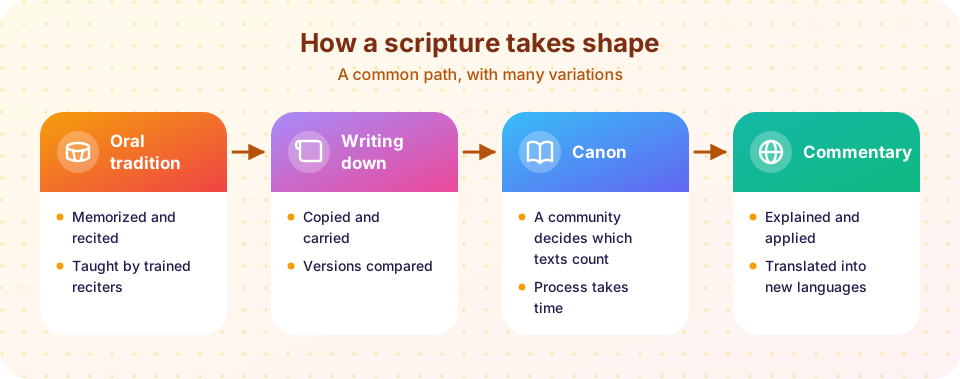
Commentary: a work that explains or applies a scripture; many traditions have a rich commentary literature.
Oral tradition: teaching and stories passed on by speech and memory, sometimes for centuries.
From speech to canon
Before writing was widespread, and in many societies after it, the spoken word carried tradition. Oral tradition is not casual memory. In ancient India the Vedic hymns were transmitted by trained reciters using elaborate methods of repetition that, according to the tradition and to scholars, preserved the sound with great accuracy over many centuries. Hindu tradition calls the Vedas shruti ("what is heard," revealed) and distinguishes them from smriti ("what is remembered"), a large body of later texts that includes epics, law books and the Puranas.
Writing changed the situation. A written text can be copied, carried and compared, but it also raises questions of which version is correct. This is where canon appears. A canon is not found in a drawer; it is a decision made over time by a community.
- Judaism. The Hebrew Bible, called the Tanakh from the initials of its three parts (Torah, Nevi'im or Prophets, Ketuvim or Writings), is the core of Jewish scripture. Rabbinic Judaism also holds that an Oral Torah was passed on alongside the written one. It was recorded in the Mishnah (around 200 CE) and later in the Talmud, which is a vast discussion of law, ethics and narrative.
- Christianity. The Christian Bible has two parts, an Old Testament (which overlaps with the Hebrew Bible but is ordered differently) and a New Testament of 27 books. Churches differ over a few books in the Old Testament: Catholic and Orthodox Bibles include writings that most Protestant Bibles do not. Lists of New Testament books circulated in the early centuries, and a list matching the 27-book collection is attested in a letter of Athanasius of Alexandria in 367 CE.
- Islam. Muslims believe that the Qur'an was revealed to the Prophet Muhammad over about 23 years (traditionally 610 to 632 CE) and that its text was collected in a single standard volume after his death. In the Muslim tradition this standard text is associated with the caliph Uthman in the 640s to 650s. Muslims regard the Qur'an in Arabic as God's speech, and recitation is itself a major form of devotion.
- Buddhism. Early Buddhist teachings were memorized and recited by monastic communities. The Pali Canon, the Tipitaka ("three baskets") of the Theravada school, covers monastic rules, discourses and philosophical analysis; tradition holds that it was first written down in Sri Lanka in the first century BCE. Other Buddhist schools have their own canons in Sanskrit, Chinese and Tibetan.
Ways of reading a text
Readers do not approach a scripture with a blank mind. They approach it through a tradition of reading. Here are four common modes. They are not mutually exclusive, and one community often uses several.
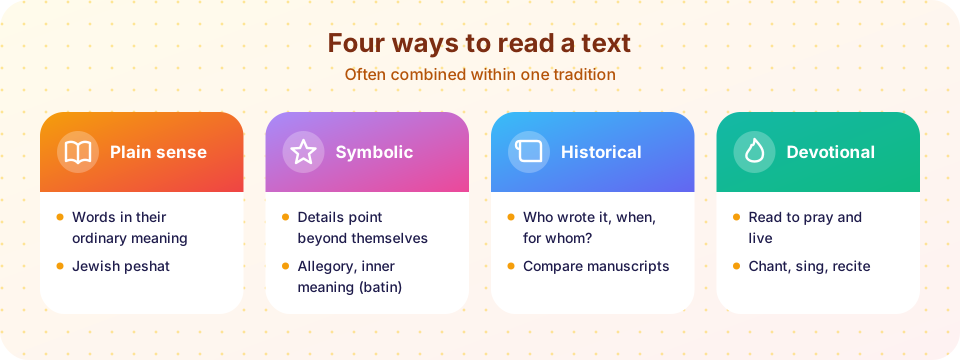
Literal or plain sense. The text is taken to mean what it says, in the ordinary sense of its words. Even "literal" reading involves choices, such as whether a poetic line is meant as description.
Allegorical or symbolic. Details are read as pointing beyond themselves. Early Jewish and Christian thinkers such as Philo of Alexandria and Origen used allegory extensively. Medieval Christians spoke of four senses of scripture: the literal, the allegorical, the moral and the "anagogical," or hope-directed. A comparable Jewish scheme is PaRDeS, an acronym for peshat (plain), remez (hinted), derash (homiletical) and sod (secret or mystical). In Islam, scholars distinguish the outer (zahir) and inner (batin) layers of meaning.
Historical-critical. Scholars ask who wrote the text, when and for what audience, and how it relates to other texts of its era. They compare manuscripts, languages and genres. Some of their conclusions agree with traditional views and some do not, which is why this method has been welcomed in some communities and resisted in others.
Devotional or liturgical. Here the text is read to pray, worship and live. A psalm may be sung, a sutra chanted, a verse recited at a funeral. The meaning is in use, not only in interpretation. Scholars have noted that for many communities the sound, look and handling of scripture, such as kissing a Torah scroll or covering the Guru Granth Sahib with respect, matter as much as the words.
Interpretation is a community activity
A text becomes authoritative within a community that agrees how to read it. That is why each tradition has institutions for interpretation: rabbis and rabbinic courts, Christian councils and theologians, Islamic jurists and schools of law (madhahib), Buddhist monastic teachers, Hindu gurus and commentators (bhashyakara). Disagreements within these communities are normal and often productive. They explain, for instance, why Christians divide into denominations that read the same Bible differently, and why Islamic law has multiple schools.
Interpretation also changes over time. A passage read one way in the Middle Ages may be read another way today, as new knowledge, questions and social conditions arise. Scholars of the subject point out that this does not make interpretation arbitrary. Communities usually argue from precedent, from language and from reasoning, and the arguments can be studied.
Translation as interpretation
Translators must choose among meanings. The Hebrew word torah, often translated "law," more broadly means "teaching" or "instruction." Dharma in Indian traditions can mean duty, law, teaching, nature or righteousness, depending on context. The Arabic islam means "submission" or "surrender" (to God), and is related to a root connected with peace and safety. Many Muslims hold that translations of the Qur'an are not the Qur'an itself but renderings of its meaning, which is one reason Arabic is used in prayer worldwide. Readers who rely on a translation are relying on a first layer of interpretation, so it is wise to compare several translations and read translators' notes.
Common misconceptions
"Scripture is one book in every religion." Many scriptures are libraries of different genres (law, poetry, stories, letters), and some traditions have no single closed book. The Hindu texts are vast, and some indigenous traditions rely on oral transmission.
"Believers who read literally never interpret." Every reader interprets, even when the reading is called literal, because words must be understood in a context.
"Historical criticism and faith are always in conflict." Some believers and scholars combine them; others hold that they answer different questions. The relationship is debated within every tradition that uses the method.
Try it
The first demonstration is a word explorer. Click a term to see a range of meanings and why a single English word can mislead. The meaning lists are simplified summaries.
The second demonstration is a keyword-in-context tool, a technique scholars use to study how a word is used across a text. The passage is an invented example (not a scripture) so you can see the method without relying on any translation.
Press Run (or Ctrl + Enter) to see the result here.
Program input · what you'd type while the program runs
Type the answers before you press Run, one per line. Each time the program reads a line (with input()), it gets the next line from this box.
Check your understanding
Quick check · 5 questions
of 5 answered You scored / 5 · perfect!
-
1. In Hindu tradition, shruti refers to
Shruti means 'what is heard' and covers the Vedas; smriti means 'what is remembered'. -
2. What is a canon?
A canon is the community's accepted collection of authoritative texts. -
3. The Jewish acronym PaRDeS names
Peshat, remez, derash and sod are four levels of interpretation. -
4. Why is translation described as a layer of interpretation?
Words like torah and dharma have a range of meanings, so a translator's choice shapes what readers see. -
5. Which reading asks who wrote a text, when and for whom?
The historical-critical method situates texts in their historical settings.
Summary
- Many scriptures began in oral tradition; canon is a community's decision about which texts are authoritative.
- Examples: Vedas (shruti and smriti), Tanakh and Talmud, the Christian Old and New Testaments, the Qur'an, the Pali Canon.
- Texts are read literally, allegorically, historically and devotionally, often in layers.
- Interpretation happens in communities with institutions, and it changes over time.
- Translation is a first interpretation; compare translations and read notes.
Next: Ritual, Myth and Symbol
Track your progress
Create a free account to tick off lessons and pick up where you left off on any device.
of Religious Studies lessons completed