


















Lesson 35 of 46 · Islam and Other Traditions
Sikhism and the Baha'i Faith
Two independent world religions compared: Sikhism from Guru Nanak and the Guru Granth Sahib, and the Baha'i Faith from the Bab and Baha'u'llah, with their beliefs and practices.
Two religions in this chapter are younger than Islam, Christianity or Judaism, and both are often misunderstood. Sikhism arose in the Punjab region of South Asia about five hundred years ago; the Baha'i Faith arose in Persia less than two hundred years ago. Each describes itself as an independent world religion, and scholars of religion treat them that way. Each also grew up in a setting where other religions were already present, and a good description explains the context without implying that one religion is just a mixture of others.
This lesson introduces each tradition's founders, teachings, scripture, worship and community life, and then compares them. The descriptions follow how each community describes itself.
What you will learn
- The ten Gurus, the Guru Granth Sahib and the Khalsa in Sikhism.
- Key Sikh teachings, practices and symbols.
- The history and teachings of the Baha'i Faith and its distinctive organization.
- Similarities and differences between the two.
Key terms
Guru: "teacher"; in Sikhism the ten human Gurus and the scripture, which is the eternal Guru.
Gurdwara: a Sikh place of worship, "door of the Guru."
Langar: the free communal meal served in a gurdwara to all visitors.
Manifestation of God: in the Baha'i Faith, a divine messenger such as Abraham, Moses, Buddha, Jesus, Muhammad or Baha'u'llah.
Progressive revelation: the Baha'i teaching that God reveals guidance step by step through successive messengers.
Sikhism
Origins. Guru Nanak (1469 to 1539) was born in the Punjab region, in a village now in Pakistan. According to Sikh tradition he had a profound spiritual experience, began to teach that there is one God and traveled widely. He lived in a context in which Hindu devotional (bhakti) and Sufi movements were active, and he taught that God is beyond both Hindu and Muslim labels. Nine more Gurus followed: Angad, Amar Das, Ram Das, Arjan, Hargobind, Har Rai, Har Krishan, Tegh Bahadur and Gobind Singh. Guru Arjan compiled the first edition of the scripture in 1604 and oversaw the Harmandir Sahib (the "Golden Temple") in Amritsar. Two Gurus were put to death under Mughal rulers: Arjan in 1606 and Tegh Bahadur in 1675, events that shaped Sikh identity and its tradition of defending the vulnerable.
The Khalsa. In 1699 on the festival of Vaisakhi, Guru Gobind Singh (1666 to 1708) founded the Khalsa, an order of committed Sikhs. Members are initiated and are expected to observe the five Ks: kesh (uncut hair, often under a turban), kangha (a comb), kara (a steel bracelet), kachera (a particular undergarment) and kirpan (a small ceremonial blade). These are religious articles, symbols of discipline, equality and readiness to protect the weak. Before his death in 1708 Guru Gobind Singh declared that the line of human Gurus would end and that the scripture would be the Guru.
Scripture. The Guru Granth Sahib is a book of 1,430 pages (angs) written in the Gurmukhi script. It contains hymns of the Sikh Gurus and also of Hindu and Muslim saints, such as Kabir, Ravidas and Sheikh Farid. It opens with the Mool Mantar, which begins with Ik Onkar, "one Being." Sikhs treat the book with the highest respect: it is installed on a raised platform under a canopy, attended with a fly-whisk and carried ceremonially.
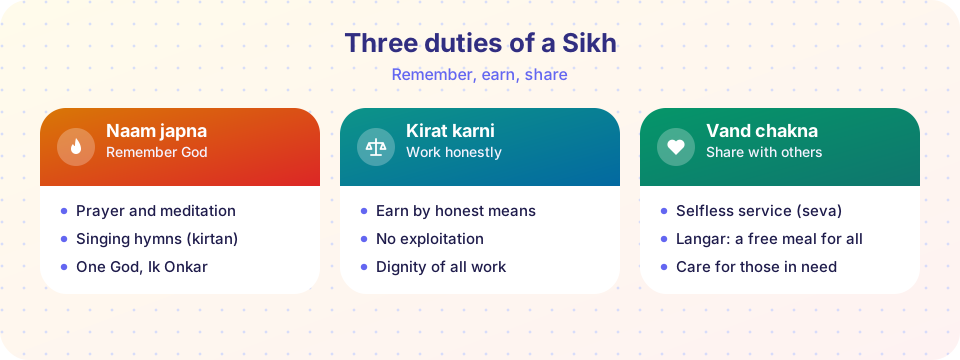
Teachings. Sikhs believe in one God, called by names such as Waheguru ("wonderful Lord"), who is both beyond creation and present in it. A person's goal is union with God, through devotion, honest life and the grace of God, rather than through ritual or asceticism. Sikhism rejects caste hierarchy and teaches the equality of all people, including women. Many Sikhs believe in reincarnation and in liberation from rebirth, a concept shared with Indian religions. Three guiding duties are:
- Naam japna: remember God through prayer and meditation.
- Kirat karni: earn a living honestly.
- Vand chakna: share with others, as in seva, selfless service.
Practice. The gurdwara is open to everyone; visitors cover their heads and remove shoes, and sit on the floor. Worship consists of hymn-singing (kirtan), readings and prayer, followed by karah prasad, a sweet offering, and by the langar, a free vegetarian meal served from a community kitchen to people of any religion or none. About 25 to 30 million Sikhs live in the world today, mostly in Punjab, with large diaspora communities in the United Kingdom, Canada, the United States and elsewhere. The Sikh Empire of Maharaja Ranjit Singh ruled much of the Punjab from 1799 until his death in 1839, and the partition of India in 1947 divided the Punjab and displaced millions.
The Baha'i Faith
Origins. The Baha'i Faith grew from a Persian movement. In 1844 a young merchant from Shiraz, Sayyid Ali Muhammad, announced himself as the Bab ("the Gate") and said that a new divine messenger was soon to come. The Bab attracted many followers, was opposed by the religious and political authorities and was executed in Tabriz in 1850. Mirza Husayn-Ali (1817 to 1892), known as Baha'u'llah ("the Glory of God"), became a follower of the Bab, was imprisoned and exiled. In 1863, in Baghdad, he declared that he was the messenger the Bab had foretold. Exiled further to Istanbul, Edirne and finally the prison city of Acre (Akka) in the Ottoman province of Syria, he spent the rest of his life writing and died near Acre in 1892.
Leadership. Baha'u'llah appointed his eldest son, Abdu'l-Baha (1844 to 1921), as the interpreter of his teachings. Abdu'l-Baha was succeeded by his grandson Shoghi Effendi, who led as "Guardian" from 1921 to 1957. Since 1963 the faith has been guided by an elected nine-member council, the Universal House of Justice, based in Haifa, Israel. There is no clergy: communities are led by elected local and national councils called Spiritual Assemblies.
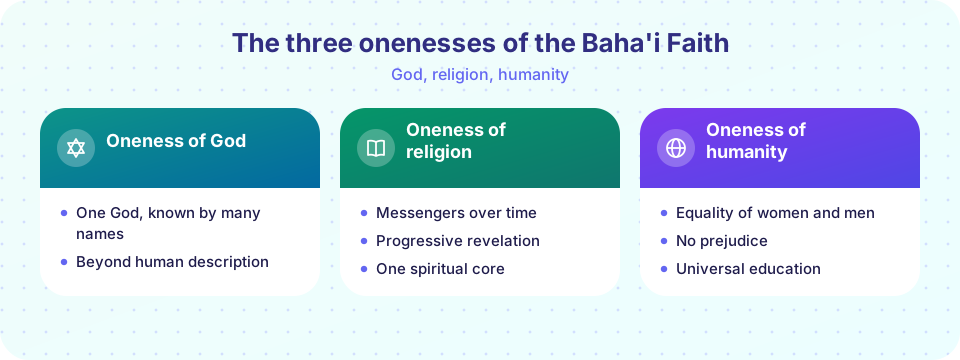
Teachings. Baha'is teach three "onenesses": the oneness of God, the oneness of religion and the oneness of humanity. Through progressive revelation, they believe that God sends messengers such as Abraham, Moses, Krishna, Buddha, Jesus, Muhammad, the Bab and Baha'u'llah, each bringing guidance suited to his age; the teachings share one spiritual core while social laws change. Other principles include the equality of women and men, the elimination of all prejudice, independent search for truth, the harmony of science and religion, universal education and the establishment of world peace.
Practice. Baha'is say daily obligatory prayers, fast for nineteen days from March 2 to 20 (during daylight), avoid alcohol and gossip, and take part in the Nineteen Day Feast, a regular community gathering for worship, consultation and fellowship. Their calendar has nineteen months of nineteen days, plus four or five extra days. Baha'i houses of worship, built on every continent, have nine sides and are open to people of all faiths, including notable temples in Wilmette (United States), New Delhi (the Lotus Temple) and Sydney. Estimates of the global community range from five to eight million people. In Iran, where the faith began, Baha'is are not recognized as a protected religious minority and have faced prolonged discrimination and persecution, as documented by international human-rights bodies.
Common misconceptions
"Sikhism is a mix of Hinduism and Islam." Sikhs and most scholars describe it as a distinct revealed religion with its own scripture, history and institutions, which arose in a context where Hindu and Muslim ideas were present.
"Sikhs wear turbans because they are Muslim or related to Hindus." The turban covers uncut hair, which is a religious practice for many Sikhs, and the kirpan is a religious article, not a weapon in intent.
"The Baha'i Faith is a sect of Islam." It arose from an Islamic context but regards itself as an independent religion with its own scripture and laws, and most Muslims regard it as distinct.
Try it
Press Run (or Ctrl + Enter) to see the result here.
Program input · what you'd type while the program runs
Type the answers before you press Run, one per line. Each time the program reads a line (with input()), it gets the next line from this box.
Check your understanding
Quick check · 5 questions
of 5 answered You scored / 5 · perfect!
-
1. What are the five Ks of the Khalsa?
The five Ks are kesh, kangha, kara, kachera and kirpan, worn by initiated Sikhs. -
2. What is the Guru Granth Sahib?
After 1708 the scripture is the eternal Guru of the Sikhs. -
3. Who is Baha'u'llah?
Baha'u'llah (1817 to 1892) declared his mission in 1863. -
4. What is langar?
Langar is the free vegetarian meal open to everyone. -
5. Which describes the Baha'i principle of progressive revelation?
Baha'is believe a series of messengers share one spiritual core.
Summary
- Sikhism began with Guru Nanak (1469 to 1539); ten Gurus, then the Guru Granth Sahib; the Khalsa was founded in 1699.
- Sikh life stresses one God, equality, honest work, sharing and service; langar and the gurdwara are central.
- The Baha'i Faith grew from the Bab (1844) and Baha'u'llah (declared 1863) and teaches the oneness of God, religion and humanity.
- Baha'is have no clergy and are guided by elected councils, with the Universal House of Justice at the top.
Next: East Asian traditions
Track your progress
Create a free account to tick off lessons and pick up where you left off on any device.
of Religious Studies lessons completed