


















Lesson 12 of 46 · Indigenous and Ancient Traditions
Shamanism, Animism and Ancestors
Understand what scholars mean by animism, shamanism and ancestor veneration, with examples from Siberia, West Africa and China, and why these terms are used carefully.
Three words come up again and again when people talk about older and Indigenous religions: animism, shamanism and ancestors. Each names a real pattern, and each has been used so loosely that it can mislead. "Animism" has been used both as an insult and as a respectful term. "Shamanism" has been stretched to cover healers and mystics on every continent. "Ancestor worship" is a phrase that many people who honor their ancestors reject. A good student of religion learns what each word describes and what it hides.
This lesson explains the three terms, gives examples from several parts of the world, and shows how scholars have revised their thinking over time. As in the previous lesson, it speaks about specific peoples where it can and about general patterns only with caution.
What you will learn
- What animism meant for Tylor and how modern scholars rethink it.
- What the word shamanism comes from and what shamans typically do.
- How ancestors are honored in West African and Chinese traditions.
- Why scholars handle these categories with care.
Key terms
Animism: the view that persons, animals, plants, places and objects can have spirit or personhood; originally Tylor's theory of religion's origin.
Shaman: in the strict sense, a ritual specialist in certain Siberian and Central Asian societies who communicates with spirits, often in a trance.
Ancestor veneration: practices that honor deceased relatives and maintain relationships with them.
Spirit possession: a state in which a spirit is understood to speak or act through a person's body.
Divination: practices for gaining knowledge of hidden matters or the future.
Animism: from theory to relationship
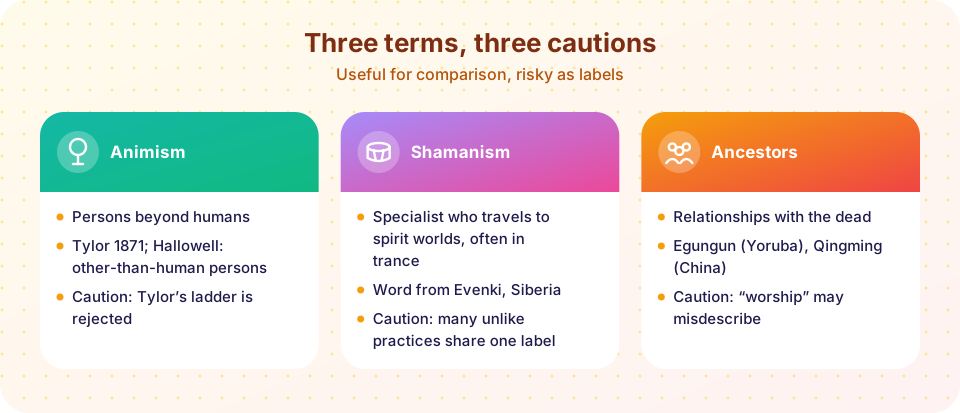
In Primitive Culture (1871), Edward Tylor proposed that religion began with "animism," a belief that spirits animate persons and nature, which early humans supposedly developed to explain dreams and death. He placed animism at the bottom of a ladder that led up to monotheism. Most scholars today reject the ladder, because it ranks peoples by assumed progress, and they doubt that one theory can explain the origin of all religion.
Yet the word has been rehabilitated in a different form. The anthropologist Irving Hallowell (1892 to 1974), working with Ojibwe people in the early twentieth century, reported that the Ojibwe category of "person" included not only humans but also certain animals, stones and other beings. He was told that some stones are alive, and he came to describe this as a way of relating to "other-than-human persons," not a mistaken theory about physics. Later writers such as Graham Harvey and Nurit Bird-David developed a "new animism" that focuses on respectful relationships with the beings around us, with etiquette, gifts and obligations. This view holds that animism is not a primitive belief but a way of being in a world full of others.
Caution is needed even here. The label "animism" is a scholar's word, and many peoples would describe their traditions with their own terms. Not all Indigenous peoples hold the same view of non-human persons, and the "new animism" is itself debated for possibly blending many different practices into one category.
Shamanism: a word with an origin
The word shaman comes from the Tungusic (Evenki) language of Siberia, and entered European languages in the seventeenth century through Russian and German travel accounts. In Siberia and Central Asia it refers to a ritual specialist who, in a trance or ecstatic state, is understood to travel to spirit worlds, negotiate with spirits, and bring back healing or guidance for the community. Drums, chanting, special costumes and altered consciousness are often involved, though they vary.
The historian of religion Mircea Eliade popularized the term in his book Shamanism: Archaic Techniques of Ecstasy (1951), presenting a worldwide pattern of "ecstatic journey." Later scholars criticized this for wrapping very different practices into one category and for relying on secondhand sources. Korean mudang, Mongolian bo, Sami noaidi, Amazonian healers and many others are all called shamans in English, but each belongs to its own social and religious system, with different roles, training, and relationships to community and state. Many scholars now prefer to use the local term and to say "so-called shamanism" or "shamanic practices" when making comparisons.
Common features across several cases include: a calling or illness that leads someone to the role; apprenticeship with an elder; a spirit helper or guide; ritual healing; divination; and a function of mediating between a community and powers that affect harvests, hunts or health. In some societies the shaman is respected and sometimes feared. In many places shamans were persecuted by colonial or later governments, and in some regions their practices have been revived or adapted for tourism or modern spiritual movements, which raises questions of authenticity and cultural appropriation.
This lesson is educational and does not recommend medical or healing practices. Descriptions of healing refer to the roles these practices play in communities, not to any claim of effectiveness.
Ancestors
Many societies maintain relationships with the dead. In some, ancestors are understood as members of the community who have changed state, who continue to care for, advise and sometimes discipline their descendants, and who must be remembered with offerings, prayers and festivals. Calling this "ancestor worship" suggests that the dead are gods; many practitioners say they honor and remember, and use words like "respect" or "care."
West African examples
In many societies of West Africa, ancestors are an active part of social life. Among the Yoruba of present-day Nigeria and Benin, the Egungun masquerade festivals involve costumed dancers who embody the ancestral dead for the community. The Yoruba tradition also has a high god, Olodumare, and a large family of spirits called orisha, such as Ogun, associated with iron and war, and Oshun, associated with rivers. A system of divination called Ifá, with a large body of verses, is used to seek guidance, and UNESCO has listed the Ifá divination system as intangible cultural heritage. Through the transatlantic slave trade, Yoruba and other West African traditions reached the Americas and combined with other influences in forms such as Candomblé in Brazil and Santería in Cuba. These are living religions with their own histories, not "survivals."
China and East Asia
In Chinese culture, many families keep ancestral tablets or photographs at home, make offerings of food, incense and paper goods, and visit graves, especially at Qingming (the "tomb-sweeping" festival, in early April) and at other festival times. Confucian thought emphasized filial respect and the continuity of the family line, and ritual remembrance of ancestors became one of the most widespread practices across East Asia, including Korea and Vietnam. Scholars disagree about whether such practices should be seen as religion, ethics, family custom or all three, and again the word "worship" may fit poorly.
Why the categories matter
These three words help us see patterns: personhood extended beyond humans, specialists who mediate with unseen powers, and relationships between the living and the dead. But they also tempt us to treat very different communities as if they were interchangeable. A useful practice is to begin with the local term and the specific people, and to use the general term only when comparing.
Common misconceptions
"Animists believe everything has a soul." Different peoples draw the line of personhood in different places, and some are careful about which stones or animals count. There is no single animist creed.
"Shamanism is one worldwide religion." The word names a family of practices that scholars group for comparison. Each is embedded in a particular society.
"Ancestor veneration is worship of dead people as gods." Most practitioners distinguish honoring ancestors from worshiping gods, and many describe it as respect, remembrance and care.
Try it
The first demonstration is a term explorer. Pick a term and see a definition, a typical example, and a caution. The text summarizes this lesson in short form.
The second demonstration works out when Qingming falls. In the Chinese solar calendar, Qingming is the solar term beginning about 15 days after the spring equinox, so it lands on 4 or 5 April in most years. The code uses the equinox date and the length of a solar term.
Press Run (or Ctrl + Enter) to see the result here.
Program input · what you'd type while the program runs
Type the answers before you press Run, one per line. Each time the program reads a line (with input()), it gets the next line from this box.
Check your understanding
Quick check · 5 questions
of 5 answered You scored / 5 · perfect!
-
1. Where does the word 'shaman' come from?
The word entered European languages through accounts of Siberian peoples, from the Evenki saman. -
2. What did Irving Hallowell report among the Ojibwe?
Hallowell described 'other-than-human persons' as part of the Ojibwe understanding of the world. -
3. Why do scholars often avoid 'ancestor worship'?
Practitioners often distinguish honoring ancestors from worshiping gods. -
4. Egungun are associated with
Egungun masquerades are a Yoruba ancestral festival tradition. -
5. What is a good first step when studying a so-called shamanic practice?
Local terms and contexts prevent false uniformity.
Summary
- Tylor's animism was a theory of origins; modern scholars discuss animism as relationship with other-than-human persons.
- Shamanism comes from Siberian usage and now names many different practices; use local terms when possible.
- Ancestors are honored in many societies, for example in Yoruba Egungun and Chinese Qingming practices.
- General terms are useful for comparison but hide differences; begin with specific peoples.
Track your progress
Create a free account to tick off lessons and pick up where you left off on any device.
of Religious Studies lessons completed