


















Lesson 40 of 46 · Religion, Society and Ethics
Religion, Ethics and Science
How religious traditions ground moral reasoning, how they debate war, wealth, the environment and life ethics, and the four models of the relationship between religion and science.
Two of the most common questions people ask about religion are "How does it tell people to live?" and "Doesn't science disprove it?" Both are better answered with careful distinctions than with slogans. This lesson looks at how religious traditions reason about right and wrong, shows that traditions contain internal debate on hard questions, and then lays out models for thinking about religion and science that scholars use.
The lesson aims at balanced description. It will name positions held by different traditions and by different groups within them; it will not say which is correct.
What you will learn
- Four common ways traditions ground morality.
- How traditions express similar ideas, such as the Golden Rule, in different words.
- How religious communities debate war, wealth, the environment and life and death.
- Barbour's four models of the relationship between religion and science, and the history behind the "conflict" story.
Key terms
Divine command theory: the view that what is right is what God commands.
Natural law: the idea that moral principles can be discovered by reason from human nature.
Virtue ethics: ethics centered on character and the habits of a good life.
Casuistry: reasoning about hard cases by comparing them with clearer ones.
Conflict thesis: the claim that science and religion are in permanent warfare.
Where do religious ethics come from?
Different traditions emphasize different sources, and the same tradition uses several.
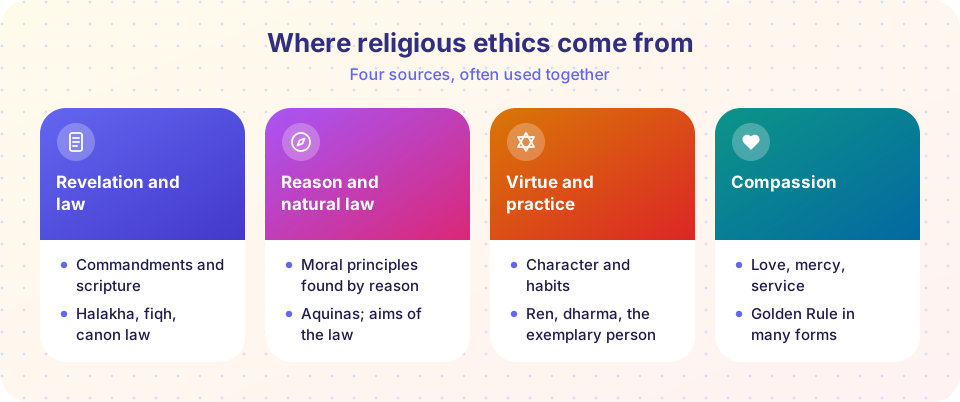
Revelation and law. In Judaism the commandments (mitzvot) and the rabbinic legal tradition guide conduct. In Islam, the Qur'an and the Prophet's example are read through jurisprudence (fiqh). In many forms of Christianity, the Bible is read with teaching authority and conscience. Philosophers describe a puzzle called the Euthyphro dilemma, from Plato's dialogue: is something good because the gods command it, or do the gods command it because it is good? Believers have answered both ways. Many theologians, such as Thomas Aquinas, hold that God's commands reflect God's good nature, so the dilemma is not a true choice.
Reason and natural law. Aquinas (1225 to 1274) taught that human reason can discover moral principles written into human nature. This tradition shaped Catholic moral teaching, and similar ideas appear in Islamic thought about the aims of the law (maqasid al-sharia), which classical scholars summarized as protecting religion, life, intellect, lineage and property.
Virtue and practice. Confucian ethics focuses on cultivating virtues such as ren and the exemplary person; Buddhist and Hindu ethics emphasize dharma, karma and compassion; Aristotle's virtue ethics, taken up by Christian and Muslim philosophers, asks what kind of person to become.
Consequences and compassion. Many traditions stress love, mercy and the effects of actions on others. Sikh teaching on service (seva) and equality, and Christian teaching on love of neighbor, are examples.
The Golden Rule, in different words
Most traditions contain a saying close to "treat others as you want to be treated." Rabbi Hillel in the Talmud is recorded as saying that what is hateful to you, you should not do to your fellow; the Gospel of Matthew has Jesus teach "do to others what you would have them do to you"; a saying of Muhammad reported in hadith collections links faith to wanting for one's brother what one wants for oneself; Confucius, in the Analects, taught not to impose on others what you do not want for yourself. The wording and context differ, and scholars warn against reducing the traditions to one slogan. Still, the common thread helps explain why people of different faiths often find shared ground on practical ethics.
Applied debates
Within each tradition, thoughtful members disagree. Some examples of topics and the kinds of positions found:
- War and peace. Christian thinkers such as Augustine and Aquinas developed just war criteria (just cause, legitimate authority, last resort, proportionality and the protection of noncombatants), while Quakers and Mennonites teach pacifism. Classical Islamic jurists set rules about fighting, including limits on harming noncombatants, and modern Muslim scholars debate their application. Buddhist and Jain traditions stress nonviolence (ahimsa) but have also had royal and military traditions.
- Wealth and economics. Judaism's tzedakah, Christian almsgiving and Islamic zakat make care for the poor a duty. Islamic law prohibits riba (usually understood as interest), which has led to the development of Islamic finance. Catholic social teaching, beginning with Pope Leo XIII's Rerum Novarum (1891), speaks about workers' rights and the common good.
- The environment. Pope Francis's encyclical Laudato Si' (2015) and the Islamic Declaration on Climate Change (2015) are two examples of religious statements on climate and stewardship; Jain, Hindu, Buddhist and indigenous traditions also stress care for living things and places.
- Life, health and death. Traditions and their members hold a wide range of views on issues such as abortion, contraception, assisted dying, organ donation and reproductive technology. Positions differ not only between religions but within them, and legal frameworks vary by country.
- Human rights and equality. Religious arguments appear on all sides of historic struggles. Quakers and evangelical Christians led movements to abolish the slave trade, while defenders of slavery also cited scripture; civil-rights leaders in the American South drew on the Black church, and gender and sexuality are subjects of active debate in many communities. Scholars note that interpretation, not text alone, drives these outcomes.
Religion and science
The popular story of a constant war between science and religion comes largely from two 19th-century books: John William Draper's History of the Conflict between Religion and Science (1874) and Andrew Dickson White's A History of the Warfare of Science with Theology in Christendom (1896). Historians of science today usually regard the "conflict thesis" as too simple. The trial of Galileo (1633), often cited, involved astronomy, but also church politics, personal rivalries and arguments about biblical interpretation; Galileo himself was a believing Catholic. Many leading early scientists, from Copernicus (a church canon) to Newton, were religious, and Islamic scholars between the 9th and 13th centuries made major advances in mathematics, astronomy and medicine within a religious culture.
Real tensions do exist. Charles Darwin's On the Origin of Species (1859) challenged literal readings of the Genesis creation stories, and the Scopes trial in Tennessee (1925) became a symbol of the clash in the United States. Responses have varied: some Christians and Muslims reject evolution, favoring creationism or "intelligent design"; others accept evolution and read the creation accounts as theological, not scientific. The Catholic Church has taught since Pope Pius XII's Humani Generis (1950) that evolution may be studied, and in 1996 Pope John Paul II said that new knowledge had led to the recognition of evolution as more than a hypothesis, while holding that the soul is created directly by God. Many Jewish, Protestant, Orthodox and Muslim thinkers have also accepted evolution in various forms.
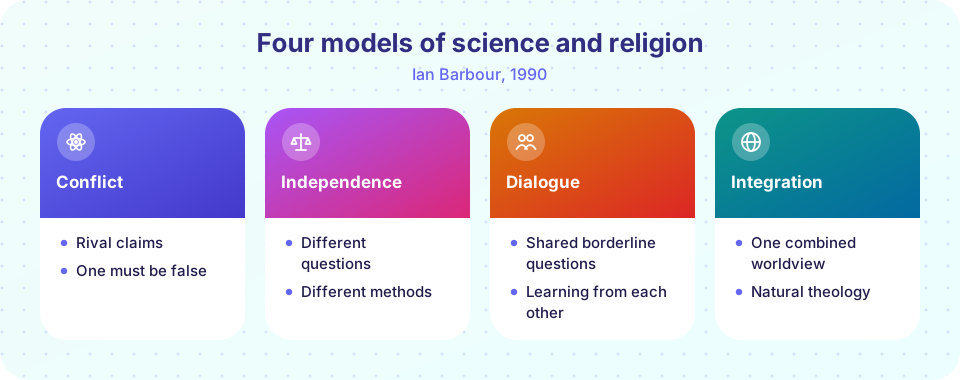
The physicist and theologian Ian Barbour (1923 to 2013) proposed four models in 1990:
- Conflict: science and religion make rival claims, and one must win. Both some atheists and some fundamentalists accept this model.
- Independence: they ask different questions and use different methods. The biologist Stephen Jay Gould's idea of "non-overlapping magisteria" (1997) is a version.
- Dialogue: they share borderline questions, such as why the universe is intelligible, and can learn from each other.
- Integration: they can be combined into a single worldview, as in natural theology or process theology.
Surveys show that views vary by country, by religion and by level of education, and that most people who are religious in many countries are not hostile to science, though there are specific points of conflict.
Common misconceptions
"Religions just give lists of rules." Traditions combine rules, stories, virtues and community practice, and they argue about how to apply them.
"Galileo was persecuted because the church hated science." The case involved scientific, personal and political factors, and many church scholars supported astronomy.
"All religious people reject evolution." Many religious people and some whole denominations accept it; rejection is concentrated in certain groups and countries.
Try it
Check your understanding
Quick check · 5 questions
of 5 answered You scored / 5 · perfect!
-
1. What is the Euthyphro dilemma?
It comes from Plato's Euthyphro and is a standard challenge for divine command theories. -
2. Which Barbour model says science and religion answer different kinds of questions?
Independence holds that the two have separate domains and methods. -
3. What is just war theory?
Just war criteria include just cause, legitimate authority, last resort, proportionality and protection of noncombatants. -
4. Which two books are the main sources of the 'conflict thesis'?
Draper's and White's books popularized the idea that science and religion are in warfare. -
5. What did the Catholic Church say in 1996 about evolution?
The message to the Pontifical Academy of Sciences followed Humani Generis (1950).
Summary
- Traditions ground ethics in revelation and law, reason and natural law, virtue and practice, and compassion, usually in combination.
- Similar ideas, such as the Golden Rule, appear in different forms across traditions.
- Applied topics, such as war, wealth, the environment and life ethics, are debated within traditions.
- The "conflict thesis" is too simple; Barbour's four models describe different relationships.
Next: Chapter review
Track your progress
Create a free account to tick off lessons and pick up where you left off on any device.
of Religious Studies lessons completed