


















Lesson 23 of 46 · Judaism
Judaism: Chapter Overview
A map of Judaism before you dive in: its long history, its sacred texts, the main movements and the rhythm of Jewish life across the week, the year and a lifetime.
Judaism is one of the oldest continuously practiced religions in the world, and one of the smallest in numbers. Roughly 15 million people identify as Jewish today, about 0.2 percent of the world's population. Yet its influence is far larger than its size: Judaism's scriptures, its idea of one God, its ethical teaching and its legal reasoning shaped Christianity and Islam, and they continue to shape debates about law, justice and memory around the world.
This chapter introduces the tradition in three further steps: its texts and beliefs, its movements and practices, and a review. This overview gives you the big picture, so that every later detail has a place to land. As in the rest of the course, the goal is to describe what Jews believe and do in their own terms, to attribute claims to the people who make them, and to leave judgments of truth to the reader.
What you will learn
- The main periods of Jewish history and what changed in each.
- Why Judaism is described as both a religion and a people.
- What each lesson in this chapter covers.
- How to use the vocabulary Jews themselves use (Torah, halakha, mitzvot, Shabbat).
Key terms
Torah: in the narrow sense, the Five Books of Moses; in the wide sense, the whole body of Jewish teaching.
Halakha: Jewish law, literally "the way of walking."
Mitzvah (plural mitzvot): a commandment, and in everyday speech a good deed.
Diaspora: Jewish communities living outside the land of Israel.
Rabbi: a teacher and legal authority, ordained after study; not a priest.
The big picture in five stages
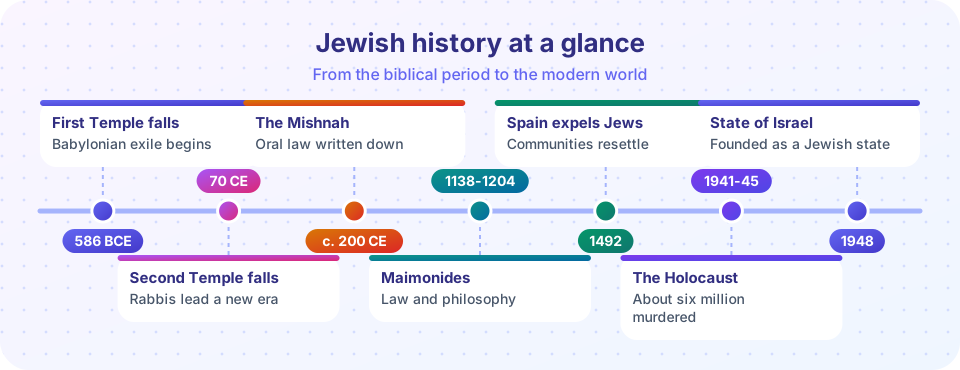
1. The biblical period. The Hebrew Bible tells of Abraham and Sarah, the covenant, the exodus from Egypt, the giving of the Torah at Sinai, the kingdoms of Israel and Judah and the building of the Temple in Jerusalem. How much of this narrative matches events that historians can confirm is debated: archaeologists and historians disagree about the dates and details of the earliest periods, while the tradition itself treats the story as foundational history. Historians are more confident from about the 9th and 8th centuries BCE, when kingdoms of Israel and Judah appear in outside records.
2. Exile and the Second Temple. In 586 BCE the Babylonians destroyed the First Temple and deported many Judeans. After the Persian conquest, Jews returned and built the Second Temple (completed around 516 BCE). This era saw the shaping of the Hebrew scriptures and the emergence of groups such as the Pharisees, Sadducees and Essenes.
3. The Rabbinic era. In 70 CE the Romans destroyed the Second Temple. Temple sacrifice ended and Judaism reorganized around study, prayer and communal life, guided by rabbis. The Mishnah (about 200 CE) and the Talmuds (completed in the following centuries) record this work.
4. Dispersion and the Middle Ages. Jewish communities lived across the Mediterranean, Mesopotamia, Europe and North Africa. In Muslim Spain scholars such as Maimonides produced philosophy, law and poetry; in Christian Europe Jews often faced restrictions, expulsions and violence. Spain expelled its Jews in 1492.
5. The modern world. The Enlightenment and emancipation opened new civil rights in Europe, and with them new movements (Reform, Conservative, Modern Orthodox). The Holocaust (1941 to 1945), the Nazi genocide of about six million Jews, devastated European Jewry. The State of Israel was founded in 1948, and today the two largest Jewish populations live in Israel and the United States.
A people and a religion
Many students expect Judaism to work like other religions: a creed that a person accepts and then joins. That is not quite how Jews usually describe it. Traditional Jewish law treats a person as Jewish if born to a Jewish mother or if they convert through a formal process (Reform Judaism in North America and some other communities also accept descent through a Jewish father when the child is raised Jewish). Because of this, a person can be Jewish by family and culture while holding very different beliefs, or none. Some Jews are devoutly observant, some are secular but strongly identified with Jewish history and food and humor, and some are both at different times of life. This is why scholars speak of Judaism as a religion, a people (am Yisrael, "the people of Israel") and a civilization.
What the chapter covers

Judaism in one minute
Movements
Plus Reconstructionist, Hasidic and others.
The Jewish year
- Texts and beliefs: the Tanakh, the Oral Torah, the Talmud, Maimonides and what Jews hold about God, covenant and the world.
- Movements and practice: Orthodox, Conservative, Reform and others; Shabbat, kosher food, prayer, festivals and the life cycle.
- Review: a one-page recap and a ten-question quiz.
Common misconceptions
"Judaism is the same as Israel." Judaism is a religion and a culture with a history of thousands of years; Israel is a modern state founded in 1948. Many Jews feel a deep connection to the land of Israel, and views about the state's policies vary widely among Jews, as among everyone.
"All Jews practice the same way." Practice ranges from strictly observant to entirely secular, with many positions between.
"The rabbi is like a priest." In Judaism a rabbi is a teacher and legal authority. Priests (kohanim) were Temple officials descended from Aaron, and the title is now mostly inherited and ceremonial.
Try it
Press Run (or Ctrl + Enter) to see the result here.
Program input · what you'd type while the program runs
Type the answers before you press Run, one per line. Each time the program reads a line (with input()), it gets the next line from this box.
Check your understanding
Quick check · 4 questions
of 4 answered You scored / 4 · perfect!
-
1. What happened in 70 CE?
In 70 CE Roman forces destroyed the Second Temple. The Babylonians had destroyed the First Temple in 586 BCE. -
2. Why do scholars often call Judaism both a religion and a people?
Jewish identity is traditionally defined by descent or formal conversion, so a person can be Jewish with varied or no personal beliefs. -
3. What is a rabbi in Judaism?
A rabbi is a trained teacher and legal authority. Priests (kohanim) were Temple officials, and there is no single head of all Jews. -
4. What does halakha mean?
Halakha comes from a Hebrew root meaning to walk or go. It names the whole body of Jewish law and practice.
Summary
- Judaism has a history of roughly three thousand years or more, marked by the Temples, exile, the Rabbinic era, dispersion and the modern world.
- It is understood by Jews as a religion, a people and a civilization.
- The destruction of the Second Temple in 70 CE shifted Judaism toward study, prayer and rabbinic leadership.
- Movements and practices vary widely, from strictly observant to secular.
Next: Texts and beliefs
Track your progress
Create a free account to tick off lessons and pick up where you left off on any device.
of Religious Studies lessons completed