


















Lesson 32 of 46 · Islam and Other Traditions
Islam and Other Traditions: Chapter Overview
A map of the chapter on Islam, Sikhism, the Baha'i Faith, Confucianism, Daoism and Shinto: who founded them, what they teach and how their communities live.
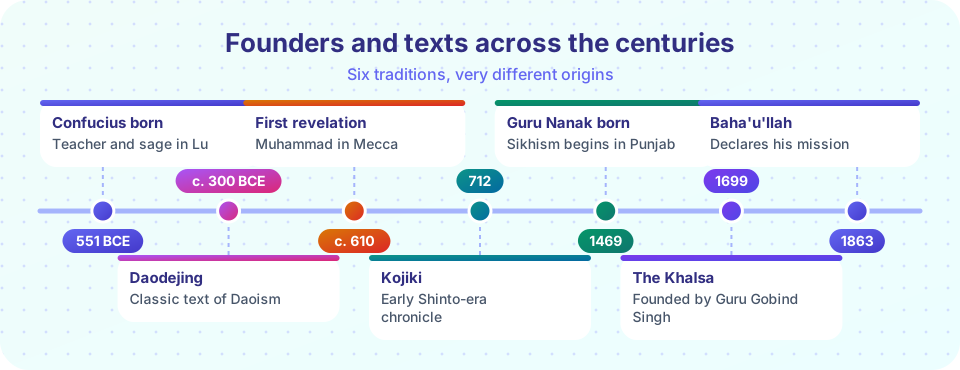
This chapter brings together Islam, the world's second-largest religion, and several other traditions that you will meet often in a study of religion: Sikhism, the Baha'i Faith, Confucianism, Daoism and Shinto. They differ enormously in size, age and character. Islam has roughly two billion followers and began in seventh-century Arabia; Sikhism began in fifteenth-century Punjab; the Baha'i Faith began in nineteenth-century Persia; Confucianism and Daoism took shape in ancient China; Shinto grew in Japan with no known founder.
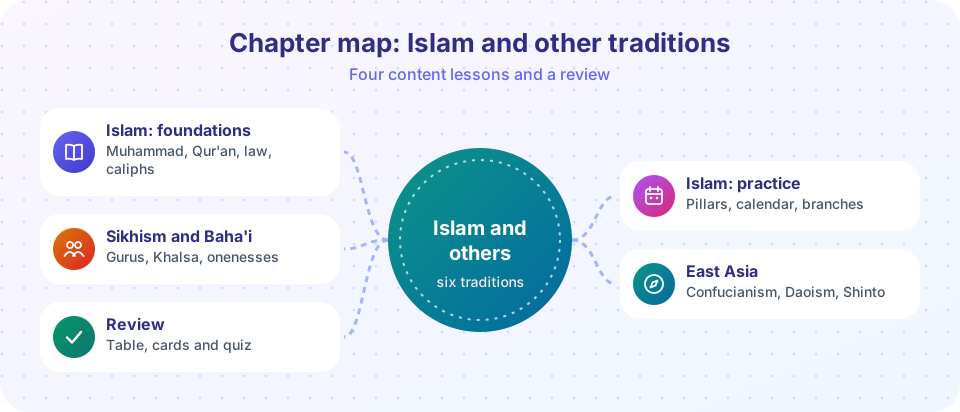
Putting them together does not mean they are alike. The aim is to give you accurate descriptions of what each tradition teaches and practices, in its own terms, and a framework for comparing them fairly. The chapter has four content lessons and a review.
What you will learn
- The origins and basic character of Islam, Sikhism, the Baha'i Faith, Confucianism, Daoism and Shinto.
- How the sizes of these communities compare.
- Why East Asian traditions challenge the idea that a person belongs to just one religion.
- What each lesson of the chapter covers.
Key terms
Monotheism: belief in one God; Islam, Sikhism and the Baha'i Faith are monotheistic.
Revelation: communication of divine truth; a central idea in Islam and the Baha'i Faith.
Scripture: a text treated as sacred; each tradition here has a different central text or none.
Syncretism: the blending of beliefs and practices from different traditions.
Founder religion: a religion associated with a named founder, in contrast to one that grew gradually.
The traditions at a glance
Islam (Arabic for "submission" to God) began with the Prophet Muhammad (about 570 to 632 CE) in Mecca and Medina. Muslims hold that the Qur'an is God's final revelation, given through Muhammad in Arabic. About a quarter of the world's population is Muslim, and Indonesia has the largest Muslim population of any country. Two lessons cover it: foundations and history, then beliefs and practice.
Sikhism was founded by Guru Nanak (1469 to 1539) and led by ten human Gurus; its scripture, the Guru Granth Sahib, is treated as the living Guru. Estimates of its followers run at about 25 to 30 million, most of them in Punjab, India, and in diaspora communities.
The Baha'i Faith arose from the teachings of Baha'u'llah (1817 to 1892), whom Baha'is regard as the latest in a series of divine messengers. Estimates of Baha'is range from about five to eight million worldwide, in nearly every country.
Confucianism, Daoism and Shinto are East Asian traditions that do not fit the common pattern of "one person, one religion." In China, Korea, Vietnam and Japan, a person might honor ancestors in a Confucian way, visit a Daoist temple for a festival and a Buddhist temple for a funeral. Shinto in Japan is a set of practices centered on kami (spirits or sacred powers) and shrines, and many Japanese people take part in Shinto rituals and also in Buddhist ones.
Islam
Sikhism and Baha'i
East Asia
- Islam: foundations and history: Muhammad, the Qur'an, hadith, law and the early caliphates.
- Islam: beliefs, practice and branches: the articles of faith, the five pillars, Sunni, Shia and Sufi Islam.
- Sikhism and the Baha'i Faith: two independent religions of recent centuries.
- East Asian traditions: Confucianism, Daoism and Shinto.
- Review: recap, flashcards and quiz.
Common misconceptions
"These are all branches of one religion." Each is distinct, with its own scripture, history and practice. Sikhism is not a blend of Hinduism and Islam, as scholars and Sikhs stress, and the Baha'i Faith is not a Muslim sect, though it arose from an Islamic context.
"You must belong to exactly one religion." This is common in some traditions, but in East Asia many people draw on more than one. Scholars often use the term "religious participation" rather than "membership" for this reason.
"Size equals importance." The Baha'i Faith and Sikhism are small compared to Islam or Christianity, yet each has a distinctive history and a worldwide presence.
Try it
Press Run (or Ctrl + Enter) to see the result here.
Program input · what you'd type while the program runs
Type the answers before you press Run, one per line. Each time the program reads a line (with input()), it gets the next line from this box.
Press Run (or Ctrl + Enter) to see the result here.
Program input · what you'd type while the program runs
Type the answers before you press Run, one per line. Each time the program reads a line (with input()), it gets the next line from this box.
Check your understanding
Quick check · 4 questions
of 4 answered You scored / 4 · perfect!
-
1. Who founded Sikhism?
Guru Nanak (1469 to 1539) was the first of the ten human Gurus. -
2. What does 'Islam' mean in Arabic?
Islam means submission (to God), and a Muslim is one who submits. -
3. Which statement about East Asian religion is most accurate?
Many people combine Confucian, Daoist, Buddhist and Shinto practices. -
4. Which tradition's scripture is the Guru Granth Sahib?
Sikhs treat the Guru Granth Sahib as the living Guru.
Summary
- Islam, Sikhism, the Baha'i Faith, Confucianism, Daoism and Shinto are distinct traditions with different origins and sizes.
- Islam, with about two billion followers, began in 7th-century Arabia; Sikhism in 15th-century Punjab; the Baha'i Faith in 19th-century Persia.
- East Asian traditions often overlap in a person's life.
- Each should be described in its own terms.
Track your progress
Create a free account to tick off lessons and pick up where you left off on any device.
of Religious Studies lessons completed