


















Lesson 11 of 46 · Indigenous and Ancient Traditions
Indigenous Worldviews and Oral Tradition
Learn how Indigenous traditions connect land, kinship and story, with examples from Aboriginal Australian and Māori traditions, and how colonization shaped their history.
Imagine a worldview in which the land is not a resource but a relative, a story is not entertainment but a map, and an ancestor is not gone but present in a particular hill. For many Indigenous peoples, this is not poetry. It is a way of living in a place that has been continuous for many generations. These worldviews are as varied as the peoples who hold them, but certain patterns recur, and understanding them makes sense of many ceremonies, laws and political struggles today.
This lesson introduces those patterns through examples, while keeping a firm warning in view: there is no single Indigenous religion. There are thousands of peoples, with their own languages and ways of knowing, and any general statement is a simplification. Where possible the lesson names the people being described and speaks of their traditions as they present them.
What you will learn
- Common features of many Indigenous worldviews: land, kinship, story and ceremony.
- Examples from Aboriginal Australian and Māori traditions.
- How oral tradition preserves knowledge and law.
- How colonization affected Indigenous religions, and what repatriation means.
Key terms
Dreaming: an English word often used for Aboriginal Australian understandings of ancestral creation, law and continuing presence in the land; different peoples have their own terms.
Songline: a route across country remembered in song, associated with the journeys of ancestral beings.
Whakapapa: in Māori tradition, genealogy that connects people to ancestors, land and the wider world.
Tapu and mana: in Māori and wider Polynesian thought, tapu is a state of sacredness or restriction and mana is spiritual authority or power.
Repatriation: the return of ancestors' remains or sacred objects to the communities they came from.
Land, kin and story
The land is relational
In many Indigenous worldviews, the land is not a neutral backdrop. It has a history, a name and a personality, and it is related to the people who live there. This explains why a mine, a dam or a road can be experienced as a violation of kin, not only as an economic loss. It also explains why some places are restricted: they may be associated with ceremonies, with ancestors, or with knowledge that only certain people may hold.
Kinship extends beyond humans
Kinship in these traditions often includes animals, plants, rivers and mountains. Obligations run both ways: people care for the land and its beings, and these sustain the people. Scholars sometimes call this a relational ontology, a view of the world in which being is understood in terms of relationships rather than separate objects. Some people, including many Indigenous thinkers, prefer simply to describe how their own peoples speak.
Religion and everyday life are not separate
Most Indigenous languages have no word that matches "religion" as a separate department of life. Ceremony, law, medicine, ecology, politics, art and genealogy overlap. A story about a river may be a record of where to find water, a law about who may fish, and a description of an ancestral being at once.
Two examples
Aboriginal Australian traditions
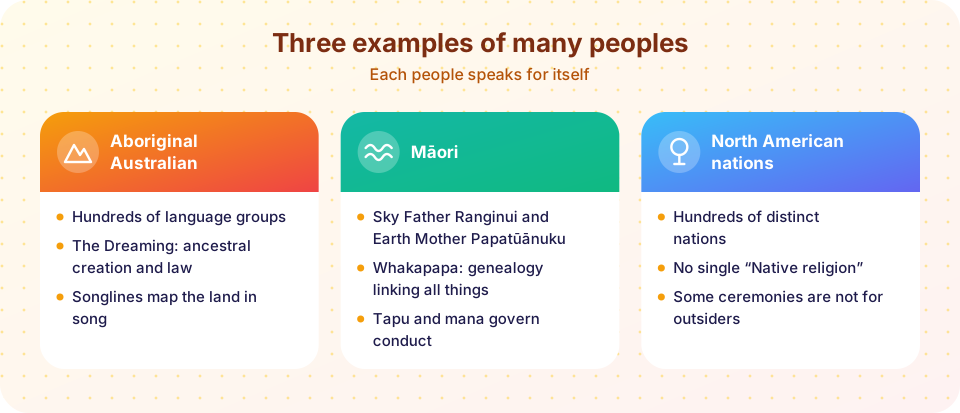
Aboriginal and Torres Strait Islander peoples have inhabited the Australian continent for tens of thousands of years, and archaeological evidence points to occupation of at least 50,000 years. There were, and are, hundreds of distinct language groups. Many share a concept often rendered in English as the Dreaming (or Dreamtime): the period and ongoing reality in which ancestral beings traveled across the land, shaping hills, rivers and waterholes, and establishing the laws and ceremonies of the people. In this understanding, the Dreaming is not simply in the past. It is continuous and is renewed through ceremony.
The ancestral journeys are often remembered as songlines, sequences of songs, stories and landmarks that run across country. Singing the songs in order can guide a traveler across a landscape and can encode knowledge of water sources, seasons and boundaries. Songlines also link different peoples along their route, and rights to sing a song belong to specific groups. This shows how oral tradition can be a system for storing geography, law and religion together.
Māori traditions
The Māori are the Indigenous people of Aotearoa New Zealand. In a widely known Māori account of origins, the Sky Father, Ranginui, and the Earth Mother, Papatūānuku, lay locked in an embrace, and their children lived in darkness between them. The children debated what to do, and one of them, Tāne, forced his parents apart, letting light into the world, while another, Tāwhirimātea, god of winds and weather, opposed the separation. Variations of this story exist among different tribes (iwi).
The idea of whakapapa links this cosmic story to everyday life. A person recites their genealogy to say who they are, which mountain and river they belong to, and which canoe their ancestors came on. Tapu and mana govern conduct: a person or place that is tapu has restrictions and protections, and the contrasting state is noa, the ordinary or common. Meeting houses (wharenui) are often understood as the body of an ancestor, so entering one is entering a relationship, which is why protocols of welcome (powhiri) matter.
The many nations of North America
North America has hundreds of distinct Indigenous nations, each with its own languages, stories and ceremonies. There is no single "Native American religion." Some nations have long ceremonial cycles, some rely on specific sacred places, some emphasize clan relationships and some have new movements that arose after colonization. Many nations ask that certain ceremonies not be photographed, recorded or imitated by outsiders. A fair student of religion respects those requests and relies on what communities choose to share publicly.
Oral tradition as a system
It is a common mistake to think oral cultures simply "forgot" what writing would have kept. Oral traditions use techniques that make accurate transmission possible: song and rhythm, repetition, formal roles for trained keepers, public performance before elders who can correct errors, and a close tie between story and place, so that the land itself acts as a reminder. Scholars have found that some oral traditions preserved accounts of real events, such as sea-level change or volcanic eruptions, over many centuries, though this is evaluated case by case and not assumed. Oral tradition also adapts: the same story can be told differently for different audiences, and this flexibility is part of how it stays alive.
Colonization, loss and revival
From the sixteenth century onward, many Indigenous peoples suffered conquest, disease, loss of land and forced assimilation. Missionaries often condemned local ceremonies, and governments sometimes outlawed them. In the nineteenth and twentieth centuries, various states removed Indigenous children from their families to boarding or residential schools intended to suppress language and religion. Truth and reconciliation processes in Canada and elsewhere have documented the harm. Ceremonial objects and human remains were collected by museums and private collectors.
In recent decades, Indigenous peoples have campaigned for religious freedom, land rights and the return of ancestors and sacred objects. In the United States, the Native American Graves Protection and Repatriation Act (1990) requires federal agencies and museums that receive federal funds to consult with tribes and return certain human remains and cultural items. In 2007 the United Nations adopted the Declaration on the Rights of Indigenous Peoples, which affirms rights to practice and revitalize cultural traditions. Many languages and ceremonies are being revived, and many Indigenous Christians and Muslims integrate their heritage with another faith, which shows that identity and religion do not always line up neatly.
Common misconceptions
"Indigenous peoples worship nature." Most would not describe it so. They speak of relationships with particular places, beings and ancestors, which is not the same as worshiping nature in general.
"Oral traditions are unreliable folklore." Oral traditions are disciplined systems of knowledge, with methods for accuracy. Evaluating their historical content is a scholarly task, like evaluating any source.
"These traditions belong to the past." They are living, changing traditions practiced by millions of people today.
Try it
The first demonstration shows two ways of describing the same river valley. Toggle between a map-and-measurement description and a relational description. It is an illustration of how different worldviews organize the same place, not a description of any real people.
The second demonstration is a simulation (not data about any community). It compares a message retold along a chain of speakers with no checking, and the same message retold with a group of three keepers who correct each other by majority. It illustrates why oral cultures build in cross-checks.
Press Run (or Ctrl + Enter) to see the result here.
Program input · what you'd type while the program runs
Type the answers before you press Run, one per line. Each time the program reads a line (with input()), it gets the next line from this box.
Check your understanding
Quick check · 5 questions
of 5 answered You scored / 5 · perfect!
-
1. What does whakapapa mean in Māori tradition?
Whakapapa is genealogy in a wide sense, connecting people with ancestors and the world. -
2. In Aboriginal Australian traditions, songlines are
Songlines encode journeys of ancestral beings and can store geographic and legal knowledge. -
3. Why is the phrase 'Native American religion' misleading?
North America has hundreds of Indigenous nations, each with its own languages and ceremonies. -
4. What does the U.S. Native American Graves Protection and Repatriation Act (1990) do?
It sets legal procedures for returning certain human remains and cultural items to Native communities. -
5. Which is a mistaken view of oral tradition?
Oral traditions use disciplined techniques; they are not simply failed writing.
Summary
- Many Indigenous worldviews treat land as relational, kinship as extending beyond humans, and story as law and map.
- Examples include the Dreaming and songlines of Aboriginal Australians and whakapapa, tapu and mana among the Māori.
- There is no single Indigenous religion; name the specific people.
- Oral tradition is a disciplined system with its own checks.
- Colonization caused deep harm; repatriation and revival are ongoing.
Track your progress
Create a free account to tick off lessons and pick up where you left off on any device.
of Religious Studies lessons completed