


















Lesson 22 of 46 · Hinduism, Buddhism and Jainism
Chapter 4 Review: Hinduism, Buddhism and Jainism
Review chapter 4: Hinduism's texts, gods and paths, the Buddha's life and teachings, Buddhist schools, and Jainism, with a comparison table, flashcards and a ten-question quiz.
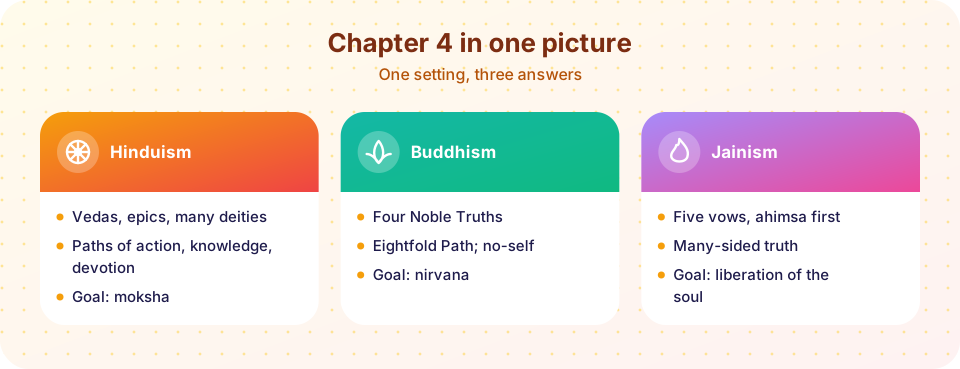
Chapter 4 introduced three traditions that grew up together in South Asia and have shaped billions of lives. You met the Vedas and the Upanishads, the many forms of the divine in Hindu devotion, and the paths of action, knowledge and devotion. You followed the Buddha from Lumbini to Kushinagar and learned the Four Noble Truths, the Eightfold Path, and the three streams of Buddhism. And you studied Jainism's vows, its soul-and-karma metaphysics and the many-sided truth of anekantavada.
What you will learn
- How to compare the three traditions point by point.
- Which terms, names and dates to remember.
- How to avoid confusing them.
Comparison table
| Hinduism | Buddhism | Jainism | |
|---|---|---|---|
| Founder | None (a family of traditions) | Siddhartha Gautama, the Buddha | Mahavira, the 24th Tirthankara |
| Authority | Vedas (shruti), epics, Puranas | Pali Canon and other canons | Agamas; Tattvartha Sutra |
| The self | Eternal atman (many schools) | No permanent self (anatta) | Eternal soul (jiva) |
| Creator god | Varied: many views | Not central | No creator god |
| Karma | Action and its fruits | Intentional action | Subtle matter bound to the soul |
| Goal | Moksha | Nirvana | Moksha (kevala) |
| Ethics | Dharma, ahimsa | Eightfold Path, five precepts | Five vows; ahimsa central |
| Key terms | dharma, samsara, bhakti | dukkha, Three Jewels | anekantavada, Tirthankara |
Ideas worth connecting
Shared setting, different answers. All three accept karma and rebirth, but they disagree about what the self is, how karma works and what liberation is. A precise comparison asks each question separately.
Paths and practice. Hindu paths of action, knowledge and devotion, the Buddhist Eightfold Path and the Jain Three Jewels each combine ethics, understanding and discipline, in different proportions.
Diversity inside traditions. Hinduism includes Vaishnava, Shaiva and Shakta traditions and several philosophical schools. Buddhism includes Theravada, Mahayana and Vajrayana. Jainism has Digambara and Shvetambara sects. Always ask "which one?"
Living tradition. Each continues in India and around the world, adapting to modern questions about caste, gender, science, politics and law.
Common misconceptions
"They all teach the same thing." They share vocabulary but not conclusions. Differences on self, God and liberation are fundamental to each.
"They are peaceful, pure philosophies without history." All have rich, complex histories with institutions, texts, politics and social change.
Try it
Use the flashcards to recall key terms from chapter 4.
The second demonstration builds a side-by-side comparison from a small data table, so you can see how a precise comparison is structured and extend it with your own rows.
Press Run (or Ctrl + Enter) to see the result here.
Program input · what you'd type while the program runs
Type the answers before you press Run, one per line. Each time the program reads a line (with input()), it gets the next line from this box.
Check your understanding
Quick check · 9 questions
of 9 answered You scored / 9 · perfect!
-
1. Which tradition teaches anatta (no permanent self)?
Anatta is a core Buddhist teaching; Hindu schools and Jainism teach an eternal self or soul. -
2. The Bhagavad Gita teaches the paths of
The Gita presents karma, jnana and bhakti yoga. -
3. Which pair is correct?
Shankara taught Advaita; Ramanuja, Vishishtadvaita; Madhva, Dvaita. -
4. Which Buddhist stream is found mainly in Sri Lanka and mainland Southeast Asia?
Theravada, using the Pali Canon. -
5. In Jainism, what is karma?
Jain karma is a subtle substance clinging to the soul. -
6. The three marks of existence in Buddhism are
Anicca, dukkha and anatta. -
7. Who led a mass conversion to Buddhism in 1956?
Ambedkar and hundreds of thousands of followers converted in Nagpur in 1956. -
8. Which sentence best follows the habit of precise comparison?
They share karma and rebirth but disagree about the self and much else. -
9. Anekantavada is best summarized as
It is the Jain teaching of many-sidedness.
Summary
- Hinduism, Buddhism and Jainism share karma, rebirth and liberation but differ on self, gods, authority and path.
- Hindu paths: action, knowledge, devotion; Buddhism: the Eightfold Path and three streams; Jainism: five vows and many-sided truth.
- Compare point by point and always ask which school or sect.
- Chapter 5 begins the Abrahamic traditions with Judaism.
Track your progress
Create a free account to tick off lessons and pick up where you left off on any device.
of Religious Studies lessons completed