


















Lesson 38 of 46 · Religion, Society and Ethics
Religion, Society and Ethics: Chapter Overview
Preview the chapter on religion in society: how scholars explain religion, secularization, law and pluralism, moral reasoning in traditions, and religion and science.
So far you have studied traditions one at a time. This chapter steps back and asks questions that cut across them. Why do societies have religion at all? Is religion declining or changing? How should a state treat people of many faiths and none? Where do religious communities get their moral guidance, and how do they argue about hard cases? What is the relationship between religion and science? These are the questions that appear in news reports, school debates and international law, and they are also the questions around which scholars of religion have built whole fields of research.
The chapter has two content lessons and a review. As in the rest of the course, the aim is balanced description: to present the main theories and positions fairly, to attribute them to the people who hold them and to be clear about what evidence supports each.
What you will learn
- The main questions of this chapter and how scholars approach them.
- The difference between describing religion and judging it.
- How church-state arrangements vary around the world.
- What each lesson in the chapter covers.
Key terms
Secularization: the idea that religion loses social influence or personal importance as societies change.
Pluralism: the condition of many religions and worldviews living side by side.
Secularism: a political principle about the relation between religion and state; it takes different forms.
Ethics: reasoned reflection on right and wrong, including the moral teachings of religions.
Empirical: based on observation and evidence.
The questions
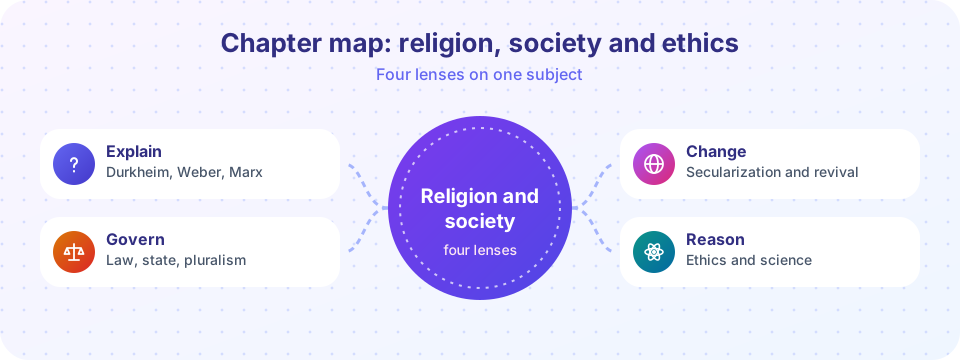
Explaining religion. Sociologists, anthropologists and psychologists have offered theories of why religion exists and what it does. Durkheim saw it as the way a community expresses its shared life; Weber studied how religious ideas shape economic behavior and authority; Marx saw it as bound up with social conditions. These theories are tools: each lights up some features and misses others.
Secularization and change. Some scholars predicted that modernization would lead religion to fade. In parts of Europe church attendance has indeed dropped steeply, but in much of the world religion remains strong or growing, and in many places it changes form rather than disappears. Debates about this shape what we expect from the future.
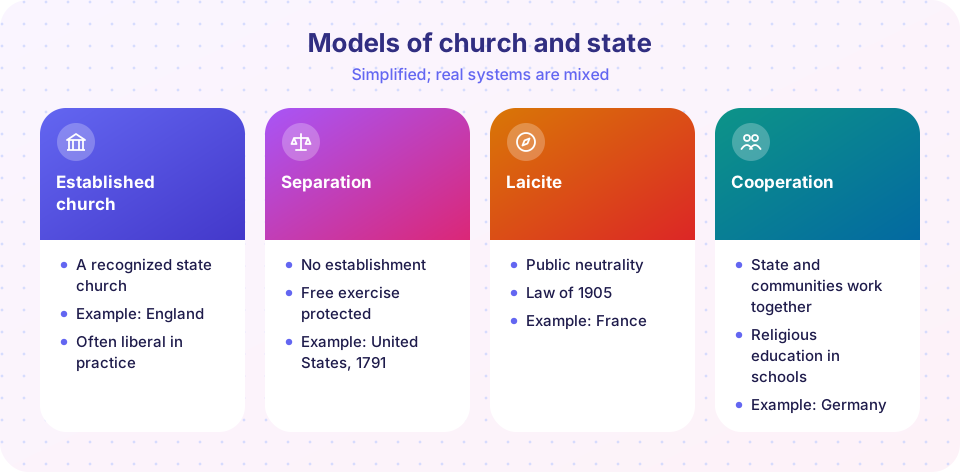
Law, state and pluralism. Countries vary in how they relate to religion: some have an established church, some a strict separation, some cooperation. The international right to freedom of religion or belief was set out in Article 18 of the Universal Declaration of Human Rights (1948). How it works in practice, for example with dress, schooling or holidays, is a matter of ongoing debate.
Ethics. Religious traditions teach about how to live, and they ground that teaching in revelation, law, tradition, reason or practice. Within each tradition there are debates about new questions, from war to medicine to the environment, and a person's moral reasoning often draws on several sources at once.
Science. Historians and philosophers have described several relationships between religion and science, from conflict to dialogue. The popular story of permanent warfare is now widely seen as too simple.
Four lenses
How to read a theory
- Religion and society: classic theories, secularization, pluralism, and religion, law and conflict.
- Ethics and science: moral reasoning in traditions, applied debates, and models of the science-religion relationship.
- Review: summary, flashcards and quiz.
Common misconceptions
"Studying religion means taking a side." The academic study of religion describes and compares; it does not ask the reader to believe or disbelieve. It also does not claim that religion is false or true.
"Secular means anti-religious." Secularism has several meanings. In many countries it means that the state is neutral among religions, and religious people may support it for that reason.
Try it
Press Run (or Ctrl + Enter) to see the result here.
Program input · what you'd type while the program runs
Type the answers before you press Run, one per line. Each time the program reads a line (with input()), it gets the next line from this box.
Check your understanding
Quick check · 3 questions
of 3 answered You scored / 3 · perfect!
-
1. What does the study of religion aim to do?
The academic study of religion describes and compares traditions and attributes beliefs to believers. -
2. Which document set out freedom of religion or belief in Article 18 in 1948?
Article 18 of the Universal Declaration of Human Rights (1948) protects freedom of thought, conscience and religion. -
3. 'Secular' always means 'against religion'.
Secularism has several meanings, and in many countries it refers to a neutral state.
Summary
- The chapter asks cross-cutting questions: why religion exists, whether it declines, how states handle pluralism, how traditions reason morally and how religion relates to science.
- Theories are tools, each with strengths and limits.
- Countries differ in church-state arrangements.
Next: Religion and society
Track your progress
Create a free account to tick off lessons and pick up where you left off on any device.
of Religious Studies lessons completed