


















Lesson 36 of 46 · Islam and Other Traditions
East Asian Traditions: Confucianism, Daoism and Shinto
Meet Confucianism, Daoism and Shinto: Confucius and virtue, the Daodejing and the Way, and Japan's kami and shrines, plus how people combine traditions in East Asia.
If you ask a person in Japan what religion they follow, you may hear "none," even though they visit a Shinto shrine at New Year, hold a Buddhist funeral for a relative and say grace before meals. In China, a family may honor ancestors in a way shaped by Confucian ideas, consult a Daoist priest about a festival date and make offerings at a Buddhist temple. These facts show why a Western-style question, "Which one religion do you belong to?", fits East Asia poorly. Many people take part in several traditions and see no conflict.
This lesson introduces three traditions that are central to East Asian culture: Confucianism, Daoism and Shinto. Buddhism, which is also important in the region, is covered elsewhere in this course. As always, the descriptions give each tradition's own account, and where scholars disagree the lesson says so.
What you will learn
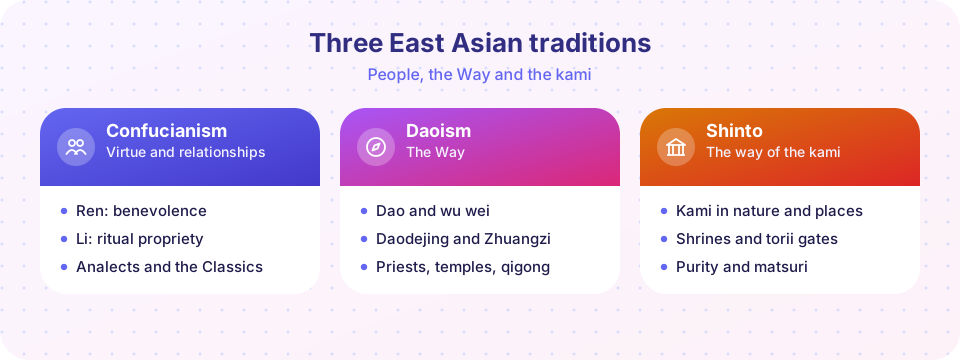
- The life and teachings of Confucius, and key Confucian ideas such as ren, li and filial piety.
- The core ideas of philosophical and religious Daoism.
- What Shinto is: kami, shrines, purification and festivals.
- Why scholars debate whether Confucianism is a religion, and why "belonging" is complicated in East Asia.
Key terms
Ren: humaneness or benevolence, the central Confucian virtue.
Li: ritual propriety, the correct forms of conduct that express respect.
Dao (Tao): "the Way": the underlying pattern of the universe in Daoism.
Wu wei: "non-forcing," acting in harmony with the natural flow instead of against it.
Kami: the sacred powers or spirits honored in Shinto, found in nature, ancestors and places.
Confucianism
Confucius (Kong Fuzi, 551 to 479 BCE) lived in the state of Lu in a period of political disorder. He was a teacher who hoped to restore harmony by cultivating moral character, in himself and in rulers. His sayings were collected by his disciples in the Analects. Confucius said he was a transmitter, not a creator: he drew on the ancient rites and texts of the Zhou dynasty, which are known as the Classics.
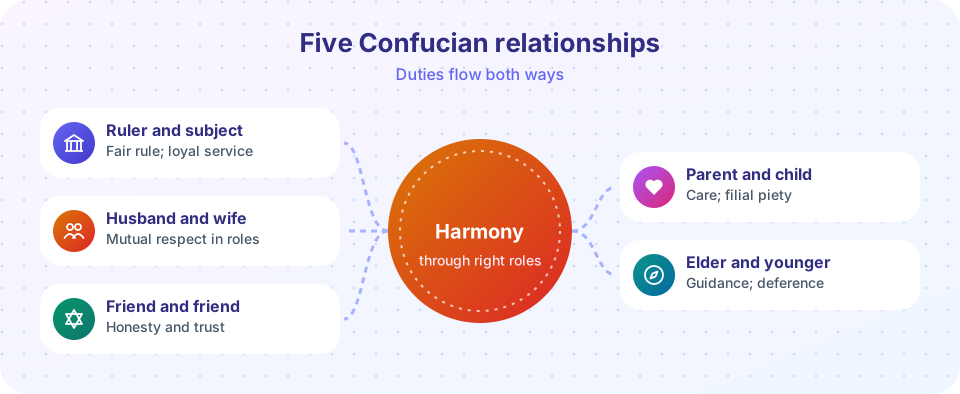
Key ideas. The central virtue is ren, often translated as benevolence or humaneness, a care for others that grows from family relationships and extends outward. Li, ritual propriety, covers ceremonies as well as everyday manners, and is how respect is shown. Xiao (filial piety) means respect and care for parents and ancestors. Confucian thought describes five key relationships: ruler and subject, parent and child, husband and wife, elder and younger sibling, and friend and friend. In each, there are duties on both sides, and a harmonious society results when people fulfil their roles. The ideal person is the junzi, the "exemplary person," who cultivates virtue through study and self-reflection. A saying attributed to Confucius, "Do not impose on others what you do not wish for yourself" (Analects 15:24), is often compared with the Golden Rule in other traditions.
Later development. Mencius (about 372 to 289 BCE) taught that human nature is inherently good, and needs nurture; Xunzi (about 310 to 235 BCE) argued that people are born with selfish tendencies and need education and ritual to become good. During the Han dynasty (206 BCE to 220 CE), Confucian learning became the basis for state education. From the Sui and Tang dynasties onward, and until 1905, the civil-service examinations tested knowledge of the Confucian classics, shaping Chinese society for a thousand years. Neo-Confucianism, led by Zhu Xi (1130 to 1200), combined the classics with metaphysical ideas and became the state orthodoxy in later China, Korea, Japan and Vietnam.
Is it a religion? Confucianism has no priesthood, no single deity and no creed, yet it includes ritual (ancestor rites, temple ceremonies for Confucius) and a vision of cosmic order. Some scholars treat it as an ethical philosophy, others as a religion, and others use terms such as "a way of life" or "a civil religion." Many Confucian scholars in China, Korea and the West reject the choice, noting that the categories of "religion" and "philosophy" developed in the West.
Daoism
Texts. Daoism (Taoism) draws on two classic books. The Daodejing, traditionally attributed to Laozi ("the Old Master"), is a short collection of poetic sayings about the Dao and its power (de). Most scholars date it to about the 4th to 3rd century BCE and doubt that Laozi was a single historical author. The Zhuangzi, from the 4th century BCE and attributed to Zhuangzi, is a witty collection of stories and arguments about freedom, relativity and spontaneity.
Key ideas. The Dao is the source and pattern of all things, beyond words ("The Dao that can be spoken is not the constant Dao," begins the Daodejing). Humans flourish by following wu wei, acting without forcing, as water finds its way around stones. Yin and yang describe complementary forces, like dark and light, that depend on each other, and qi is the vital energy that flows through the cosmos and the body. Daoist writers criticize rigid rules and ambition and value simplicity, humility and spontaneity, which makes an interesting contrast with Confucian emphasis on ritual and duty. Yet in practice the two traditions often coexist.
Religious Daoism. Beyond philosophy there is an organized religion. The Celestial Masters movement, traditionally traced to Zhang Daoling in 142 CE, founded a community with priests, rituals and a Daoist canon. Daoist priests perform rites for communities, such as festivals and funerals; temples honor gods and immortals; and practices include meditation, breath control, diet, alchemy (the pursuit of long life or immortality) and the martial and healing arts known as qigong and tai chi. Daoist temples and monasteries exist throughout China, and Daoism is also practiced in Taiwan and in Chinese communities worldwide.
Shinto
What it is. Shinto ("the way of the kami") is the indigenous religious tradition of Japan. It has no founder, no single scripture and no formal creed. It centers on kami, a word that covers gods of mountains, rivers and trees, ancestral spirits, deified people and deities of clans and places. Believers do not so much "believe in" kami as live in relationship with them, through rituals at home and at shrines. The oldest written accounts are the Kojiki (712 CE) and the Nihon Shoki (720 CE), which mix myth and early imperial history; in them, the sun goddess Amaterasu is the ancestor of the imperial family. Her main shrine is at Ise.
Practice. A shrine (jinja) is marked by a gate called a torii. Visitors rinse their hands and mouth, bow, offer a coin, clap twice and pray. Central themes are purity (harae, ritual cleansing, and misogi, purification with water) and avoiding pollution (kegare). People buy amulets and write wishes on wooden plaques (ema). Seasonal festivals (matsuri) feature processions, music and dance. Life-cycle events such as a newborn's first shrine visit and the "seven-five-three" festival for children are often held at shrines, while many funerals follow Buddhist rites.
History. For centuries Shinto and Buddhism were intertwined: Buddhist temples and Shinto shrines shared compounds, and kami were often seen as protectors of the Buddha's teaching. In 1868 the Meiji government ordered their separation and, from then until 1945, promoted "State Shinto" tied to the emperor and the nation. After Japan's defeat in 1945, the Allied occupation ended state sponsorship, and Shinto became a voluntary religion supported by shrines and communities. Today Japan has tens of thousands of shrines, and surveys show that many people visit them while saying they are not religious.
Overlap and "belonging"
In China, Korea and Vietnam the "three teachings" of Confucianism, Daoism and Buddhism have long blended with each other and with local folk religion, which includes ancestor veneration, local gods and festivals. In Japan, Shinto, Buddhism and Confucian ethics coexist. Scholars sometimes describe a person's practice as "diffuse," woven into daily life and family. Statistics about the size of Confucianism, Daoism or Shinto are therefore very uncertain, because it depends on whether one counts practice, belief, identification or membership.
Common misconceptions
"Daoism is just a philosophy of relaxation." Daoism includes philosophy, but also priests, temples, rituals and a large body of religious texts.
"Confucius was a god or the founder of a church." Confucius was a teacher, and later honored as a sage. Temples to him exist, but he is not worshipped as a creator god.
"Shinto is a branch of Buddhism, or entirely about the emperor." Shinto has its own long history; its association with the emperor was strongest in the State Shinto period, from 1868 to 1945.
Try it
Check your understanding
Quick check · 5 questions
of 5 answered You scored / 5 · perfect!
-
1. What is ren in Confucian thought?
Ren is the central virtue of humaneness; li is ritual propriety. -
2. What does wu wei mean?
Wu wei, often translated 'non-action,' means effortless action in accord with the Dao. -
3. What are kami?
Kami are the sacred powers found in nature, ancestors and places. -
4. What happened to Shinto in 1945?
State Shinto (1868 to 1945) ended under the Allied occupation. -
5. Why do scholars find it hard to count Confucians or Daoists?
Practice overlaps and belonging is diffuse, so counts depend on definitions.
Summary
- Confucianism stresses ren, li, filial piety and learning; Confucius (551 to 479 BCE) is its teacher, not a god.
- Daoism follows the Dao and wu wei, in philosophical texts and in a religion with priests and temples.
- Shinto centers on kami, shrines, purification and festivals; it has no founder.
- Many East Asians draw on several traditions, so "belonging" is hard to measure.
Track your progress
Create a free account to tick off lessons and pick up where you left off on any device.
of Religious Studies lessons completed