


















Lesson 17 of 46 · Hinduism, Buddhism and Jainism
Hinduism: Foundations
An introduction to Hinduism: its names and diversity, the Vedas, Upanishads and epics, major deities, and core ideas of dharma, karma, samsara and moksha.
Hinduism is among the oldest living religious traditions and has about 1.2 billion followers, most of them in India and Nepal, with large communities in Southeast Asia, East Africa, the Caribbean, North America, Europe and elsewhere. It is also one of the hardest traditions to summarize, because it has no single founder, no single creed, no central authority and no one scripture that all Hindus use in the same way. It is better described as a family of related traditions, with shared texts, ideas, practices and festivals, and enormous variation among regions, castes, sects and individuals.
This lesson introduces the vocabulary and big ideas that most Hindu traditions share. As always, "Hindus believe" is a risky phrase; the lesson describes what many Hindus hold and where there is variety.
What you will learn
- Why "Hinduism" is a family of traditions and what the word means.
- The main texts: Vedas, Upanishads, epics and Puranas.
- The principal deities and the idea of one reality with many forms.
- Dharma, karma, samsara and moksha, and the four goals of life.
- How caste is understood and contested.
Key terms
Veda: "knowledge"; the oldest Hindu scriptures, regarded by many as shruti (revealed, heard).
Atman and Brahman: the self, and the ultimate reality that underlies the universe; the relation between them is interpreted differently by different schools.
Murti: an image or statue of a deity in which the deity is understood to be present for worship.
Puranas: a large body of later texts of myth, cosmology and devotion.
Varna and jati: the classical fourfold social order, and the many local birth groups commonly called castes.
Names and shape
The word Hindu comes from Sindhu, the Sanskrit name of the Indus river; Persian and Greek writers used it for the people living beyond the Indus, and the term later became a religious label. Many Hindus call their tradition Sanatana Dharma, "the eternal way." The tradition's history is long and layered. Some scholars point to links with the Indus Valley civilization (about 2600 to 1900 BCE), though this is debated. The Vedic religion, with its fire sacrifices to gods such as Agni and Indra, formed in northern India in the second millennium BCE. Later developments include the philosophical Upanishads, the great epics, devotional movements, regional temple cults and modern reform movements.
Texts
Hindu texts are divided in a broad classification already met in chapter 2.
- Shruti ("heard") includes the four Vedas: the Rigveda (hymns), Samaveda (chants), Yajurveda (sacrificial formulas) and Atharvaveda (spells and hymns). Each Veda has layers: hymns (samhitas), ritual commentaries (Brahmanas), forest texts (Aranyakas) and the philosophical Upanishads, which explore the self and ultimate reality.
- Smriti ("remembered") includes the epics, law books and Puranas. The Mahabharata, a vast epic about a dynastic war, contains the Bhagavad Gita, a dialogue between the warrior Arjuna and Krishna on duty, action and devotion, which is among the most widely read Hindu texts. The Ramayana, which tells of Rama, his wife Sita and the demon king Ravana, is beloved across South and Southeast Asia and is told in countless regional versions. The Puranas tell of the gods, creation and the great cycles of time.
Gods and one reality
Hindu worship includes many deities, which leads outsiders to call it polytheistic. Many Hindus, however, understand the many deities as forms or aspects of one ultimate reality (Brahman), while others emphasize devotion to one chosen deity (ishta-devata), and some are atheistic or non-theistic in philosophy. A neutral way to put it: Hindu traditions combine plurality of gods with various views of unity.
Major strands of devotion center on:
- Vishnu, the preserver, and his avatars (descents), especially Rama and Krishna (Vaishnavism).
- Shiva, the ascetic and transformer, often worshiped in the form of the linga and with his family, including Ganesha, the elephant-headed remover of obstacles (Shaivism).
- Devi, the Goddess, in forms such as Durga, Lakshmi and Kali (Shaktism).
- Many other regional and village deities, and also Hanuman, the devoted servant of Rama.
Some Hindus describe a trio of cosmic functions, creation (Brahma), preservation (Vishnu) and destruction or transformation (Shiva), known as the Trimurti, though worship of Brahma is rare compared with the others.
Four central ideas
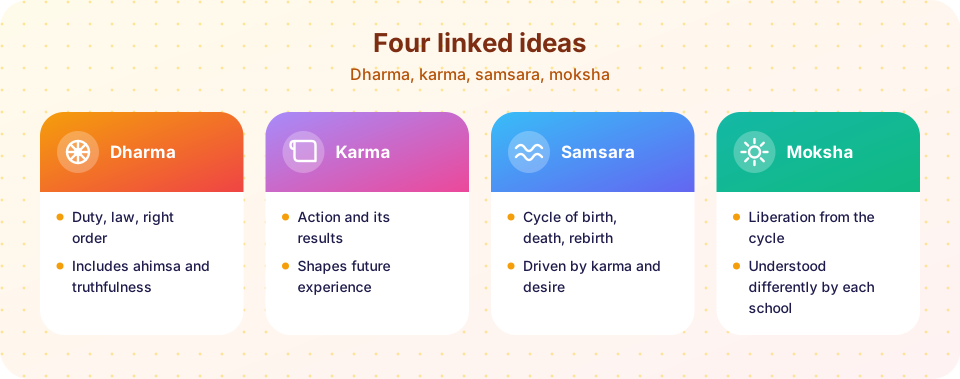
Dharma is a word with many meanings: duty, law, righteousness, the proper order of things. In the Hindu context it includes the duties that belong to one's stage of life and social position (svadharma), as well as universal virtues such as truthfulness and non-violence (ahimsa).
Karma means action and its results. Good and bad actions are understood to shape future experiences, in this life and the next.
Samsara is the cycle of birth, death and rebirth, driven by karma and desire.
Moksha is liberation from samsara. Different schools describe it differently: union with or realization of identity with Brahman, eternal devotion in the presence of a personal god, or freedom of the self from matter.
The four goals and four stages
Classical Hindu thought speaks of four aims of human life (purusharthas): dharma (right conduct), artha (material welfare), kama (pleasure and love) and moksha (liberation). It recognizes that people legitimately pursue wealth and pleasure, but within the bounds of dharma and with liberation as the ultimate aim. An idealized scheme of four life stages (ashramas) places these aims in sequence: student, householder, forest-dweller or retiree, and renunciant. Real lives, of course, do not follow the model strictly.
Caste
Classical texts describe four social classes (varna): priests (Brahmins), rulers and warriors (Kshatriyas), traders and farmers (Vaishyas) and servants (Shudras). In practice, society was organized into thousands of local birth groups, jatis, and a large group of people was treated as outside the system and suffered discrimination as "untouchables." Many Hindu reformers, including some medieval devotional poets and modern thinkers, rejected caste hierarchy. B. R. Ambedkar (1891 to 1956), a Dalit leader who chaired the committee that drafted India's constitution, campaigned against untouchability and in 1956 converted to Buddhism with hundreds of thousands of followers. India's constitution (1950) outlaws untouchability and caste-based discrimination, but caste remains a living social reality, and Hindus disagree about its relationship to their religion. Scholars discuss caste as a social institution with religious justifications, not just a religious doctrine.
Common misconceptions
"Hindus worship thousands of idols." Many Hindus say they worship God (or a deity) through an image in which the deity is present, and many understand their deities as aspects of one reality. The relationship between image and deity is a matter of theology, not simple idolatry.
"Karma means fate." In most Hindu thought karma concerns the consequences of one's own actions, which one can influence by present choices. It is not usually described as blind fate.
"Hinduism is a religion of cows and caste." The cow is honored in many Hindu communities as a symbol of gentleness and nourishment, and caste is a social reality, but neither defines the vast range of Hindu belief and practice.
Try it
The first demonstration is a deity explorer. Click a deity to see its associations. The associations are widely held but are not universal; many communities have their own emphases.
The second demonstration lays out the classical four life stages as an idealized timeline. It is a textbook model of an ideal, not a description of how people actually live.
Press Run (or Ctrl + Enter) to see the result here.
Program input · what you'd type while the program runs
Type the answers before you press Run, one per line. Each time the program reads a line (with input()), it gets the next line from this box.
Check your understanding
Quick check · 5 questions
of 5 answered You scored / 5 · perfect!
-
1. What does the word Hindu originally derive from?
Hindu comes from Sindhu, the Sanskrit name of the Indus river. -
2. Which text is part of the Mahabharata and records a dialogue between Arjuna and Krishna?
The Gita is a section of the Mahabharata. -
3. What are the four purusharthas?
Right conduct, material welfare, pleasure and love, and liberation. -
4. Samsara refers to
Samsara is the cycle of rebirth driven by karma and desire. -
5. Who led a mass conversion to Buddhism in 1956 and helped draft India's constitution?
Ambedkar, a Dalit leader, converted in 1956 and campaigned against untouchability.
Summary
- Hinduism is a family of traditions with no single founder or creed; many Hindus call it Sanatana Dharma.
- Texts include the Vedas and Upanishads (shruti) and the epics and Puranas (smriti), with the Bhagavad Gita among the best known.
- Many deities are understood as forms of one reality; Vishnu, Shiva and Devi traditions are major streams.
- Dharma, karma, samsara and moksha, and the four goals of life, frame much of Hindu thought.
- Caste is a contested social reality with religious justifications and many critics, including Ambedkar.
Next: Hindu Paths and Practice
Track your progress
Create a free account to tick off lessons and pick up where you left off on any device.
of Religious Studies lessons completed