A one-page recap of Judaism, Christianity, Islam, Sikhism, the Baha'i Faith and East Asian traditions: origins, texts, worship, calendars, key dates and the habits of fair description.
When you revise, you do not need every detail on every page: you need a clear map you can hold in your head. This cheat sheet puts the second half of the course on a few pictures and lists. It is not a replacement for the lessons, but it shows what to remember and where to look when you cannot.
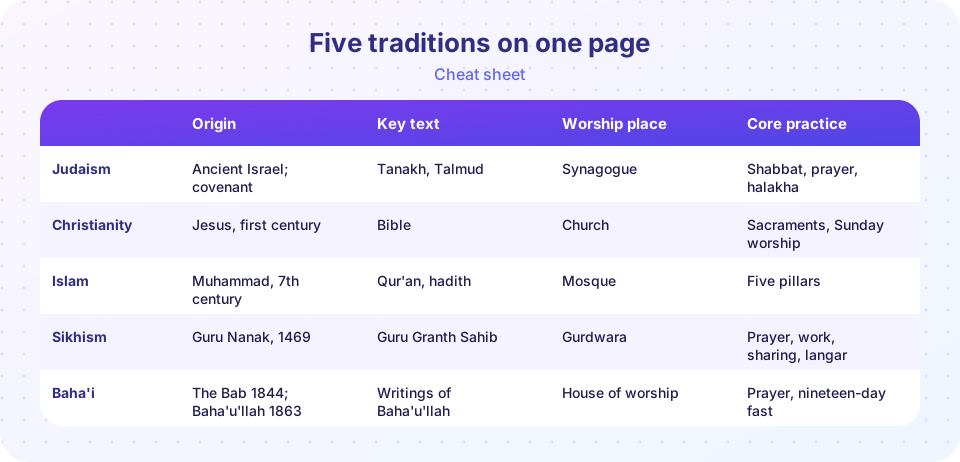
The table above gives the starting point. Add these reminders. Judaism is a people and a religion, with the Tanakh and the Talmud as its core texts, a law (halakha) of 613 mitzvot in tradition and several movements. Christianity is centered on Jesus as the Christ, the Bible and the creeds, with three great families of churches. Islam centers on tawhid, the Qur'an and the sunnah, the five pillars and two main branches, Sunni and Shia, with Sufism as a mystical path. Sikhism is built on one God, the ten Gurus and the Guru Granth Sahib, with service and equality as ideals. The Baha'i Faith teaches the oneness of God, religion and humanity and is organized through elected councils.
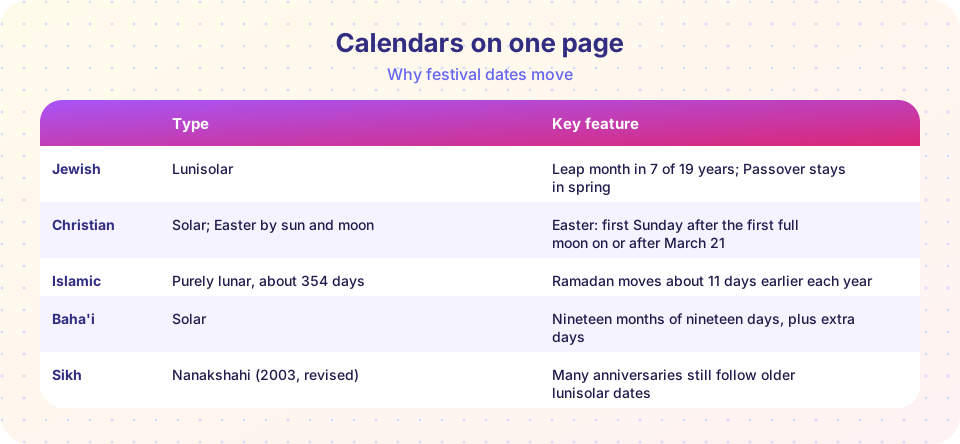
Caption: Different calendars explain why festival dates move.
The big idea is simple. A lunar year is about 11 days shorter than a solar year. A calendar that never adjusts, like the Islamic one, drifts through the seasons. A lunisolar calendar, like the Jewish one, adds leap months so that festivals stay in season. The Christian calendar is fixed to the sun for Christmas and tied to both sun and moon for Easter. The Baha'i calendar is solar, with nineteen months of nineteen days. The Sikh Nanakshahi calendar (introduced in 2003 and later revised) is solar, but many Sikh anniversaries are still observed by older lunisolar dates, so Sikh dates are best checked each year.
586 BCE The Babylonians destroy the First Temple. 70 CE The Romans destroy the Second Temple. About 200 CE The Mishnah is edited.
About 30 CE Jesus is crucified. About 50 CE Paul writes his letters. 313 Edict of Milan. 325 Nicaea. 451 Chalcedon. 1054 East-West split (traditional date). 1517 Luther's 95 Theses.
About 570 Muhammad born. About 610 First revelation. 622 The Hijra. 632 Muhammad dies. 750 Abbasids take power. 1258 Mongols sack Baghdad.
1469 Guru Nanak born. 1604 The first Sikh scripture completed. 1699 The Khalsa founded. 1708 The Guru Granth Sahib becomes the Guru.
1844 The Bab's declaration. 1863 Baha'u'llah's declaration. 1892 Baha'u'llah dies. 1963 First Universal House of Justice.
551 BCE Confucius born. About 300 BCE The Daodejing. 712 Kojiki. 1868 to 1945 State Shinto in Japan.
1948 Universal Declaration of Human Rights; State of Israel declared.
<style>:root{--ink:#1e1b4b;--mut:#475569;--bg1:#faf5ff;--bg2:#eff6ff;--ac:#6366f1;--ac2:#ec4899}@media(prefers-color-scheme:dark){:root{--ink:#e0e7ff;--mut:#a5b4fc;--bg1:#1e1b4b;--bg2:#1e293b}}*{box-sizing:border-box}body{margin:0;padding:14px;font-family:system-ui,-apple-system,'Segoe UI',sans-serif;color:var(--ink);background:linear-gradient(135deg,var(--bg1),var(--bg2));min-height:100vh}h3{margin:0 0 4px;font-size:17px}.sub{margin:0 0 12px;color:var(--mut);font-size:13px}.card{background:#fff;color:#1e1b4b;border-radius:18px;padding:16px 18px;box-shadow:0 10px 24px rgba(67,56,202,.15)}button{font:inherit;cursor:pointer;border:0;border-radius:999px;padding:8px 14px;background:linear-gradient(135deg,#6366f1,#4338ca);color:#fff;font-weight:600;font-size:14px}button.ghost{background:#eef2ff;color:#312e81}button.on{background:linear-gradient(135deg,#a855f7,#db2777);color:#fff}.row{display:flex;flex-wrap:wrap;gap:8px;margin-bottom:12px}.muted{color:#475569;font-size:14px}.big{font-size:19px;font-weight:700}</style><h3>Cheat sheet flashcards</h3><pclass="sub">Click the card to flip it. Mark whether you knew it.</p><divid="c"class="card"style="min-height:130px;cursor:pointer;display:flex;flex-direction:column;justify-content:center;text-align:center"><divid="t"class="muted"></div><divid="x"class="big"></div></div><divclass="row"style="margin-top:12px"><buttonclass="ghost"id="p">Previous</button><buttonclass="ghost"id="n">Next</button><buttonclass="ghost"id="s">Shuffle</button><buttonid="k">I knew it</button></div><divclass="muted"id="st"></div><script>varD=[["Which calendar drifts through the seasons?","The Islamic Hijri calendar, which is purely lunar (about 354 days)"],["Which calendar adds a leap month in 7 of 19 years?","The Jewish lunisolar calendar"],["How many months does the Baha'i calendar have?","Nineteen months of nineteen days, plus intercalary days"],["Key date for the Khalsa","1699"],["Key date for the Hijra","622 CE"],["Key date for Nicaea","325 CE"],["Key date for the Mishnah","About 200 CE"],["The Baha'i fast","Nineteen days, March 2 to 20, in daylight"],["Two main Islamic branches","Sunni and Shia"],["The Sikh scripture","Guru Granth Sahib, 1,430 pages"]],i=0,f=false,known=0,seen={};functionshow(){document.getElementById('t').textContent=(f?'Answer':'Question')+' '+(i+1)+' of '+D.length;document.getElementById('x').textContent=D[i][f?1:0];document.getElementById('st').textContent='Marked as known: '+known+' of '+D.length;}
document.getElementById('c').onclick=function(){f=!f;show()};
document.getElementById('n').onclick=function(){i=(i+1)%D.length;f=false;show()};
document.getElementById('p').onclick=function(){i=(i+D.length-1)%D.length;f=false;show()};
document.getElementById('s').onclick=function(){for(var a=D.length-1;a>0;a--){var b=Math.floor(Math.random()*(a+1));var t=D[a];D[a]=D[b];D[b]=t}i=0;f=false;show()};
document.getElementById('k').onclick=function(){if(!seen[D[i][0]]){seen[D[i][0]]=1;known++}show()};show();</script>
Which tradition?
<style>:root{--ink:#1e1b4b;--mut:#475569;--bg1:#faf5ff;--bg2:#eff6ff;--ac:#6366f1;--ac2:#ec4899}@media(prefers-color-scheme:dark){:root{--ink:#e0e7ff;--mut:#a5b4fc;--bg1:#1e1b4b;--bg2:#1e293b}}*{box-sizing:border-box}body{margin:0;padding:14px;font-family:system-ui,-apple-system,'Segoe UI',sans-serif;color:var(--ink);background:linear-gradient(135deg,var(--bg1),var(--bg2));min-height:100vh}h3{margin:0 0 4px;font-size:17px}.sub{margin:0 0 12px;color:var(--mut);font-size:13px}.card{background:#fff;color:#1e1b4b;border-radius:18px;padding:16px 18px;box-shadow:0 10px 24px rgba(67,56,202,.15)}button{font:inherit;cursor:pointer;border:0;border-radius:999px;padding:8px 14px;background:linear-gradient(135deg,#6366f1,#4338ca);color:#fff;font-weight:600;font-size:14px}button.ghost{background:#eef2ff;color:#312e81}button.on{background:linear-gradient(135deg,#a855f7,#db2777);color:#fff}.row{display:flex;flex-wrap:wrap;gap:8px;margin-bottom:12px}.muted{color:#475569;font-size:14px}.big{font-size:19px;font-weight:700}</style><h3>Which tradition?</h3><pclass="sub">Choose the best category for each item. You get feedback straight away.</p><divclass="card"><divclass="big"id="q"></div><divclass="row"id="b"style="margin-top:12px"></div><divid="f"class="muted"></div></div><divclass="muted"style="margin-top:10px"id="sc"></div><script>varCA=["Judaism","Christianity","Islam","Sikhism","Baha'i Faith"],IT=[["Talmud and halakha","Judaism","The core of rabbinic law."],["Nicene Creed","Christianity","Formulated in 325 and 381."],["Five pillars","Islam","Shahada, salat, zakat, sawm, hajj."],["Five Ks and the Khalsa","Sikhism","Founded in 1699."],["Universal House of Justice","Baha'i Faith","A nine-member elected body in Haifa."],["Passover seder","Judaism","Retells the exodus."],["Lent and Easter","Christianity","Forty days before Easter."],["Ramadan","Islam","Fasting in the ninth month."]],i=0,ok=0,done=false;var b=document.getElementById('b');CA.forEach(function(c){var x=document.createElement('button');x.className='ghost';x.textContent=c;x.onclick=function(){pick(c)};b.appendChild(x)});functionshow(){if(i>=IT.length){document.getElementById('q').textContent='Finished';b.style.display='none';document.getElementById('f').textContent='You matched '+ok+' of '+IT.length+'. Reload the preview to try again.';return}
document.getElementById('q').textContent=IT[i][0];document.getElementById('f').textContent='';document.getElementById('sc').textContent='Item '+(i+1)+' of '+IT.length+' | Correct so far: '+ok;done=false}functionpick(c){if(done)return;done=true;var right=IT[i][1];if(c===right){ok++;document.getElementById('f').textContent='Correct: '+right+'. '+(IT[i][2]||'')}else{document.getElementById('f').textContent='Not quite. Best answer: '+right+'. '+(IT[i][2]||'')}
document.getElementById('sc').textContent='Correct so far: '+ok;setTimeout(function(){i++;show()},1700)}show();</script>