


















Lesson 34 of 46 · Islam and Other Traditions
Islam: Beliefs, the Five Pillars and Branches
What Muslims believe about God, prophets and the afterlife, the five pillars, the Hijri calendar and Ramadan, and how Sunni, Shia and Sufi traditions relate to each other.
Islam is often summarized in two lists. The first is the articles of faith: what a Muslim believes. The second is the five pillars: what a Muslim does. Together they show that Islam, like Judaism, joins belief and practice closely, and, like Christianity, calls on all of humanity. This lesson explains both lists, shows how the Islamic calendar and the month of Ramadan work, and then introduces the main branches: Sunni, Shia and the mystical tradition of Sufism.
As in the rest of this course, descriptions state what Muslims hold, and where Muslims differ among themselves the lesson says so.
What you will learn
- The articles of faith: God, angels, scriptures, prophets, the Last Day and divine decree.
- The five pillars and what each involves in practice.
- How the Hijri calendar and Ramadan move through the seasons.
- The relationship between Sunni and Shia Islam, and what Sufism is.
Key terms
Tawhid: the oneness of God, the central doctrine of Islam.
Shahada: the declaration of faith: there is no god but God, and Muhammad is the messenger of God.
Salat: the ritual prayer performed five times daily.
Zakat: obligatory almsgiving, usually 2.5 percent of qualifying savings per year.
Imam: a prayer leader; in Shia Islam also a title for the divinely guided successors of Muhammad.
What Muslims believe
The articles of faith, as set out in Sunni teaching, are belief in:
- God (Allah), one, unique and without partners (tawhid). The Qur'an gives God many names, such as the Merciful, the Compassionate and the Just.
- Angels, spiritual beings who serve God; Jibril (Gabriel) brought revelation.
- Scriptures: the Qur'an, and earlier books such as the Torah (Tawrat), the Psalms (Zabur) and the Gospel (Injil), which Muslims believe were also revealed but that the Qur'an completes and corrects.
- Prophets: a line that includes Adam, Noah, Abraham, Moses and Jesus, ending with Muhammad, the "seal of the prophets." Muslims honor Jesus (Isa) as a prophet, born of the virgin Mary (Maryam), but not as divine or the son of God. This is a key difference from Christian belief, and the Qur'an treats Mary with great respect.
- The Last Day, resurrection and judgment, followed by paradise or hell.
- Divine decree (qadar), God's knowledge and power over all things, which Muslims understand together with human moral responsibility.
Twelver Shia Muslims, who are the largest Shia group, arrange the fundamentals a little differently, listing five "roots of religion": divine unity, divine justice, prophethood, the imamate (leadership of the Prophet's family) and the return on the Day of Judgment.
The five pillars
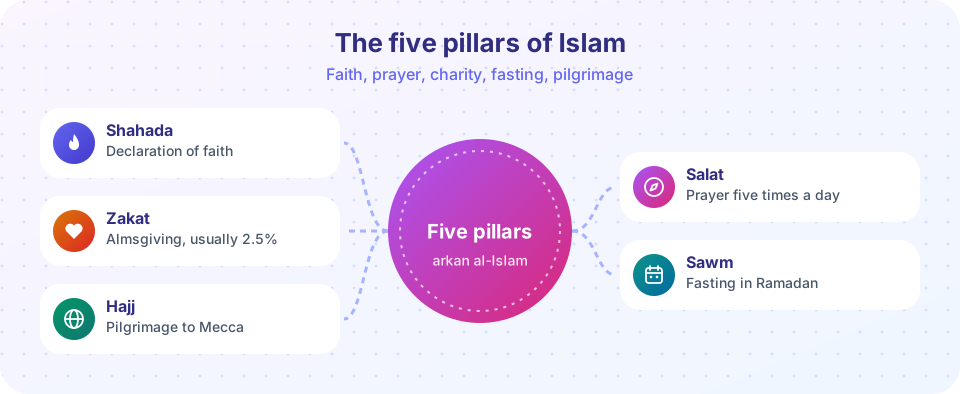
1. Shahada (declaration of faith). To say, sincerely, "There is no god but God, and Muhammad is the messenger of God" is the entry into Islam, and it is repeated in the call to prayer and in daily prayers.
2. Salat (prayer). Muslims pray at five times of the day: before dawn (fajr), midday (dhuhr), afternoon (asr), after sunset (maghrib) and night (isha). Before praying one performs washing (wudu), and prayer is performed facing the Kaaba in Mecca (the qibla), in a sequence of standing, bowing, prostrating and sitting, with recitation in Arabic. Prayer can be done anywhere clean. On Friday at midday, the community gathers at the mosque (masjid) for the congregational prayer (jumu'a) and a sermon (khutba). A mosque is a prayer hall, often with a niche (mihrab) showing the direction of Mecca; it is led by an imam, who is not a priest.
3. Zakat (almsgiving). Muslims with wealth above a minimum level (the nisab) give a fixed share, usually 2.5 percent of savings held for a lunar year, to people in need and other designated causes. Zakat is understood as purification of wealth and a duty to the community, not as optional charity. Voluntary charity (sadaqa) is encouraged in addition.
4. Sawm (fasting). During the month of Ramadan, adults who are able abstain from food, drink and marital relations from dawn until sunset. Muslims believe the Qur'an was first revealed in this month; one of the last ten nights, Laylat al-Qadr (the Night of Power), is said to be better than a thousand months. Exemptions apply for the sick, travelers, pregnant or nursing women and others. The month ends with the festival of Eid al-Fitr.
5. Hajj (pilgrimage). Every Muslim who is physically and financially able should make the pilgrimage to Mecca at least once, in the month of Dhu al-Hijjah. Pilgrims wear simple white garments, walk around the Kaaba and perform rites that recall Abraham, Hagar and Ishmael. The festival of Eid al-Adha coincides with the end of the hajj and commemorates Abraham's willingness to sacrifice his son (understood in Muslim tradition to be Ishmael).
Everyday life is further guided by categories of halal (permitted) and haram (forbidden), which include food rules (no pork, no alcohol and meat slaughtered with God's name), the rules of finance (no interest, riba) and many other aspects of conduct.
The Islamic calendar
The Hijri calendar is purely lunar. Its twelve months begin with the sighting of the new crescent and last 29 or 30 days, making a year of about 354 days, roughly 11 days shorter than the solar year. It does not insert leap months, so its months move backward through the seasons. Ramadan can fall in winter or summer, and it takes about 33 years to cycle back to the same season. Fasting days are therefore short in the winter and long in the summer, and for a Muslim living far north, the summer fast can be very long.
Branches: Sunni, Shia and Sufi
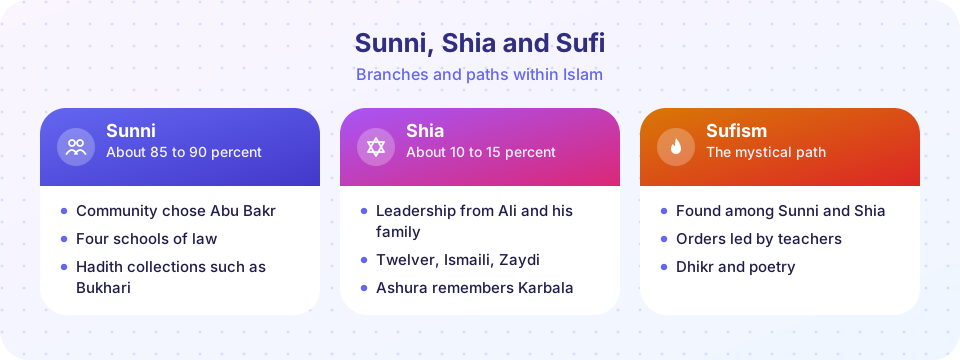
The main division in Islam goes back to the question of who should lead after Muhammad's death in 632. Sunnis (the large majority, about 85 to 90 percent of Muslims) hold that the community chose the best qualified person, Abu Bakr. Shia Muslims (about 10 to 15 percent) hold that Muhammad designated his cousin and son-in-law, Ali, and that leadership belongs to a line of imams from his family. The killing of Ali's son Husayn at Karbala in 680 became central to Shia memory and is commemorated each year on Ashura. Within Shia Islam, Twelvers (the majority, concentrated in Iran, Iraq, Azerbaijan and Bahrain) follow twelve imams; Ismailis and Zaydis follow other lines of succession.
Sunnis and Shia share the Qur'an, the five pillars (with some differences of detail) and most beliefs, and they differ in leadership, certain legal rulings and some rituals. Their relationship has seen long periods of coexistence and also conflict, which is often driven as much by politics as by theology. Another group, the Ibadis, is a distinct tradition dominant in Oman.
Sufism (tasawwuf) is the mystical dimension of Islam, a path of inner purification and love of God, practiced by Sunni and Shia Muslims alike. Sufis organized in orders (tariqas) led by teachers, practice remembrance of God (dhikr) and have produced great poetry, such as that of Jalal al-Din Rumi (1207 to 1273) and Hafez (about 1325 to 1390). The scholar al-Ghazali (1058 to 1111) wove together law, theology and spiritual practice. Some modern Muslims criticize Sufi practices, such as visiting tombs of saints, while others cherish them.
Common misconceptions
"Sunni and Shia are different religions." They are two branches of Islam that share its core beliefs.
"All Muslim women are forced to wear a headscarf." Practices and legal requirements vary by country and community; many Muslim women choose to wear a head covering as an act of faith, some do not, and in some places law or social pressure compels or forbids it. Describing it accurately means asking about a specific place and person.
"Islam teaches that Jesus is not respected." The Qur'an honors Jesus as a prophet and Messiah; what Muslims reject is the Christian doctrines of his divinity and crucifixion.
Try it
Press Run (or Ctrl + Enter) to see the result here.
Program input · what you'd type while the program runs
Type the answers before you press Run, one per line. Each time the program reads a line (with input()), it gets the next line from this box.
Press Run (or Ctrl + Enter) to see the result here.
Program input · what you'd type while the program runs
Type the answers before you press Run, one per line. Each time the program reads a line (with input()), it gets the next line from this box.
Check your understanding
Quick check · 5 questions
of 5 answered You scored / 5 · perfect!
-
1. Which is NOT one of the five pillars?
The five pillars are shahada, salat, zakat, sawm and hajj. -
2. How long is a Hijri lunar year, approximately?
Twelve lunar months make about 354 days, so Ramadan moves earlier each solar year. -
3. What is the usual rate of zakat on qualifying savings?
The usual rate on qualifying savings above the nisab, held for a lunar year, is 2.5 percent. -
4. What is the main disagreement between Sunni and Shia Muslims at its origin?
The split concerned succession in 632: Sunnis point to Abu Bakr and the community; Shia to Ali and the family line of imams. -
5. What is Sufism?
Sufism is the mystical path, practiced by Sunni and Shia Muslims.
Summary
- Islam centers on tawhid, the oneness of God, and on the prophets, the revealed books, angels, the Last Day and divine decree.
- The five pillars are shahada, salat, zakat, sawm and hajj.
- The Hijri calendar is lunar, so Ramadan moves through the seasons about every 33 years.
- Sunni and Shia Islam differ over leadership after Muhammad; Sufism is a mystical path found in both.
Track your progress
Create a free account to tick off lessons and pick up where you left off on any device.
of Religious Studies lessons completed