


















Lesson 6 of 46 · Studying Religion
Approaches to the Study of Religion
Explore the main scholarly approaches to religion (historical, sociological, psychological, anthropological, phenomenological) through Tylor, Durkheim, Weber, James, Otto and Geertz.
Modern religious studies grew in the nineteenth century, when European scholars gained access to translated scriptures, travelers' reports and archaeological finds from around the world. They asked large questions: where did religion come from, what is it for, and why does it take so many forms? Their early answers were often shaped by the assumptions of their time, including the idea that societies move from "simple" to "advanced" religion. Later scholars challenged that idea, and the field became more careful, more comparative and more respectful of how religion is lived.
This lesson walks through the main approaches by following the people who built them. You will see what each approach asks, what it found, and what its critics say.
What you will learn
- The main approaches: historical, sociological, psychological, anthropological and phenomenological.
- Key works and ideas by Tylor, James, Weber, Durkheim, Otto and Geertz.
- The strengths and limits of each approach.
- Why scholars debate reductionism.
Key terms
Animism: Tylor's term for belief in spirits that animate persons, animals, places and objects.
Collective effervescence: Durkheim's term for the shared emotional energy of a gathered group.
Charisma: Weber's term for a leader's exceptional personal authority, as followers perceive it.
Numinous: Otto's word for the sense of an overwhelming, mysterious holy presence.
Thick description: Geertz's phrase for describing actions together with the meanings that give them sense.
The historical approach
The historical approach asks when and how a tradition began, how it changed, and how it was influenced by its neighbors. It uses texts, inscriptions, archaeology and the records of the tradition itself. The historical-critical method, developed especially in nineteenth-century German universities, treats scripture like any ancient text: it asks who wrote it, when, in what language, from what earlier sources, and for whom. Many religious scholars accept this method, while some believers reject parts of its conclusions, and others combine it with faith. Historians also trace contact: how Buddhism changed as it moved from India to China, how Christianity and Islam absorbed local customs, or how a tradition responds to empires and migration.
The sociological approach
Sociologists ask how religion relates to society: how it organizes groups, supports or challenges power, and changes with modernization.
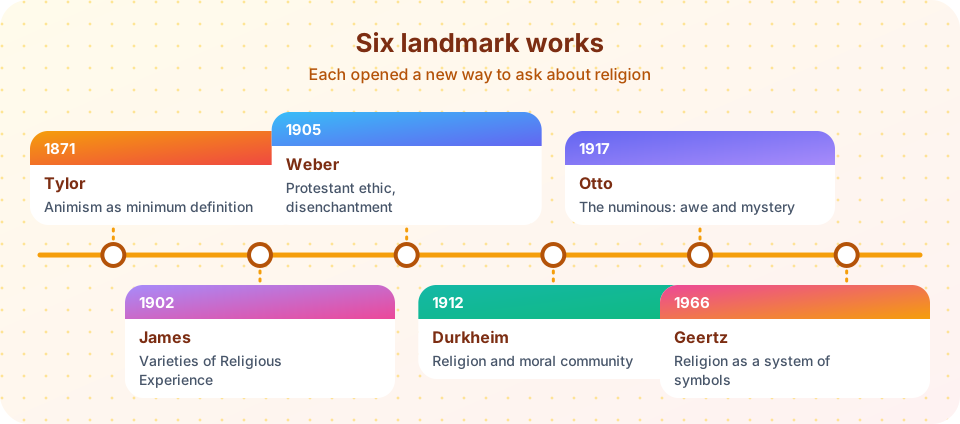
Émile Durkheim argued in The Elementary Forms of Religious Life (1912) that a society's sacred things are, in effect, symbols of the community itself. When people gather for ritual, they feel a shared energy, which he called collective effervescence, and the group's solidarity is renewed. Critics note that his evidence came mainly from reports of Aboriginal Australian groups (secondhand), and that his claim that religion is "really" society is hard to test.
Max Weber (1864 to 1920) took a different path. In The Protestant Ethic and the Spirit of Capitalism (1904 to 1905) he argued that certain Protestant ideas about vocation and disciplined work helped shape the habits that supported modern capitalism. Historians still debate how far this holds. Weber also described types of authority (traditional, legal and charismatic) and the idea of "disenchantment," the sense that modern societies explain the world in terms of rational calculation rather than spirits and magic.
Karl Marx (1818 to 1883) saw religion as bound up with social and economic conditions. In a famous line he called it the "opium of the people," which in context describes religion as both a sign of suffering and a consolation in it. Later scholars use his insights about power and ideology without necessarily accepting his predictions.
Contemporary sociology of religion studies secularization (the debated claim that religion declines with modernity), religious pluralism, migration, gender and the role of religion in politics. Chapter 8 returns to these.
The psychological approach
William James (1842 to 1910) gave lectures published as The Varieties of Religious Experience (1902). James focused on individual experience, such as conversion, mysticism and saintliness, and judged it by its fruits in a person's life, not by its metaphysical claims. His book remains a model of respectful psychology.
Sigmund Freud (1856 to 1939) proposed in The Future of an Illusion (1927) that religion is a wish-fulfilling illusion grounded in childhood dependence. Many psychologists and scholars have criticized this as speculative, and Freud's views are now treated as historically important rather than as settled science. Carl Jung instead saw religious symbols as expressions of universal patterns in the psyche, an idea that remains controversial.
Since the 1990s the cognitive science of religion has proposed that features of ordinary human minds, such as a tendency to detect agents and to think about minds, make religious ideas easy to remember and transmit. Researchers still debate how strongly the data support particular claims, and they warn that "easy to think" does not mean "false." The approach also studies the effects of prayer, ritual and meditation on well-being, with results that are often mixed and depend on context.
The anthropological approach
Anthropologists live among a community for long stretches (participant observation) and describe religion as part of everyday life. Edward Tylor's Primitive Culture (1871) defined religion as belief in spiritual beings (animism) and ranked societies on a scale of development, a ranking that later anthropologists rejected. E. E. Evans-Pritchard showed in Witchcraft, Oracles and Magic among the Azande (1937) that Azande beliefs about witchcraft formed a coherent system that made sense in its own logic.
Clifford Geertz (1926 to 2006) defined religion in a famous essay (1966) as a system of symbols that shapes moods and motivations by creating an idea of a general order of existence. His method, thick description, tries to capture the meaning of actions, as when a wink differs from a twitch. Critics say his definition is too focused on beliefs and meanings and neglects power, and that "culture as text" can underplay conflict.
The phenomenological approach
Phenomenology of religion tries to describe religious experience and forms without reducing them to something else. Rudolf Otto (1869 to 1937), in The Idea of the Holy (1917), described the "numinous" as mysterium tremendum et fascinans: a mystery that is awe-inspiring and also attractive. Mircea Eliade (1907 to 1986) contrasted the sacred and the profane in The Sacred and the Profane (1957) and described how many traditions mark certain places and times as sacred. Critics argue that phenomenologists sometimes assume a universal "religious experience" that hides cultural and historical differences, and that Eliade drew broad patterns from scattered evidence.
Putting the lenses together
| Approach | Typical question | Strength | Common criticism |
|---|---|---|---|
| Historical | How did it begin and change? | Evidence and context | Can neglect present-day practice |
| Sociological | How does it relate to society? | Patterns and power | May reduce religion to social function |
| Psychological | What happens in the mind? | Experience and motivation | Generalizing from small samples |
| Anthropological | What does it mean to people? | Rich local detail | Hard to generalize |
| Phenomenological | What is the experience like? | Respects believers' accounts | May assume a universal core |
No single lens is "the right one." A strong study of a pilgrimage might use history for its origins, sociology for who attends and why, anthropology for the meaning of the walk, and psychology for what people report feeling.
Common misconceptions
"Early scholars were neutral." The nineteenth-century founders often ranked religions from "primitive" to "advanced," with Protestant Christianity at the top. Modern scholars treat this as a bias, not a finding.
"If religion can be explained by psychology or society, it is false." Explaining how a belief arises does not show whether it is true. This is called the genetic fallacy when treated as an argument. Whether religious claims are true is a question for philosophy and theology, not a conclusion of social science.
"There is one correct approach." Fields advance when approaches check each other. Each lens has blind spots that the others can fill.
Try it
The first demonstration is a thinker-and-idea matcher. Click a thinker, then the idea you think belongs to them. It checks your answer and keeps score.
The second demonstration puts the six landmark works in order and measures the gaps between them. It also shows how recent the whole field is compared with the traditions it studies.
Press Run (or Ctrl + Enter) to see the result here.
Program input · what you'd type while the program runs
Type the answers before you press Run, one per line. Each time the program reads a line (with input()), it gets the next line from this box.
Check your understanding
Quick check · 5 questions
of 5 answered You scored / 5 · perfect!
-
1. Which work argued that gatherings produce a shared energy that renews group solidarity?
Durkheim called this shared energy collective effervescence. -
2. What did William James emphasize in his study of religion?
The Varieties of Religious Experience (1902) focused on conversion, mysticism and saintliness in individual lives. -
3. 'Thick description' is associated with
Geertz used thick description to capture the meanings behind actions, as in the difference between a wink and a twitch. -
4. Why is it a mistake to say that a psychological explanation shows a belief is false?
Origins and truth are separate questions; confusing them is the genetic fallacy. -
5. What did Otto mean by the numinous?
Otto described the numinous as a mystery that is both awe-inspiring and attractive.
Summary
- Historical, sociological, psychological, anthropological and phenomenological approaches ask different questions about religion.
- Key works: Tylor (1871), James (1902), Weber (1905), Durkheim (1912), Otto (1917), Geertz (1966).
- Each approach has strengths and criticisms; combining them gives the fullest picture.
- Early scholarship carried biases that later scholars corrected.
- Explaining how religion works socially or mentally does not decide whether its claims are true.
Track your progress
Create a free account to tick off lessons and pick up where you left off on any device.
of Religious Studies lessons completed