


















Lesson 10 of 46 · Indigenous and Ancient Traditions
Chapter 3 Overview: Indigenous and Ancient Traditions
Overview of chapter 3: Indigenous worldviews and oral tradition, animism, shamanism and ancestors, ancient Egypt and Mesopotamia, and Greek, Roman and Norse religion.
For most of human history, nobody belonged to "a religion" the way we use the phrase today. People belonged to a family, a place, a people and a set of customs, and their dealings with sacred powers were woven through all of these. They fed the ancestors, told the stories of the land, kept the seasonal feasts, and honored the powers that governed rain, harvest and birth. This chapter looks at two large families of traditions that preserve that older pattern: Indigenous traditions that continue today, and ancient traditions that once structured whole civilizations and now survive in texts, ruins and sometimes living memory.
What you will learn
- What the four lessons of chapter 3 cover.
- Five themes shared by many Indigenous and ancient traditions.
- Why "living" and "ancient" traditions need different kinds of evidence.
- Why some terms from earlier scholarship need care.
Key terms
Indigenous: belonging to peoples who are the original or long-standing inhabitants of a region, usually with distinct languages, territories and cultures, and often a history of colonization.
Polytheism: the worship of many gods.
Cosmology: an account of how the universe is ordered.
Kinship: a network of relations among people (and sometimes other beings) that carries rights and duties.
The chapter at a glance
Living Indigenous traditions
Ancient civilizations
Questions to carry
What each lesson covers
- Indigenous Worldviews and Oral Tradition explains why land, kinship and story are central, with examples from Aboriginal Australian and Māori traditions, and how colonization changed everything.
- Shamanism, Animism and Ancestors examines three widely used terms, what they describe, and why scholars use them with care.
- Ancient Egypt and Mesopotamia introduces the world's earliest great temple-and-text civilizations, their gods, kings and views of the afterlife.
- Ancient Greece, Rome and the Norse covers civic polytheism, the Roman state religion, and Norse mythology with its source problems.
- Chapter 3 Review recaps the chapter with a quiz.
Two kinds of evidence
Living traditions and ancient ones are studied with different evidence, and mixing them up leads to mistakes. For a living Indigenous community, the best evidence is what its members say and do now, and the respectful route is to listen to them. For an ancient tradition, no worshippers speak for themselves; scholars rely on texts, inscriptions, art, temples, tombs and tools, and these usually come from elites. We know more about the priests and kings of Egypt than about what a village farmer prayed. A responsible account says what the evidence can and cannot show.
Words that need care
Earlier scholars used terms such as "primitive religion," "tribal religion," "paganism" and "mythology" in ways that implied that these traditions were simpler or false. Today scholars avoid "primitive," and use "Indigenous traditions" or the specific name of a people, and "ancient polytheistic traditions" or the name of the civilization. The word "myth," as you learned in chapter 2, can be neutral. In this course you will see Indigenous and ancient traditions presented as coherent systems of thought and practice, described in their own terms where we can.
"Indigenous religion" is not one religion. There are thousands of distinct Indigenous peoples, with different languages and ceremonies. A statement that applies to one nation may not apply to another. Use the specific name of a people whenever you can.
"Ancient means disappeared." Some ancient traditions ended, some changed into other forms, and some are being revived or reinterpreted today. Chapter 8 discusses new religious movements.
Try it
The first demonstration is a "tradition match" quiz. Read a clue and pick the tradition or civilization it describes. The clues are brief summaries of ideas you will study in this chapter.
The second demonstration lays out the chapter across a study week, spreading five lessons over days and reserving time for retrieval practice.
Press Run (or Ctrl + Enter) to see the result here.
Program input · what you'd type while the program runs
Type the answers before you press Run, one per line. Each time the program reads a line (with input()), it gets the next line from this box.
Check your understanding
Quick check · 3 questions
of 3 answered You scored / 3 · perfect!
-
1. Why should you avoid saying 'Indigenous religion' as if it were one religion?
Indigenous traditions differ widely; naming the specific people is more accurate. -
2. For an ancient civilization, what evidence do scholars mainly rely on?
Ancient evidence comes from surviving texts and objects, which often reflect elite perspectives. -
3. Polytheism means
Poly means many; polytheistic traditions honor several or many gods.
Summary
- Chapter 3 covers Indigenous traditions, animism, shamanism and ancestors, Egypt and Mesopotamia, and Greece, Rome and the Norse.
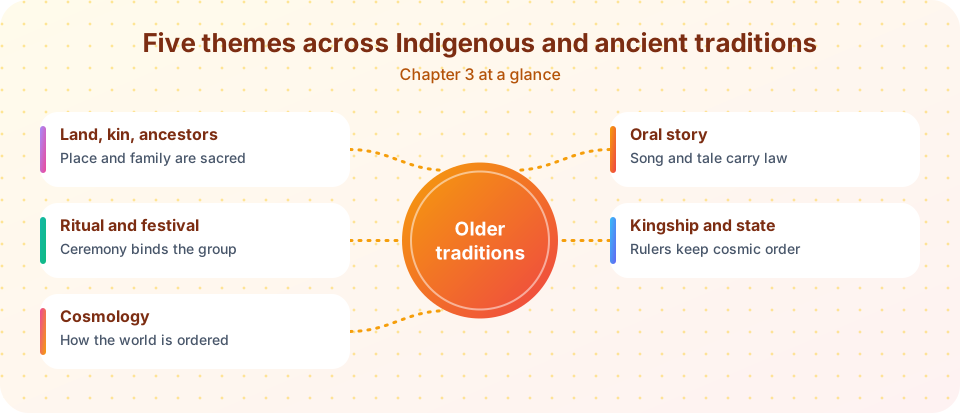
- Recurring themes: land, kin and ancestors, oral story, ritual, kingship and the state.
- Living and ancient traditions call for different evidence and different manners of respect.
- Avoid terms like "primitive"; use specific names and neutral descriptions.
Track your progress
Create a free account to tick off lessons and pick up where you left off on any device.
of Religious Studies lessons completed