


















Lesson 13 of 46 · Indigenous and Ancient Traditions
Ancient Egypt and Mesopotamia
Explore the religions of ancient Egypt and Mesopotamia: gods, temples, kingship, maat, the afterlife, Gilgamesh and the Enuma Elish, and what the evidence can tell us.
The earliest civilizations known to history grew up along rivers: the Nile in Egypt and the Tigris and Euphrates in Mesopotamia, the land between the rivers in what is now Iraq and neighboring regions. In both places, large cities, writing, monumental architecture and organized religion appeared together. Temples were among the biggest buildings, scribes recorded hymns and rituals, and kings ruled in the name of the gods. Their writings include some of the oldest religious texts we can read.
This lesson tours the two traditions, compares them and explains what we know and how we know it. Remember the rule from the chapter overview: we have no living worshippers to ask, and most of our evidence was made by or for elites, so every claim about "what the Egyptians believed" is an inference from texts, art and archaeology.
What you will learn
- The main gods, temples and ideas of Egyptian religion, including maat and the afterlife.
- The main gods, myths and practices of Mesopotamian religion.
- Key texts: the Pyramid Texts, the Book of the Dead, the Enuma Elish and the Epic of Gilgamesh.
- How scholars handle gaps and biases in ancient evidence.
Key terms
Maat: in ancient Egypt, the principle of order, truth, justice and balance, also personified as a goddess.
Pharaoh: the king of ancient Egypt, understood as mediating between gods and people.
Ziggurat: a stepped temple tower of ancient Mesopotamia.
Cuneiform: wedge-shaped writing pressed into clay, used in Mesopotamia for thousands of years.
Epic: a long narrative poem about heroes and gods.
Ancient Egypt
A cosmos kept in order
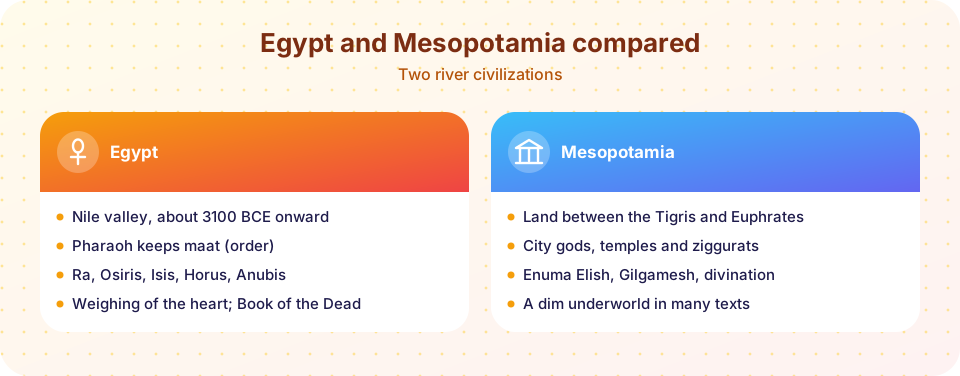
Egyptian civilization lasted roughly three thousand years, from the unification of the Nile valley around 3100 BCE (traditional dating) to the Roman era. Its religion was polytheistic, with many gods and goddesses, and it changed over time and across regions. Important figures include Ra (the sun god), Osiris (god of the dead and rebirth), Isis (his wife, associated with magic and motherhood), Horus (a sky god, linked with kingship), Hathor (associated with love, music and motherhood), Anubis (guardian of embalming) and Thoth (god of writing and wisdom). Gods often had animal features in art: Horus a falcon, Anubis a jackal, Thoth an ibis. Scholars interpret these images as expressions of qualities, not as worship of animals, though some animals were also kept as sacred.
Central to Egyptian thought was maat, the principle of order, truth and justice, which the gods established at creation and which humans must uphold through right conduct and ritual. Its opposite was chaos (isfet). Daily temple rituals aimed to sustain maat: priests washed, clothed and fed the statue of the god in the temple, which was understood as the god's dwelling place.
The king
The pharaoh was the key figure. He was understood as the son of the sun god and the living Horus, the intermediary who kept the cosmos in order. In practice, he delegated temple duties to priests. The royal ideology supported the state, which means that much of the surviving religious art serves royal purposes.
Death and the afterlife
Egyptians elaborated a rich view of life after death. The body was preserved by mummification so the person's various aspects, including the ka (life force) and the ba (a personality aspect often shown as a bird with a human head) could continue. The earliest large collection of religious texts, the Pyramid Texts, was carved inside royal pyramids at the end of the Old Kingdom (the earliest known version in the pyramid of Unas, around 2350 BCE). Later, Coffin Texts and then the Book of the Dead (a modern name; the Egyptians called it something like "Book of Coming Forth by Day") supplied spells for non-royal people. A famous scene in the Book of the Dead shows the weighing of the heart: the deceased's heart is balanced against the feather of Maat while Anubis tends the scale and Thoth records the result. If the heart is in balance, the person is admitted to the afterlife; if not, the monstrous Ammit devours it. This scene tells us how the Egyptians imagined judgment, though they also thought spells and ritual could help the dead.
A religious experiment
One famous episode is the reign of Akhenaten (about 1353 to 1336 BCE), who promoted the worship of the Aten, the sun's disk, above other gods, built a new capital at Amarna and closed or neglected many temples. Scholars debate whether this was a form of monotheism or a royal cult centered on the king. After his death, his successors, including Tutankhamun, restored the traditional gods.
Mesopotamia
Gods, cities and temples
Mesopotamian religion developed among the Sumerians, then the Akkadians, Babylonians and Assyrians, and lasted for about three thousand years. It was also polytheistic. Each city had a patron god whose temple was the center of civic life, the household of the god, with the ziggurat rising beside it. Major gods include An (sky), Enlil (air and storm), Enki (called Ea in Akkadian, god of fresh water and wisdom), Inanna (Ishtar in Akkadian, goddess of love and war) and Marduk, who became the chief god of Babylon.
Mesopotamian religion emphasized that humans were created to serve the gods, providing food, shelter and honor in the temple, so that the gods would maintain the world. Kings acted as the gods' stewards. Because the Tigris and Euphrates flooded unpredictably, some scholars have suggested that Mesopotamian texts show a more anxious view of divine power than the Egyptian emphasis on order; others warn that this link between climate and belief is speculative.
Myths and epics
The Enuma Elish ("When on high"), a Babylonian creation epic, describes how Marduk defeated the sea goddess Tiamat and created the world from her body, and how humans were made to serve the gods. It was recited at the Babylonian New Year festival, the Akitu. The Epic of Gilgamesh, whose standard Babylonian version was gathered from earlier Sumerian and Akkadian stories, tells of a king of Uruk who seeks immortality after the death of his friend Enkidu, and concludes that human life is limited and must be lived well. It includes a flood story told by Utnapishtim, which scholars compare with the flood narrative in the Hebrew Bible. Scholars debate the exact relationship between these accounts, but the parallels are well known. Many tablets of Gilgamesh were found in the library of the Assyrian king Ashurbanipal at Nineveh (seventh century BCE).
Ritual, omens and the dead
Mesopotamians used divination extensively: priests read omens in the entrails of sacrificed animals, the stars and unusual events, to learn the will of the gods. Hymns, laments, incantations and prayers survive in great numbers. The afterlife, in many texts, was a dim underworld, the "house of dust," where the dead lived without much joy, a view sometimes contrasted with Egyptian expectations.
Comparing and connecting
| Feature | Egypt | Mesopotamia |
|---|---|---|
| Landscape | Nile with a regular flood | Tigris and Euphrates, less predictable |
| Kingship | Pharaoh as a divine intermediary | King as steward of the gods |
| Core idea | Maat: order to be upheld | Humans serve the gods' household |
| Afterlife | Judgment and a possible blessed existence | Dim underworld in many texts |
| Writing | Hieroglyphs and later scripts | Cuneiform on clay tablets |
The two civilizations also traded, fought and influenced each other and their neighbors, and some of their ideas, such as flood stories and creation themes, appear in later traditions of the region. Scholars compare these cautiously, distinguishing borrowing, shared heritage and independent development.
Common misconceptions
"The Egyptians worshipped animals." Egyptian gods were often shown with animal heads or forms, which scholars read as expressing qualities. Animals also played a role in cults, but the idea of animal worship oversimplifies.
"Ancient religions were static." Egyptian and Mesopotamian religions changed over thousands of years; Ra, Osiris and Marduk each rose and changed in importance.
"Gilgamesh is the Bible's flood story." The Gilgamesh flood story is an older, independent text that shows similar motifs. Scholars study how stories travel; they do not simply equate them.
Try it
The first demonstration is a "weighing the heart" illustration. Slide the "deeds" meter and watch the scale tip toward the heart or the feather. It is a conceptual illustration of the Egyptian scene, not a game of judgment.
The second demonstration counts across the BCE and CE divide. There is no year 0, so the gap between a BCE year and a CE year is the sum of the two minus one. The code uses dates from this lesson.
Press Run (or Ctrl + Enter) to see the result here.
Program input · what you'd type while the program runs
Type the answers before you press Run, one per line. Each time the program reads a line (with input()), it gets the next line from this box.
Check your understanding
Quick check · 5 questions
of 5 answered You scored / 5 · perfect!
-
1. In ancient Egyptian thought, what was maat?
Maat was the order established at creation that humans were to uphold; it was also a goddess. -
2. Which text tells how Marduk defeated Tiamat?
The Babylonian creation epic Enuma Elish tells this story and was recited at the Akitu festival. -
3. A ziggurat is
Ziggurats were stepped temple towers beside Mesopotamian temples. -
4. What did the Akhenaten episode involve?
Akhenaten promoted the Aten, built Amarna and neglected other cults; successors restored the old gods. -
5. Why is evidence about ancient religions often biased?
Temples, tombs and royal inscriptions survive better than the prayers of ordinary people.
Summary
- Egyptian religion centered on maat, a divine kingship, temple ritual and a rich afterlife, expressed in the Pyramid Texts and the Book of the Dead.
- Mesopotamian religion centered on city gods, temples and ziggurats, divination, and myths such as the Enuma Elish and the Epic of Gilgamesh.
- The two traditions differ in emphasis but share polytheism, temples and royal roles.
- Evidence comes largely from elites, so claims are inferences with limits.
Track your progress
Create a free account to tick off lessons and pick up where you left off on any device.
of Religious Studies lessons completed