


















Lesson 30 of 46 · Christianity
Christianity: Worship, Sacraments and the Church Year
How Christians worship: the sacraments, the Eucharist, prayer, monasticism, the liturgical year from Advent to Pentecost, and how the date of Easter is calculated.
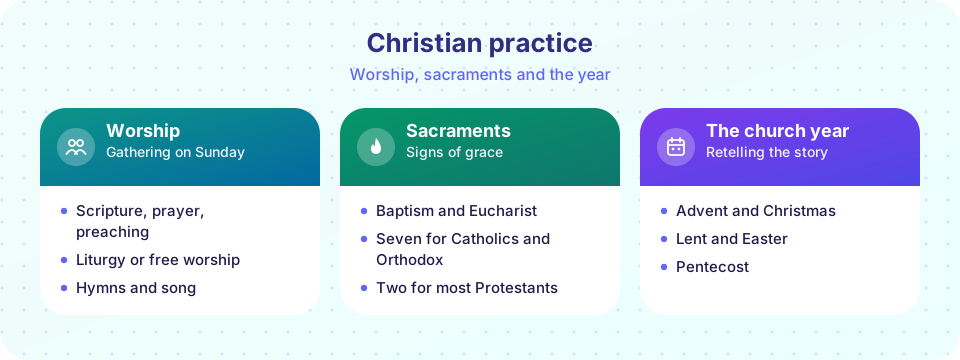
Ask a Christian what the faith looks like in practice and the answers differ widely. For a Greek Orthodox believer it may be the Divine Liturgy, with incense, icons and chant; for a Quaker, silent waiting; for a Pentecostal, singing, praying aloud and testimony; for a Catholic, the Mass; for a Baptist, preaching and congregational singing. Yet all of these traditions gather on Sundays, read scripture, pray, and mark certain central events: the birth, death and resurrection of Jesus.
This lesson looks at the shared patterns: the rites called sacraments, the different views of the Eucharist, forms of prayer and monastic life, and the liturgical year. It ends with a practical puzzle: why Easter falls on a different date each year, and why Western and Eastern churches often celebrate it on different days.
What you will learn
- What sacraments are, and how many different churches count.
- The main Christian views on the Eucharist.
- Forms of prayer and monastic life.
- The liturgical year, from Advent to Pentecost.
- How the date of Easter is calculated and why East and West differ.
Key terms
Sacrament: a rite understood as a visible sign of grace; Catholics and Orthodox count seven, many Protestants two.
Eucharist: the rite of bread and wine recalling Jesus' last supper; also called Holy Communion, the Lord's Supper or the Mass.
Liturgy: a fixed order of public worship.
Lent: a period of forty days before Easter observed with fasting, prayer and repentance.
Monasticism: a way of life of prayer and work in a community under a rule.
Sacraments
Christians have long used physical things and actions, such as water, bread, wine, oil and the laying on of hands, as signs of spiritual realities. The Catholic and Orthodox churches count seven sacraments (the Orthodox often call them "mysteries"): baptism (entry into the church with water), confirmation or chrismation (anointing with oil, strengthening the Spirit's gift), the Eucharist, penance or reconciliation (confession and forgiveness), anointing of the sick, marriage and holy orders (ordination). Most Protestant churches follow the Reformers in counting two sacraments, baptism and the Lord's Supper, because these were instituted by Christ in the Gospels; some groups, such as Quakers and the Salvation Army, do not practice outward sacraments at all.
Baptism is one of the clearest points of disagreement. Many churches baptize infants (Catholic, Orthodox, Lutheran, Anglican, Reformed), seeing it as the sign of belonging to the community. Baptists and many evangelical and Pentecostal churches practice believer's baptism, administered to those old enough to profess faith, often by full immersion.
The Eucharist
The Eucharist is the central act of worship in most churches. In the Gospels, Jesus shares bread and wine with his disciples at his last meal and says, "This is my body," "This is my blood." Christians interpret these words differently.
- Transubstantiation (Roman Catholic): the bread and wine become the body and blood of Christ while their appearances remain. The idea was systematized by Thomas Aquinas in the 13th century.
- Real presence (Orthodox, Lutheran, Anglican in various forms): Christ is truly present, and the church calls the manner a mystery rather than defining it as precisely.
- Spiritual presence (Reformed tradition, following Calvin): Christ is present to believers by the Holy Spirit as they receive the bread and wine in faith.
- Memorial (many Baptist and evangelical churches, following Ulrich Zwingli): the meal is a remembrance of Christ's death.
These disagreements led to one of the sharpest conflicts of the Reformation, and in some places they still limit who may receive communion in which church.
Prayer, scripture and monastic life
Christian prayer includes praise, thanksgiving, confession and petition. The Lord's Prayer ("Our Father"), which the Gospels of Matthew and Luke record, is used by nearly every denomination. Liturgical churches use fixed prayers and set readings; others emphasize free prayer. Many Christians read scripture daily, and many practice silent or contemplative prayer. Catholics and Orthodox use the rosary or the Jesus Prayer, and Orthodox Christians use icons as aids to prayer, a practice defended at the Second Council of Nicaea (787) after a long dispute over icons.
Monasticism began in the 3rd and 4th centuries with Egyptian hermits such as Anthony the Great (about 251 to 356) and spread through communities. In the West, Benedict of Nursia (about 480 to 547) wrote a Rule for monks that balanced prayer, work and study, and Benedictine monasteries preserved texts and ran schools and hospitals. Later orders include the Franciscans (founded 1209) and Dominicans (founded 1216). Many Protestants rejected monasticism, but some communities, such as Taizé in France and various Anglican orders, have revived forms of it. Christians also practice charity, running schools, hospitals and aid organizations around the world.
The liturgical year
Many churches organize time around a cycle of seasons that retells the life of Christ.
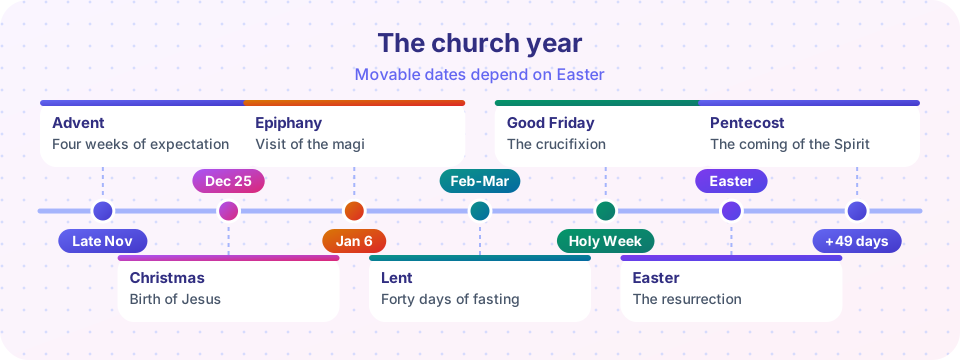
- Advent begins four Sundays before Christmas and is a time of expectation.
- Christmas celebrates the birth of Jesus on December 25 in most Western churches; many Orthodox churches use the Julian calendar, which places it on January 7 in the Gregorian calendar. The choice of December 25 is first attested in the 4th century, and scholars debate how it was chosen.
- Epiphany (January 6) marks the visit of the magi, and in some Eastern churches the baptism of Jesus.
- Lent is forty days (not counting Sundays) from Ash Wednesday to Holy Saturday, a time for fasting and reflection.
- Holy Week includes Palm Sunday, Maundy Thursday (the last supper), Good Friday (the crucifixion) and Easter Sunday.
- Easter celebrates the resurrection, the central feast of the Christian year. It is followed by fifty days of Eastertide.
- Ascension (a Thursday, the 40th day counting Easter itself) and Pentecost (a Sunday, the 50th day counting Easter itself) remember Jesus' departure and the coming of the Spirit.
- Ordinary Time fills the rest of the year.
Sunday, the day of the resurrection, became the main day of worship, called the Lord's Day. In some traditions, such as Seventh-day Adventists, the Sabbath is kept on Saturday.
When is Easter?
Easter is a "movable feast." Western churches define it as the first Sunday after the first full moon on or after March 21, using an "ecclesiastical" moon (a table-based approximation) rather than the real one. The Orthodox churches use the same rule but with the older Julian calendar, which currently runs 13 days behind the Gregorian one, and their calculation of the equinox date (March 21 in the Julian calendar is April 3 in the Gregorian). As a result Easter dates coincide in some years, such as 2025, and differ by one to five weeks in others. Other feasts depend on Easter: Ash Wednesday comes 46 days before it, Ascension 39 days after and Pentecost 49 days after. Many Christians have proposed a fixed date to unify celebrations, but no agreement has been reached.
Common misconceptions
"Christmas is the most important Christian festival." In most traditions Easter is the most important, because it celebrates the resurrection.
"All churches use the same date for Easter." Western and Orthodox churches often differ because of different calendars.
"Lent is forty days long counting every day." The forty days usually exclude Sundays, which are seen as celebrations of the resurrection; the count is 46 days from Ash Wednesday to Easter.
Try it
Press Run (or Ctrl + Enter) to see the result here.
Program input · what you'd type while the program runs
Type the answers before you press Run, one per line. Each time the program reads a line (with input()), it gets the next line from this box.
Check your understanding
Quick check · 5 questions
of 5 answered You scored / 5 · perfect!
-
1. How many sacraments do the Catholic and Orthodox churches count?
Catholic and Orthodox churches count seven sacraments; many Protestants count two. -
2. Which view of the Eucharist teaches that the bread and wine become the body and blood of Christ while their appearance remains?
Transubstantiation is the Roman Catholic doctrine, systematized by Thomas Aquinas. -
3. When is Ash Wednesday relative to Easter?
Ash Wednesday begins Lent and falls 46 days before Easter. -
4. Why do Western and Orthodox Easter often differ?
The Orthodox use the Julian calendar for the calculation, which currently runs 13 days behind the Gregorian. -
5. Who wrote a famous Rule for monks in the West?
Benedict (about 480 to 547) wrote the Rule that shaped Western monasticism.
Summary
- Sacraments are rites that carry grace: seven for Catholics and Orthodox, two for most Protestants.
- Views of the Eucharist range from transubstantiation to memorial.
- Prayer, scripture reading and monasticism are major forms of Christian practice.
- The church year runs from Advent through Christmas, Lent and Easter to Pentecost.
- Easter's date depends on the equinox, the moon and the choice of calendar.
Next: Christianity review
Track your progress
Create a free account to tick off lessons and pick up where you left off on any device.
of Religious Studies lessons completed