Review the Christianity chapter with a one-picture summary, a recap table, flashcards, a branch sorter and a nine-question quiz on origins, beliefs, branches and the church year.
This chapter followed Christianity from its Jewish roots to its global present: the life of Jesus as Christians tell it, the New Testament and the early church, the doctrines settled at the great councils, the three major branches, and the worship and calendar that shape Christian life. This review puts the pieces side by side and checks that you can recall them.
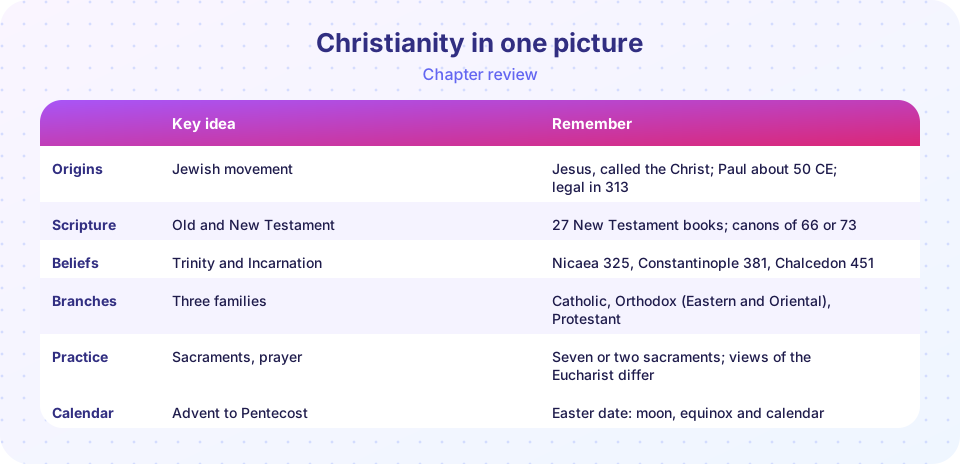
Caption: The chapter in one picture: what to remember about each part of Christianity.
Compare Christianity with Judaism, which you studied in the last chapter. Both read an authoritative scripture and a tradition of interpretation. Both use a calendar of festivals, and Christianity's Easter is linked with the Jewish Passover in the Gospels' chronology. Both are divided into movements that disagree on authority, and both include people who are deeply observant and people who identify culturally. Differences are equally instructive: Judaism emphasizes law and community identity through descent, while Christianity emphasizes creeds, the person of Christ and a universal mission. These contrasts are patterns, not rules, and every community has exceptions.
Notice also how history shapes belief. The creeds came out of arguments in the 4th and 5th centuries, the great branches came out of political and theological divisions, and the modern global church came out of missions, migration and local leadership. When you meet an unfamiliar Christian practice, ask what historical question it answers.
Try answering these in a few sentences each, using only what you can recall. Then check the lessons.
Why is it important to say that Jesus and his first followers were Jews?
What problem did the Council of Nicaea set out to solve, and what did it decide about the Son?
Compare how Catholics, Orthodox Christians and Protestants understand authority. Where does each place the final word?
Explain, step by step, why Western and Orthodox Easter can fall on different Sundays.
What does it mean to say that the center of Christianity has shifted to the Global South, and what evidence supports it?
A good answer names the people, councils and dates involved and attributes beliefs to the groups that hold them ("Catholics teach that...") rather than stating them as facts about all Christians.
"The Bible fell from heaven as one book." The Bible is a library of books written over many centuries and collected gradually. Christians believe it is inspired but understand inspiration in different ways.
"There is one Christian church." There are many churches, which sometimes recognize each other and sometimes do not.
<style>:root{--ink:#1e1b4b;--mut:#475569;--bg1:#faf5ff;--bg2:#eff6ff;--ac:#6366f1;--ac2:#ec4899}@media(prefers-color-scheme:dark){:root{--ink:#e0e7ff;--mut:#a5b4fc;--bg1:#1e1b4b;--bg2:#1e293b}}*{box-sizing:border-box}body{margin:0;padding:14px;font-family:system-ui,-apple-system,'Segoe UI',sans-serif;color:var(--ink);background:linear-gradient(135deg,var(--bg1),var(--bg2));min-height:100vh}h3{margin:0 0 4px;font-size:17px}.sub{margin:0 0 12px;color:var(--mut);font-size:13px}.card{background:#fff;color:#1e1b4b;border-radius:18px;padding:16px 18px;box-shadow:0 10px 24px rgba(67,56,202,.15)}button{font:inherit;cursor:pointer;border:0;border-radius:999px;padding:8px 14px;background:linear-gradient(135deg,#6366f1,#4338ca);color:#fff;font-weight:600;font-size:14px}button.ghost{background:#eef2ff;color:#312e81}button.on{background:linear-gradient(135deg,#a855f7,#db2777);color:#fff}.row{display:flex;flex-wrap:wrap;gap:8px;margin-bottom:12px}.muted{color:#475569;font-size:14px}.big{font-size:19px;font-weight:700}</style><h3>Christianity flashcards</h3><pclass="sub">Click the card to flip it. Mark whether you knew it.</p><divid="c"class="card"style="min-height:130px;cursor:pointer;display:flex;flex-direction:column;justify-content:center;text-align:center"><divid="t"class="muted"></div><divid="x"class="big"></div></div><divclass="row"style="margin-top:12px"><buttonclass="ghost"id="p">Previous</button><buttonclass="ghost"id="n">Next</button><buttonclass="ghost"id="s">Shuffle</button><buttonid="k">I knew it</button></div><divclass="muted"id="st"></div><script>varD=[["Who is the Christ?","Jesus of Nazareth, whom Christians call the anointed one (Messiah)"],["What are the Synoptic Gospels?","Matthew, Mark and Luke"],["How many books are in the Protestant Bible?","66 (39 Old Testament and 27 New Testament)"],["What did Nicaea (325) decide?","The Son is of one substance with the Father"],["What did Chalcedon (451) decide?","Christ has two natures, divine and human, in one person"],["What is the filioque?","The Western addition that the Spirit proceeds from the Father and the Son"],["What happened in 1517?","Luther published his 95 Theses, starting the Reformation"],["What is Lent?","Forty days before Easter (not counting Sundays) of fasting and reflection"],["How is Easter dated?","First Sunday after the first full moon on or after March 21 (ecclesiastical)"],["Which branch is the largest?","The Roman Catholic Church, about half of all Christians"]],i=0,f=false,known=0,seen={};functionshow(){document.getElementById('t').textContent=(f?'Answer':'Question')+' '+(i+1)+' of '+D.length;document.getElementById('x').textContent=D[i][f?1:0];document.getElementById('st').textContent='Marked as known: '+known+' of '+D.length;}
document.getElementById('c').onclick=function(){f=!f;show()};
document.getElementById('n').onclick=function(){i=(i+1)%D.length;f=false;show()};
document.getElementById('p').onclick=function(){i=(i+D.length-1)%D.length;f=false;show()};
document.getElementById('s').onclick=function(){for(var a=D.length-1;a>0;a--){var b=Math.floor(Math.random()*(a+1));var t=D[a];D[a]=D[b];D[b]=t}i=0;f=false;show()};
document.getElementById('k').onclick=function(){if(!seen[D[i][0]]){seen[D[i][0]]=1;known++}show()};show();</script>
Which branch?
<style>:root{--ink:#1e1b4b;--mut:#475569;--bg1:#faf5ff;--bg2:#eff6ff;--ac:#6366f1;--ac2:#ec4899}@media(prefers-color-scheme:dark){:root{--ink:#e0e7ff;--mut:#a5b4fc;--bg1:#1e1b4b;--bg2:#1e293b}}*{box-sizing:border-box}body{margin:0;padding:14px;font-family:system-ui,-apple-system,'Segoe UI',sans-serif;color:var(--ink);background:linear-gradient(135deg,var(--bg1),var(--bg2));min-height:100vh}h3{margin:0 0 4px;font-size:17px}.sub{margin:0 0 12px;color:var(--mut);font-size:13px}.card{background:#fff;color:#1e1b4b;border-radius:18px;padding:16px 18px;box-shadow:0 10px 24px rgba(67,56,202,.15)}button{font:inherit;cursor:pointer;border:0;border-radius:999px;padding:8px 14px;background:linear-gradient(135deg,#6366f1,#4338ca);color:#fff;font-weight:600;font-size:14px}button.ghost{background:#eef2ff;color:#312e81}button.on{background:linear-gradient(135deg,#a855f7,#db2777);color:#fff}.row{display:flex;flex-wrap:wrap;gap:8px;margin-bottom:12px}.muted{color:#475569;font-size:14px}.big{font-size:19px;font-weight:700}</style><h3>Which branch?</h3><pclass="sub">Choose the best category for each item. You get feedback straight away.</p><divclass="card"><divclass="big"id="q"></div><divclass="row"id="b"style="margin-top:12px"></div><divid="f"class="muted"></div></div><divclass="muted"style="margin-top:10px"id="sc"></div><script>varCA=["Catholic","Orthodox","Protestant"],IT=[["Led by the pope, the bishop of Rome","Catholic","The pope is seen as successor of Peter."],["Priests may be married; Divine Liturgy with icons","Orthodox","Eastern Orthodox churches ordain married men as priests."],["Sola scriptura: scripture alone","Protestant","A principle of the Reformation."],["Self-governing churches such as the Greek and Russian churches","Orthodox","They recognize the honorary primacy of Constantinople."],["Usually two sacraments: baptism and the Lord's Supper","Protestant","Most Reformers kept those instituted in the Gospels."],["Seven sacraments and the doctrine of transubstantiation","Catholic","Systematized by Aquinas."]],i=0,ok=0,done=false;var b=document.getElementById('b');CA.forEach(function(c){var x=document.createElement('button');x.className='ghost';x.textContent=c;x.onclick=function(){pick(c)};b.appendChild(x)});functionshow(){if(i>=IT.length){document.getElementById('q').textContent='Finished';b.style.display='none';document.getElementById('f').textContent='You matched '+ok+' of '+IT.length+'. Reload the preview to try again.';return}
document.getElementById('q').textContent=IT[i][0];document.getElementById('f').textContent='';document.getElementById('sc').textContent='Item '+(i+1)+' of '+IT.length+' | Correct so far: '+ok;done=false}functionpick(c){if(done)return;done=true;var right=IT[i][1];if(c===right){ok++;document.getElementById('f').textContent='Correct: '+right+'. '+(IT[i][2]||'')}else{document.getElementById('f').textContent='Not quite. Best answer: '+right+'. '+(IT[i][2]||'')}
document.getElementById('sc').textContent='Correct so far: '+ok;setTimeout(function(){i++;show()},1700)}show();</script>