


















Lesson 39 of 46 · Religion, Society and Ethics
Religion and Society: Theories, Secularization and Pluralism
How Durkheim, Weber and Marx explained religion, what the secularization debate says, how states handle religious pluralism, and what scholars find about religion and conflict.
Religion is not only what people believe in private. It builds communities, supplies calendars and holidays, shapes law and education, funds charities and sometimes sits at the center of political conflict. Because of this, scholars in sociology, anthropology, history and political science have long tried to explain it, not by deciding whether its claims are true but by asking what it does and how it changes.
This lesson introduces three classic theorists, the debate about secularization and its revisions, the ways states deal with religious diversity, and what scholars say about the relationship between religion and conflict or peace. It also gives you a tool for describing individual religiosity: the five dimensions proposed by Charles Glock and Rodney Stark.
What you will learn
- The central ideas of Durkheim, Weber and Marx about religion.
- The secularization thesis, the evidence for and against it and later revisions.
- How states regulate religion, and what freedom of religion means in law.
- What scholars say about religion, conflict and peace.
- The five dimensions of religiosity.
Key terms
Sacred and profane: Durkheim's distinction between things set apart and treated with reverence and the ordinary.
Charisma: Weber's term for an exceptional personal authority, as in a prophet.
Secularization thesis: the claim that modernization leads to a decline of religion's role.
Pluralism: the existence of many religions and worldviews side by side.
Interfaith dialogue: organized conversation among people of different religions.
Three classic theories
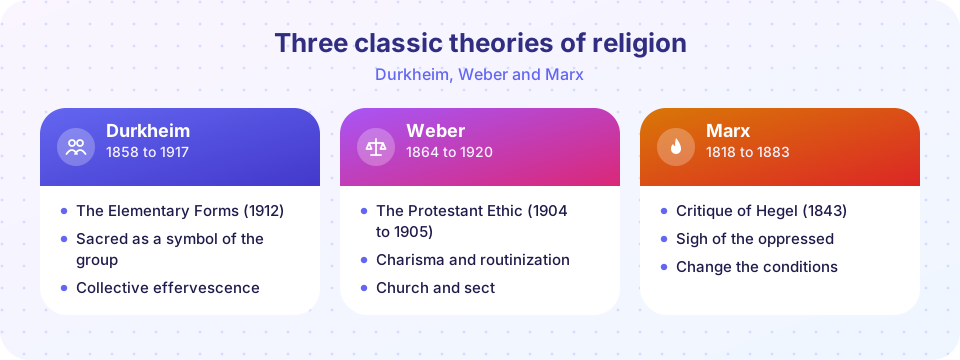
Émile Durkheim (1858 to 1917) argued in The Elementary Forms of Religious Life (1912) that religion is a social fact. Studying Aboriginal Australian clan ceremonies, he proposed that what a group holds sacred is a symbol of the group itself, and that shared rituals create what he called "collective effervescence," a feeling of belonging to something larger than oneself. On this view, religion binds a community together. Critics note that his evidence came from a narrow selection of sources and that the theory fits unity better than conflict.
Max Weber (1864 to 1920) asked how religious ideas influence behavior. In The Protestant Ethic and the Spirit of Capitalism (1904 to 1905) he suggested that certain Protestant ideas, especially Calvinist beliefs about calling and discipline, encouraged habits that favored modern capitalism. The thesis remains debated by historians. Weber also studied types of authority, including the charismatic authority of prophets and the way it is "routinized" in institutions after the founder's death, and he distinguished churches from sects.
Karl Marx (1818 to 1883) wrote in 1843 that religion is "the sigh of the oppressed creature, the heart of a heartless world," and "the opium of the people." The line is often quoted as simple hostility, but it also expresses sympathy: religion consoles people who suffer, while for Marx the deeper task was to change the conditions that made consolation necessary. Later scholars, including liberation theologians in Latin America, have drawn on Marxist analysis while remaining religious.
Others have added to these views. Sigmund Freud (The Future of an Illusion, 1927) analyzed religion as a psychological wish. Clifford Geertz (1966) defined religion as a system of symbols that shapes moods and motivations and gives a sense of order. Each theory is partial; most scholars use several.
The secularization debate
In the mid-20th century, many sociologists, including Bryan Wilson and Peter Berger, predicted that science, education, urbanization and bureaucracy would gradually shrink religion's role. The evidence has been mixed.
- Evidence for decline. In much of Western Europe, regular church attendance and formal membership have fallen steeply since the 1960s. In the United States, the share of adults who say they have no religion has risen markedly since the 1990s, to roughly three in ten in recent surveys. Across many countries, younger people are on average less affiliated.
- Evidence against a universal decline. Globally, religious populations have grown because of birth rates and conversion; Christianity and Islam are growing in Africa, and Pentecostalism has spread widely. Religion remains a strong political and cultural force in India, the Middle East, Latin America and the United States. Berger himself, in 1999, wrote that the world is "as furiously religious as it ever was" and called his earlier thesis mistaken.
- Revisions. Grace Davie described British religion as "believing without belonging": many hold beliefs without attending services. Pippa Norris and Ronald Inglehart (2004) proposed that religion is strongest where people face insecurity and weakens where life becomes safer and more predictable. Rodney Stark and others argued, using a "religious economy" model, that competition among religious groups, not secularization, explains differences in participation. Other scholars speak of "post-secular" societies, where religion and secular life interact. Some also emphasize that secular beliefs such as humanism are growing alongside religion.
Most scholars now treat secularization as a set of separate processes (a decline in institutions' power, in personal belief or in practice) that may go in different directions in different places.
Pluralism, law and the state
Most societies today include many religions. How should a state treat them? Common arrangements include:
- Established church: a state-recognized church with a formal role, as with the Church of England (the monarch is its Supreme Governor), though the practice can be liberal.
- Separation: the United States' First Amendment (1791) bans a government establishment of religion and protects free exercise.
- Laïcité: France's 1905 law separated churches and state, and the French model stresses the neutrality of public institutions, which has led to debates about religious dress in public schools.
- Cooperation: Germany recognizes religious communities as public bodies that can offer religious education in schools and collect a church tax.
- Principled distance: India's constitution treats religions with equal respect and allows the state to reform some religious practices.
International law protects freedom of thought, conscience and religion (Article 18 of the Universal Declaration of Human Rights, 1948, and the International Covenant on Civil and Political Rights, 1966). This includes the freedom to change one's religion and to practice it, subject to limits needed to protect safety, health and others' rights. Hard cases arise over religious dress, blasphemy and speech laws, conscientious objection, the ritual slaughter of animals and the place of religion in school.
Interfaith dialogue has grown. The World's Parliament of Religions met in Chicago in 1893, the Catholic Church's declaration Nostra Aetate (1965) changed its approach to other religions and especially to Judaism, and in 2007 Muslim scholars published A Common Word, an open letter to Christian leaders about shared commandments to love God and neighbor.
Religion, conflict and peace
Conflicts are sometimes described as "religious wars," such as the Troubles in Northern Ireland (about 1968 to 1998) or the wars in the former Yugoslavia in the 1990s. Scholars usually find that religion is one marker of identity intertwined with ethnicity, territory, history and politics, so that explaining the conflict by religion alone is misleading. Religious ideas have also been used to justify violence, and religious leaders and movements have inspired nonviolent action, from Mahatma Gandhi and Martin Luther King Jr. to Archbishop Desmond Tutu's leadership of South Africa's Truth and Reconciliation Commission. A fair summary is that religion can intensify or restrain conflict, depending on who is using it and for what.
Measuring religiosity
Charles Glock (1962) and later Glock and Rodney Stark (1968) proposed that religiosity has several dimensions: belief (what a person accepts), practice (rituals and worship), experience (feelings of contact with the divine), knowledge (what one knows of the tradition) and consequences (how religion affects daily life). A person might score high on one and low on another, which is why a single question like "Are you religious?" misses so much.
Common misconceptions
"Marx said religion is just a drug and should be mocked." The famous passage is more complex, since it also speaks of compassion for suffering. Marx's own program was social change, not ridicule.
"Secularization means that everyone is becoming nonreligious." The evidence is mixed. Decline in some regions coincides with growth in others.
"Wars between religions are caused by religious belief." Scholars generally find multiple causes, with religion as one of several identity markers.
Try it
Check your understanding
Quick check · 5 questions
of 5 answered You scored / 5 · perfect!
-
1. Which work by Durkheim argued that religion expresses a community's shared life?
Durkheim's 1912 book proposed that the sacred is a symbol of the group. -
2. What did Weber suggest in The Protestant Ethic?
Weber argued for an elective affinity between certain Protestant ideas and capitalism; historians still debate it. -
3. What did Grace Davie mean by 'believing without belonging'?
Davie described British religion in the late 20th century as private belief without regular participation. -
4. How do scholars generally explain conflicts like Northern Ireland?
Most scholars see multiple causes, with religion as one of several linked identities. -
5. Which is one of Glock and Stark's five dimensions?
The five are belief, practice, experience, knowledge and consequences.
Summary
- Durkheim, Weber and Marx offered three classic accounts: religion as community, as a driver of ideas and authority, and as tied to social conditions.
- The secularization thesis is supported in some regions and contradicted in others, and has been revised.
- States relate to religion in different ways, and international law protects freedom of religion or belief.
- Religion can intensify or restrain conflict; causes are usually multiple.
- Religiosity has several dimensions, not one.
Next: Ethics and science
Track your progress
Create a free account to tick off lessons and pick up where you left off on any device.
of Religious Studies lessons completed