


















Lesson 20 of 46 · Hinduism, Buddhism and Jainism
Buddhism: Schools and Practice
Compare Theravada, Mahayana and Vajrayana Buddhism, see how Buddhism spread across Asia, and learn about meditation, monastic life, merit-making and festivals.
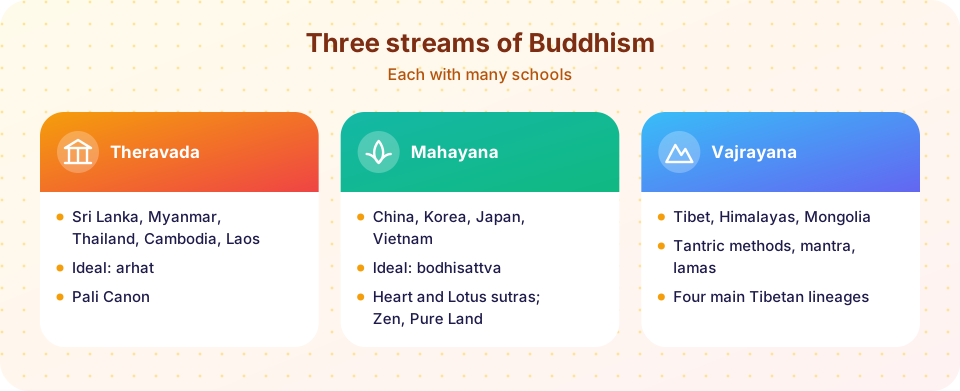
Buddhism did not stay in the Ganges plain. Within a few centuries it had spread across India, and over the next thousand years it traveled by sea and land to Sri Lanka, Southeast Asia, Central Asia, China, Korea, Japan, Tibet and Mongolia. As it moved, it met new languages, philosophies and rulers and took new forms. Today scholars commonly speak of three main streams: Theravada, Mahayana and Vajrayana, each with many schools and local varieties, and today also of new Buddhist movements in Europe and the Americas.
This lesson compares the streams, follows the spread of Buddhism, and describes practices that are shared across many Buddhist communities: meditation, monastic life, merit-making, chanting and festivals.
What you will learn
- The main features of Theravada, Mahayana and Vajrayana Buddhism.
- How Buddhism spread, and the role of King Ashoka and the Silk Road.
- The main forms of meditation and monastic life.
- Popular practice: merit, offerings and festivals.
Key terms
Theravada: "teaching of the elders"; the school found mainly in Sri Lanka and mainland Southeast Asia, using the Pali Canon.
Mahayana: "great vehicle"; a broad stream found mainly in East Asia, stressing the bodhisattva ideal.
Vajrayana: "diamond vehicle"; the tantric Buddhism of Tibet, the Himalayas and Mongolia.
Bodhisattva: a being who aims at full awakening in order to help all beings.
Meditation: disciplined training of attention; in Buddhism includes calm (samatha) and insight (vipassana).
Three streams
Theravada
Theravada is the dominant form of Buddhism in Sri Lanka, Myanmar, Thailand, Cambodia and Laos. It treats the Pali Canon (the Tipitaka) as its scripture and emphasizes the monastic order and the ideal of the arhat, a person who has attained nirvana by following the Buddha's teaching. Its distinctive features include a strong monastic tradition, in which young men often spend a time as monks, and an emphasis on meditation and the early discourses. The Theravada tradition regards itself as the closest to the Buddha's original teaching, a claim other schools dispute.
Mahayana
The Mahayana arose in India in the centuries around the start of the common era and became dominant in China, Korea, Japan and Vietnam. Its distinctive ideal is the bodhisattva, who vows to attain awakening for the sake of all beings and delays final release to help others. Mahayana writings include the Prajnaparamita ("Perfection of Wisdom") sutras, with the short Heart Sutra, which teaches that all phenomena are "empty" of independent existence (shunyata), and the Lotus Sutra. The philosopher Nagarjuna (about the second to third century CE) developed the Madhyamaka ("Middle") philosophy of emptiness, and another major school, Yogacara, analyzed consciousness.
Mahayana includes many schools. Pure Land Buddhism emphasizes faith in the Buddha Amitabha and the aspiration to be reborn in his Pure Land, where practice is easier. Chan (in China) and Zen (in Japan) emphasize meditation and direct insight, often with teaching stories (koans) and close teacher-student relationships. Tiantai and Nichiren emphasize the Lotus Sutra. The bodhisattva Avalokiteshvara (Guanyin in China, Kannon in Japan) is revered as a figure of compassion.
Vajrayana
Vajrayana, also called Tantric Buddhism, developed in India from about the seventh century and spread to Tibet, the Himalayan regions and Mongolia, and, in forms, to Japan (as Shingon). It uses additional methods, such as visualization of deities, mantra recitation, ritual, and guidance by a teacher (lama), that it regards as powerful ways to attain awakening. Tibetan Buddhism has four main lineages: Nyingma, Kagyu, Sakya and Gelug. The Dalai Lama, a leading figure of the Gelug school, is regarded by Tibetans as an emanation of Avalokiteshvara; the present, 14th Dalai Lama is Tenzin Gyatso. Tibetan Buddhism recognizes tulkus, teachers regarded as reincarnations of earlier masters.
How Buddhism spread
In the third century BCE the Indian emperor Ashoka (reigned about 268 to 232 BCE), after a bloody conquest, is said to have embraced Buddhist teaching, set up inscriptions promoting moral conduct and tolerance, and sent missions, including one to Sri Lanka. Later, merchants, monks and pilgrims carried Buddhism along the Silk Road to Central Asia and China, where it arrived by the first centuries CE. Chinese pilgrims such as Xuanzang (seventh century) traveled to India and returned with texts. Buddhism became deeply woven into the cultures of East Asia, interacting with Daoism, Confucianism and Shinto, which is one reason Buddhism looks so different in different countries. In India itself, Buddhism declined from about the twelfth to thirteenth century, due to a combination of factors including the revival of Hindu devotion, political changes and the destruction of monasteries, and was revived in the twentieth century, notably by the Ambedkar movement.
Practice
Meditation
The Buddhist tradition places great weight on training the mind. Two broad methods are calm (samatha), which develops steady concentration, for example by following the breath, and insight (vipassana), which develops clear awareness of impermanence, dukkha and non-self. Other practices include loving-kindness meditation (metta), recitation of the Buddha's name, walking meditation, visualization and, in Zen, seated meditation (zazen). In recent decades secular mindfulness programs, such as the one developed by Jon Kabat-Zinn in 1979, have adapted some of these methods for health settings. Research on mindfulness-based programs shows modest benefits for some conditions and mixed results for others, and critics note that the secular versions leave out Buddhist ethical and philosophical context. This is educational information, not advice for any health condition.
Monastic life
Buddhism has an order of monks (bhikkhus) and nuns (bhikkhunis) who follow a monastic code, the Vinaya, living simply and often depending on lay donations. In Theravada countries, many men spend a period as a monk. The nuns' lineage died out in Theravada countries and has been revived and debated in recent decades. Monastic communities have been centers of learning, medicine, art and social support.
Lay practice: merit and ritual
For most Buddhists, practice means ethical living and merit-making (punya): giving food to monks, donating to temples, chanting, offering flowers and incense to images, and joining festival days. Merit is understood as wholesome karma that improves one's future and can be shared with others, including deceased relatives. Many communities also honor local spirits and deities alongside Buddhist practice, a pattern scholars note across Asia.
Festivals
Vesak (also called Buddha Day or Wesak) commemorates the Buddha's birth, awakening and death, on the full moon in May in many countries, with lamp-lighting, offerings and processions. Other festivals include Asalha Puja, which recalls the first sermon, the end of the rains retreat, Obon in Japan (honoring ancestors), and the Tibetan New Year (Losar).
Common misconceptions
"Buddhism is one uniform religion." Buddhist communities differ widely in practice, texts and doctrine. Theravada monks in Thailand, Zen practitioners in Japan and Tibetan lamas live very different forms of the same family of traditions.
"Zen is just meditation without belief." Zen has a rich body of texts, ritual and monastic discipline, and Japanese Zen temples also conduct funerals and ancestor rites.
"Mindfulness apps are Buddhism." Secular mindfulness draws on Buddhist practice but is not Buddhism. The relationship is debated.
Try it
The first demonstration is a comparison explorer. Select two schools and see how they differ on region, ideal, texts and practice. The entries are simplified summaries.
The second demonstration is a toy model of the classic beginner exercise of counting breaths from one to ten and starting over whenever the mind wanders. It illustrates why the exercise trains attention: the count resets often at first. It uses random numbers and is not data about real practice.
Press Run (or Ctrl + Enter) to see the result here.
Program input · what you'd type while the program runs
Type the answers before you press Run, one per line. Each time the program reads a line (with input()), it gets the next line from this box.
Check your understanding
Quick check · 5 questions
of 5 answered You scored / 5 · perfect!
-
1. Which stream of Buddhism uses the Pali Canon as its scripture?
Theravada Buddhism, found in Sri Lanka and mainland Southeast Asia, relies on the Pali Canon. -
2. The bodhisattva ideal is especially associated with
Mahayana stresses the bodhisattva who aims at awakening to help all beings. -
3. Who is the present Dalai Lama?
Tenzin Gyatso is the 14th Dalai Lama. -
4. What does Vesak commemorate?
Vesak marks the key events in the Buddha's life, in many countries on the May full moon. -
5. Which emperor sent Buddhist missions in the third century BCE?
Ashoka of the Mauryan Empire promoted Buddhist ethics and sent missions, including one to Sri Lanka.
Summary
- Theravada, Mahayana and Vajrayana are three broad streams with different regions, ideals and texts.
- Ashoka's missions and the Silk Road carried Buddhism across Asia; it declined in medieval India and revived in modern times.
- Meditation (calm and insight), monastic life and merit-making are central practices.
- Festivals like Vesak and local customs shape lay Buddhist life.
- Secular mindfulness adapts Buddhist methods but is distinct from Buddhism.
Next: Jainism
Track your progress
Create a free account to tick off lessons and pick up where you left off on any device.
of Religious Studies lessons completed