


















Lesson 8 of 46 · Studying Religion
Ritual, Myth and Symbol
Learn how scholars understand ritual, rites of passage, myth and symbol, from van Gennep and Turner to Geertz, with examples from several traditions.
If you visited a religious community and could only watch, not ask, you would mostly see three things: people doing things together (rituals), people telling or hearing stories (myths), and people using objects, gestures and words that stand for something more (symbols). These three are the working tools of religious life, and they are also the favorite subjects of anthropologists and historians of religion.
This lesson explains what each term means in scholarship, why none of them means "fake" or "empty," and how thinkers have tried to explain what they do for people. The examples come from several traditions, and each is described as the community describes it.
What you will learn
- What ritual is and what kinds there are.
- How rites of passage work (van Gennep, Turner).
- What scholars mean by myth, and what myths do.
- How symbols carry meaning, according to Geertz and others.
Key terms
Ritual: a patterned, repeated action, often involving words, gestures and objects, performed with a sense of significance beyond the practical.
Rite of passage: a ritual that marks a change of status, such as birth, adulthood, marriage or death.
Liminality: the "threshold" state between one status and another, when a person is neither one thing nor the other.
Myth: in scholarship, a sacred narrative that expresses a community's understanding of reality, not a statement that a story is false.
Symbol: something that stands for or evokes more than itself.
What ritual is
A ritual is more than a habit. Brushing your teeth is a routine, but it carries no particular meaning beyond hygiene. A ritual involves action that is formalized, repeated and marked as special: lighting candles, kneeling, washing before prayer, sharing bread, walking around a shrine. Rituals can be sorted by purpose. Calendrical rituals mark the year (harvest festivals, Ramadan, Easter, Diwali). Life-cycle rituals mark personal transitions. Devotional rituals express worship and prayer. Purification rituals remove impurity or sin. Commemorative rituals recall founding events.
Scholars disagree about whether belief or ritual comes first. Some, following the view that religion is a set of ideas, treat ritual as the expression of belief. Others, including many anthropologists, argue that for many communities doing is the center and the explanations come later and vary. Two terms capture the contrast: orthodoxy means "right belief" and orthopraxy means "right practice." Christianity has often stressed orthodoxy through creeds, while Judaism and Islam have often stressed practice through law, though in each tradition both matter. The distinction is a useful tool, not a verdict on any religion.
Rites of passage
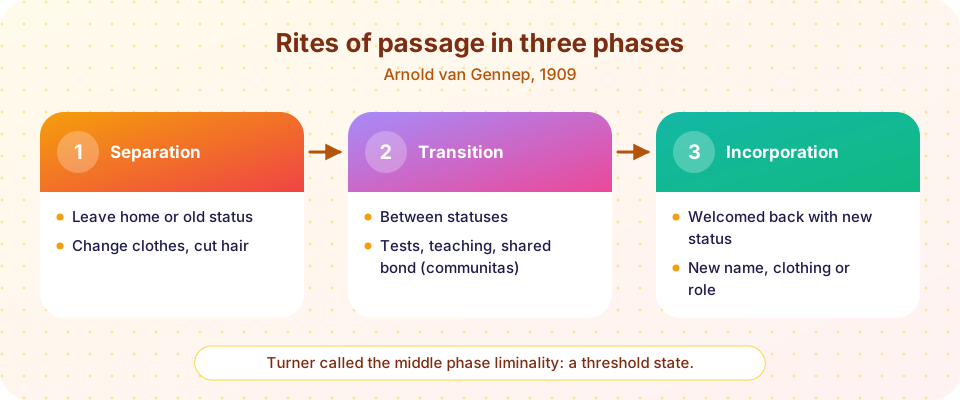
In 1909 the French ethnographer Arnold van Gennep published Les rites de passage. He noticed that rituals marking changes of status, such as birth, adulthood, marriage and death, tend to share a three-part structure:
- Separation. The person is set apart from their old status or place, often by leaving home, changing clothes or cutting hair.
- Transition (liminal phase). The person is "between," subject to rules, tests or teaching that belong to neither the old nor the new status.
- Incorporation. The person is welcomed back with a new status and often a new name, clothing or role.
The anthropologist Victor Turner (1920 to 1983) developed the middle phase, which he called liminality. In his book The Ritual Process (1969) he described how people in the liminal phase often lose ordinary rank, and may feel a deep bond with others in the same situation, which he called communitas.
Examples show the pattern, though real rituals are always richer than a template. In many Jewish communities, a young person reaching religious responsibility (around age 12 or 13) is called to read from the Torah in a bar or bat mitzvah, and is then counted as an adult in religious obligations. In Christianity, baptism marks entry into the church: in many traditions it includes an act of washing, a statement of faith and a welcome. Many Hindu families hold the upanayana, a ceremony in which a boy of certain castes is invested with a sacred thread and begins formal study; the practice is limited by caste and gender in traditional forms, and communities differ on whether it should be extended. In several Southeast Asian Buddhist societies, a boy may enter a monastery temporarily as a novice (a rite called shinbyu in Myanmar), leaving home, living by monastic rules and then returning. During the Muslim hajj, pilgrims set aside ordinary clothes, men wearing simple unstitched white garments, as members of one crowd; many Muslims describe this as equality before God.
What myths do
In everyday speech "myth" means a false belief. In religious studies it means something different: a sacred narrative that a community uses to explain who they are, where they came from and how the world is ordered. Calling a story a myth in this sense says nothing about whether it is true. It says that the story has special authority and meaning for a community.
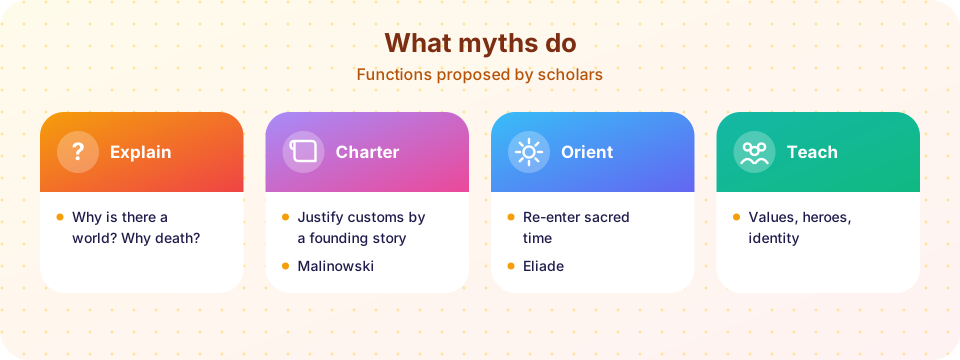
Scholars have proposed several functions:
- Explanation. Myths answer questions such as why the world exists, why there is death, or why a ritual is done.
- Charter. The anthropologist Bronisław Malinowski (1884 to 1942) argued that myths act as a "charter" that justifies customs, institutions and rights by connecting them to a founding story.
- Orientation. Mircea Eliade described myths as taking people back to "sacred time," the time of origins, which ritual re-enters.
- Structure. Claude Lévi-Strauss (1908 to 2009) analyzed myths as systems of contrasts, such as raw and cooked, nature and culture, that help a society think. His method is influential and also criticized as speculative.
- Values and identity. Stories teach who the heroes are, what is valued and what is feared.
An example of myth and ritual linked is the Jewish Passover seder. The meal retells the story of the exodus from Egypt, and the traditional text, the Haggadah, instructs each person to see themselves as though they personally went out of Egypt. Foods on the table, such as unleavened bread, are used as signs for parts of the story. The story shapes the meal, and the meal makes the story present. Similarly, many Christians describe the Eucharist (also called Communion or the Lord's Supper) as remembering the last meal of Jesus with his followers, with different churches understanding the presence of Christ in the bread and wine in different ways.
The popular writer Joseph Campbell (1904 to 1987) argued for a universal "hero's journey" pattern in myths. Many scholars of religion regard this as a helpful storytelling idea but too general to describe specific traditions, because it leaves out the cultural details that make each myth what it is.
Symbols and meaning
A symbol is anything that carries meaning beyond its physical form: a cross, a crescent, a wheel with eight spokes, a lamp, a circle, a particular color, a gesture such as folding the hands, a name never spoken. Clifford Geertz argued that religious symbols do two jobs at once: they are a model of reality (describing how the world is) and a model for reality (guiding how to act). A lamp lit at a festival of light is not only a picture of the victory of light over darkness in a story; it also invites people to act on that hope.
Symbols are often polyvalent, meaning they have several meanings at once, and their meanings shift with context. Water can signify cleansing, rebirth, danger and life. Bread can signify food, community and sacrifice. Understanding a symbol therefore requires asking who uses it and how, rather than looking it up in a dictionary of symbols. Many "symbol dictionaries" present a single meaning, and scholars treat them with caution.
Common misconceptions
"Ritual is empty routine." Believers often describe ritual as the place where meaning is felt. Observers should ask what the participants say it does before judging it.
"Myth means false." In religious studies, "myth" names a kind of story. Whether the events happened is a separate question, and communities answer it in different ways, some literally and some symbolically.
"One symbol, one meaning." Symbols usually carry several meanings that depend on the community and setting.
Try it
The first demonstration is a rite-of-passage sorter. Each event is part of a made-up, generic initiation. Pick the phase (separation, transition or incorporation) you think it belongs to. The made-up example avoids attributing a ritual to any real community.
The second demonstration shows why some rituals move through the seasons. The Islamic calendar is purely lunar (twelve lunar months), so a date such as the start of Ramadan falls about ten or eleven days earlier each solar year. The code computes the drift from the length of a lunar month.
Press Run (or Ctrl + Enter) to see the result here.
Program input · what you'd type while the program runs
Type the answers before you press Run, one per line. Each time the program reads a line (with input()), it gets the next line from this box.
Check your understanding
Quick check · 5 questions
of 5 answered You scored / 5 · perfect!
-
1. Which three phases did van Gennep identify in rites of passage?
Van Gennep (1909) described separation, a liminal transition and incorporation. -
2. In religious studies, 'myth' means
The term describes the role of the story, not whether it is true. -
3. Geertz said religious symbols are both a model of and a model for reality. What does 'model for' mean?
Symbols both describe how the world is and shape moods and conduct. -
4. What is communitas, in Victor Turner's work?
Turner used communitas for the sense of equality and fellowship in the liminal phase. -
5. The contrast between orthodoxy and orthopraxy is a contrast between
Orthodoxy stresses correct belief, orthopraxy correct practice; both matter in most traditions.
Summary
- Ritual is formalized, repeated, meaningful action: calendrical, life-cycle, devotional, purifying or commemorative.
- Van Gennep's separation, transition and incorporation structure many rites of passage; Turner added liminality and communitas.
- Myth means a sacred narrative with authority for a community; scholars list functions such as explanation, charter, orientation and values.
- Symbols often carry several meanings and shape both understanding and action.
- Ask what participants say a ritual, story or symbol means before interpreting it.
Next: Chapter 2 Review
Track your progress
Create a free account to tick off lessons and pick up where you left off on any device.
of Religious Studies lessons completed