


















Lesson 2 of 45 · Getting Started
What Is Psychology?
Learn what psychology is, its four goals, the biopsychosocial model and the main subfields, with a clear look at what psychologists actually do.
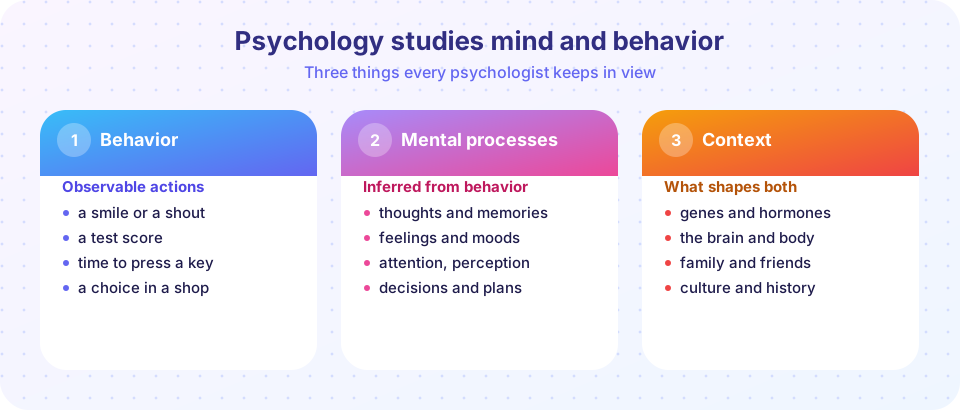
Imagine watching a friend suddenly go quiet during a group conversation. You can see what happened: they stopped talking, looked at the floor and picked at their sleeve. You cannot see why. Were they bored, shy, tired, offended, thinking hard about something else? Psychology is the discipline that tries to answer questions like this one carefully, using evidence instead of guesses.
The official definition is short: psychology is the scientific study of behavior and mental processes. Every word carries weight, and in this lesson we unpack the definition, the goals of the field, the main ways psychologists divide their work and the habit of mind that connects them all.
What you will learn
- The meaning of "behavior", "mental processes" and "scientific" in the definition.
- The four goals of psychology: describe, explain, predict and change.
- The difference between basic and applied research, and between psychologists and psychiatrists.
- The biopsychosocial model and why one behavior has many causes.
- The main subfields and what a psychologist in each one does.
Key terms
Behavior: any action an organism does that can be observed and recorded, such as speaking, moving, choosing or blinking.
Mental processes: internal experiences such as thoughts, memories, perceptions and feelings. They cannot be seen directly.
Operational definition: a precise description of how a concept will be measured, for example "stress = score on a stress questionnaire".
Biopsychosocial model: the view that biological, psychological and social factors all contribute to behavior and health.
Basic and applied research: basic research seeks knowledge for its own sake; applied research solves a practical problem.
Behavior and mental processes
Early in the twentieth century some psychologists argued that only behavior was a legitimate subject, because it can be observed by anyone. Others replied that ignoring thoughts and feelings leaves out most of what makes us human. Modern psychology takes both seriously. It treats mental processes as real but private, so they must be inferred from behavior, from what people report, and increasingly from measurements of the body and brain.
Inference is a skill. If a person's heart races and they say "I'm nervous", we infer anxiety. If a child reaches for the toy hidden under a cup after you have moved it, we infer that the child lacks, or has, a particular belief about the toy. Good studies are designed so that different mental explanations lead to different observable results. That is how invisible ideas become testable.
Why "scientific" matters
Plenty of people have opinions about human nature, from philosophers to your neighbor. What makes psychology a science is its method: it states questions that can be tested, measures things in a repeatable way, looks for patterns across many people and invites others to check the results. Chapter 2 is entirely about this. For now remember that a claim counts only if some possible observation could show it is wrong.
The four goals
Psychologists usually describe four goals, each building on the one before.
- Describe: say accurately what happens. "About how many hours do teenagers sleep on school nights?"
- Explain: say why. "Why does the body clock shift later during adolescence?"
- Predict: say what is likely next. "Who is at higher risk of falling behind if sleep is short?"
- Change (sometimes "control" or "improve"): use that knowledge to help. "Would starting school later help?"
Notice how the questions become harder and more valuable. Description alone is a catalog; explanation gives understanding; prediction proves the explanation is useful; change puts it to work for people. Ethics (Chapter 2) governs the last one.
Basic versus applied
Basic research asks about the mind for its own sake. How does the brain recognize a face? How much can we hold in working memory? Applied research uses the answers to solve problems: designing safer cockpit displays, improving classroom teaching, treating phobias, reducing prejudice. The two feed each other. Findings about memory (basic) shaped study advice (applied); problems in schools (applied) raised new questions about learning (basic).
Many causes, many levels
Take a single behavior: a student freezes during an exam. A biological psychologist might point to a surge of stress hormones. A cognitive psychologist might talk about worry using up working memory. A social psychologist might note a classroom where mistakes feel shameful. A cultural psychologist might look at how different societies treat tests and failure. None of these is wrong. They are different levels of analysis, and the fullest picture combines them.
This idea is formalized as the biopsychosocial model, introduced in medicine by George Engel in 1977:
| Level | Examples of causes |
|---|---|
| Biological | genes, brain activity, hormones, sleep, illness |
| Psychological | beliefs, memories, emotions, learned habits, coping skills |
| Social and cultural | family, friends, school, media, norms, language, income |
A useful rule: when someone offers a single cause for a complicated behavior ("it is all genes", "it is all upbringing"), be suspicious. Behavior almost always comes from interacting causes.
Who does what: the subfields
Psychology is a large family. Here are the main branches, each with a typical question.
| Subfield | Typical question |
|---|---|
| Cognitive | How do we remember, reason and decide? |
| Biological / neuroscience | How do brain cells and hormones produce behavior? |
| Developmental | How do people change from infancy to old age? |
| Social | How do other people influence our thoughts and actions? |
| Personality | How do people differ in stable patterns of behavior? |
| Clinical and counseling | How can distress and disorders be understood and treated? |
| Educational and school | How can learning be supported? |
| Industrial-organizational | How can workplaces select, train and motivate people? |
| Health | How do behavior and stress affect physical health? |
| Forensic | How does psychology inform courts, police and prisons? |
| Experimental | How do we design studies that answer these questions? |
Many psychologists work in more than one area, and the boundaries blur. A researcher on sleep and learning might be at once biological, cognitive, developmental and educational.
Psychologist, psychiatrist, therapist
These words are often confused. A clinical psychologist typically holds a doctoral degree in psychology and is trained in assessment and psychotherapy. A psychiatrist is a medical doctor who specializes in mental health and can prescribe medication. "Therapist" and "counselor" are broader terms whose legal meaning varies from country to country. Most psychologists, in fact, are researchers or work in schools, companies and clinics, not in a therapist's armchair.
Reading the mind from evidence: an example
To see inference in action, think about reaction time. If asked to decide whether a string of letters is a word, people respond faster to "doctor" after seeing "nurse" than after seeing "bread". Nobody can watch the mind link nurse to doctor. But the faster response, measured in milliseconds across many people, is evidence that related ideas are stored in connected ways. The invisible (an association in memory) is inferred from the visible (a speed difference). Repeating this logic in different ways is most of cognitive psychology.
Common misconceptions
"Psychologists can read your mind." They infer mental states from evidence, and with limits. They are no better than anyone else at guessing what you are thinking at a party.
"Psychology equals therapy." Therapy is one application. Most of the field is research and practical work in education, business, design and health.
"Psychologists and psychiatrists are the same." They have different training. Psychiatrists are physicians; psychologists usually are not, although both can work together.
"There is one right school of thought." The perspectives lesson shows they are complementary lenses, not rival religions. Most modern psychologists use several.
Try it
The first demonstration is an interactive example of levels of analysis. Pick a behavior and see how each level explains it. Notice that the explanations add up rather than compete.
The second demonstration is a small classifier. It sorts everyday phrases into observable behavior or inferred mental process, which is a skill you will use all course. Add your own phrases and re-run.
Press Run (or Ctrl + Enter) to see the console output here.
No output.
Check your understanding
Quick check · 5 questions
of 5 answered You scored / 5 · perfect!
-
1. Why are mental processes described as 'inferred'?
Thoughts and feelings are private. Psychologists infer them from what people do, say and from body and brain measurements. -
2. A study asks why adolescents' body clocks shift later. Which goal is mainly being pursued?
'Why' questions are the explain goal. Describing would be reporting how late they sleep. -
3. Which pair correctly matches training to profession?
Psychiatrists go through medical school and can prescribe medication. Clinical psychologists train in psychology and assessment. -
4. The biopsychosocial model says that behavior
Engel's model argues that one-cause explanations are too narrow; the factors interact. -
5. An operational definition of 'stress' as 'score on a stress questionnaire' is useful because
Operational definitions turn vague ideas into measurable ones, a requirement for repeatable science.
Summary
- Psychology is the scientific study of behavior (observable) and mental processes (inferred).
- Its goals are to describe, explain, predict and change.
- Basic research seeks knowledge; applied research solves problems; each helps the other.
- Behavior has many interacting causes (biological, psychological, social, cultural).
- The field has many subfields, and psychologists and psychiatrists are different professions.
- Operational definitions make hidden ideas measurable.
Track your progress
Create a free account to tick off lessons and pick up where you left off on any device.
of Introduction to Psychology lessons completed