


















Lesson 24 of 45 · Learning and Conditioning
Observational and cognitive learning
Explore learning by watching and thinking: Bandura's Bobo doll studies, Tolman's cognitive maps, Köhler's insight and learned helplessness, with a simulation you can run.
Imagine learning to ride a bicycle only by being rewarded when you happen to balance. It would take forever, and some mistakes would hurt. Fortunately you can watch someone else do it, ask questions, and form an idea of what to do. Humans, and many other animals, learn a huge amount without direct reward or punishment. This lesson looks at two ideas that went beyond strict behaviorism: learning by observing others and learning by building internal knowledge.
What you will learn
- What Bandura's Bobo doll studies found and what they did not prove.
- The four conditions of observational learning.
- How Tolman's latent learning and cognitive maps challenged behaviorism.
- What insight learning and learned helplessness show.
- Why the evidence on media and aggression is contested.
Key terms
Observational learning: learning by watching the behavior of a model and its consequences.
Vicarious reinforcement: seeing a model rewarded makes you more likely to copy the behavior.
Cognitive map: an internal representation of the layout of a place.
Latent learning: learning that is not shown in behavior until there is a reason to show it.
Insight: a sudden realization of a solution.
Bandura and the Bobo doll
In 1961 Albert Bandura, Dorothea Ross and Sheila Ross showed nursery-school children an adult playing in a room with toys and an inflatable "Bobo" doll. Some children saw the adult attack the doll with a mallet and shouts. Others saw the adult play quietly. Later, when the children were alone with the toys, those who had seen the aggressive model were more likely to hit the doll, often using the same actions and phrases. Nobody had been rewarded for copying.
A follow-up in 1963 found children also copied aggression from a filmed adult and even from a cartoon character. In 1965 Bandura found that seeing the model rewarded or punished changed how readily children performed the behavior, even though they had learned it either way. When children were later offered a reward for showing what they remembered, those who had seen the model punished could still reproduce the behavior. This is the difference between learning and performance.
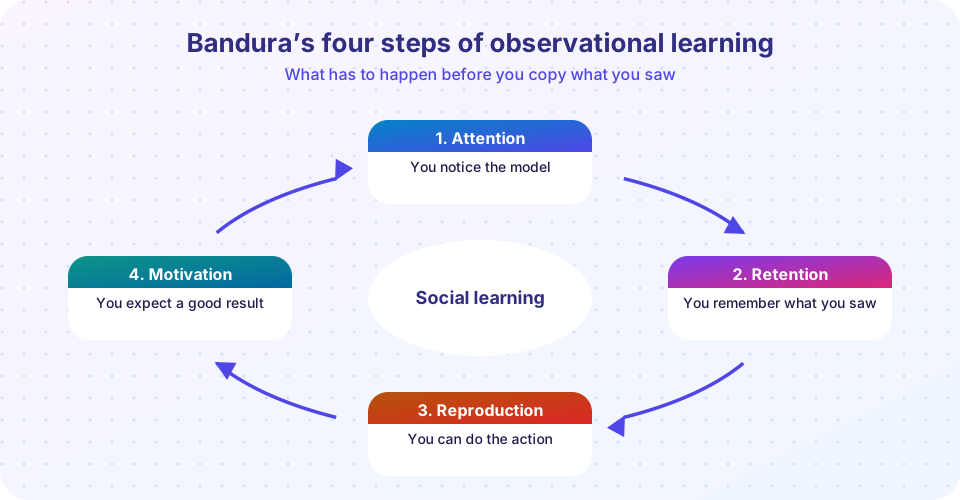
Bandura's four conditions explain why we copy some models and not others.
- Attention. You must notice the model. Models who are similar, admired, or powerful draw more attention.
- Retention. You must store what you saw, often as images or words.
- Reproduction. You must be able to do it. Watching a skilled pianist does not make your fingers able.
- Motivation. You must expect something good, or at least not bad, to come of it.
Bandura later called his approach social-cognitive theory and added self-efficacy, your belief in your ability to succeed at a task, which strongly predicts whether people try and persist.
What the Bobo studies do and do not show
The studies show that children readily copy novel behaviors they see. They do not show that violent media make children violent in the real world. A plastic doll designed to bounce back is not a person, and hitting it may have felt like permitted play. Critics also note that the children were mostly from one university nursery.
Decades of research on media violence and aggression have produced a mixed picture. Many studies find small positive links between heavy exposure and aggressive thoughts or behavior, while other analyses find the effects are very small or inflated by publication bias and measurement choices. The honest summary is that the question is unsettled, effect sizes are small, and individual factors such as family environment matter a great deal. Observational learning also works for good: children learn kindness, safety habits and skills from models.
Do mirror neurons explain it?
In the 1990s researchers found neurons in macaque monkeys that fired both when the monkey performed an action and when it watched another do it. These mirror neurons were popularly said to explain imitation and empathy. The evidence in humans is much less direct, and many scientists think the claims have been overstated. Treat mirror neurons as an interesting finding, not as an established explanation of social learning.
Cognitive maps and latent learning
Edward Tolman believed learning was more than stimulus-response habits. In 1930, Tolman and Honzik ran rats through a complex maze with a food box at the end. One group got food every time. A second group got no food at all. A third group got no food for ten days and then food from day 11. The unrewarded rats wandered and seemed to learn little. But once the food started, the third group's errors dropped sharply, and within a day or two they performed as well as the always-rewarded group.
Tolman concluded that the rats had been learning the layout of the maze all along but had no reason to show it. This is latent learning, and the internal representation is a cognitive map. Other experiments show rats can take new shortcuts or detours when a familiar route is blocked, which is hard to explain by habit alone. Later research on the hippocampus, including the discovery of place cells by John O'Keefe, who shared a Nobel Prize in 2014 for this work, gave Tolman's idea a neural basis. You use a cognitive map when you find your way around your town by thinking about where things are.
Insight
In the 1910s Wolfgang Köhler studied chimpanzees on Tenerife. In one task a banana hung out of reach and boxes lay around the cage. A chimp named Sultan seemed to pause, then stack the boxes and climb. Köhler described this as insight: the solution appeared suddenly, after a pause, rather than gradually through trial and error. Since then, researchers have debated how sudden insight really is, since previous experience also matters. Human studies of "aha" moments find that people often feel certain of an insight before they can explain it, but insight solutions are not always correct.
Learned helplessness
In the 1960s Martin Seligman and Steven Maier gave dogs inescapable shocks. Later, in a box where they could easily escape shocks by jumping over a barrier, many of these dogs just lay down and took them. Dogs that had earlier been able to stop the shocks did not show this. Seligman called it learned helplessness: experiencing that outcomes cannot be controlled can lead to passivity even when control becomes possible.
The idea was influential in the study of depression, and later work by Maier and Seligman has revised it: the brain's default may be passivity, and the key learning is that one can control the outcome. This course does not offer diagnosis or treatment. It is enough to see the lesson: feeling that effort matters is a powerful influence on whether people try.
Common misconceptions
"Bandura proved that violent TV makes children violent." He showed that children imitate novel behavior in a lab. Real-world media effects are debated and appear small on average.
"If a behavior is copied, it was reinforced." Children copied the model without any reward. Reinforcement affects performance, but learning can occur without it.
"Insight means no prior learning is needed." Insight usually builds on earlier knowledge and experience; it feels sudden but is not magic.
Try it
Press Run (or Ctrl + Enter) to see the result here.
Program input · what you'd type while the program runs
Type the answers before you press Run, one per line. Each time the program reads a line (with input()), it gets the next line from this box.
Check your understanding
Quick check · 5 questions
of 5 answered You scored / 5 · perfect!
-
1. In Bandura's 1961 Bobo doll study, children who watched an aggressive model:
The children imitated novel aggressive actions without being reinforced, which showed learning by observation. -
2. Which is NOT one of Bandura's four conditions of observational learning?
The four conditions are attention, retention, reproduction and motivation. Extinction belongs to conditioning. -
3. In Tolman and Honzik's rat maze study, why did the late-reward group improve so fast once food appeared?
The rats had formed a cognitive map earlier and only showed it when rewarded. -
4. Learned helplessness experiments suggest that:
Dogs exposed to inescapable shock often failed to escape later, though later research reinterprets what is learned. -
5. Which statement about media violence and aggression is best supported?
Studies often find small associations with debate about methods and effect size.
Summary
- Observational learning lets us acquire behaviors by watching models, and depends on attention, retention, reproduction and motivation.
- Bandura's Bobo doll studies showed imitation without direct reward, but they do not settle the media violence debate.
- Tolman's latent learning and cognitive maps showed that learning can be stored without being shown.
- Insight and learned helplessness show that thinking, control and expectation matter for learning.
Next: Chapter 5 review
Track your progress
Create a free account to tick off lessons and pick up where you left off on any device.
of Introduction to Psychology lessons completed