


















Lesson 5 of 45 · Getting Started
Chapter 1 Review: Getting Started
Review chapter 1 of introductory psychology with a one-picture recap, a summary table, an interactive term check and a ten-question quiz.
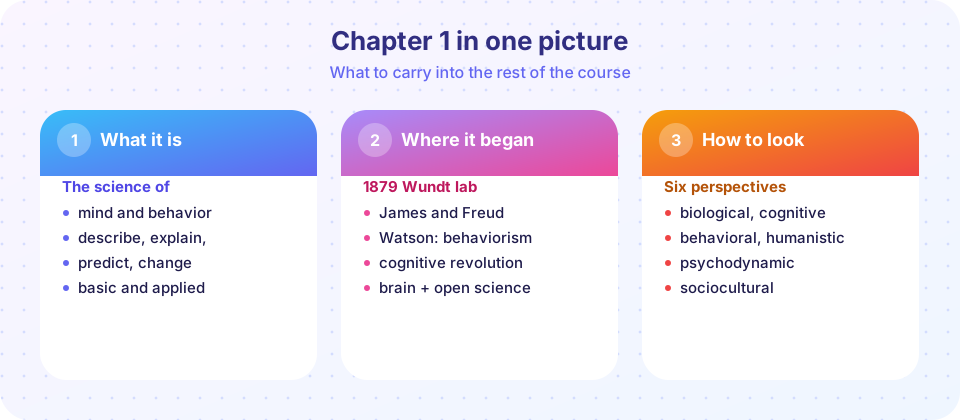
You have finished the first chapter. You now have the vocabulary of the field, a map of its history and six lenses for looking at behavior. This lesson pulls the pieces together. Read the picture first, scan the table, test yourself with the demonstrations and then take the ten-question quiz. Doing this a day or two after finishing the chapter, rather than straight away, makes it work better: that is the spacing effect from the course map in action.
What you will learn
- How the chapter's ideas fit together.
- Which topics you can already explain, and which need another look.
- How the definition, the history and the perspectives connect.
Chapter in one table
| Lesson | Big idea | One thing to remember |
|---|---|---|
| Course map | Study psychology using psychology | Retrieval practice and spacing beat rereading |
| What is psychology? | Scientific study of behavior and mental processes | Behavior is observed; mental processes are inferred |
| History | Debates produced the schools | Wundt 1879, James, Freud, Watson, cognitive revolution, open science |
| Perspectives | Six lenses on behavior | Different questions, different methods, one person |
Key connections
Definition and history. The definition's double focus (behavior and mental processes) is the result of the history: structuralism and functionalism studied the mind, behaviorism insisted on behavior, and cognitive psychology rebuilt the bridge with better methods.
History and perspectives. Each perspective carries an old school's best idea: behaviorism's careful conditioning experiments, the psychodynamic school's interest in hidden motives, humanism's respect for individual experience, the cognitive model of information processing, and the biological and sociocultural views that widen the lens.
Perspectives and science. Each lens makes claims that can be tested. Chapter 2 shows exactly how.
Turning the chapter into questions
A good way to review is to turn each heading into a question and answer it from memory. For example: "What are the four goals of psychology, and which one is a why question?" or "Which school reacted against introspection, and what did it insist on instead?" Write your answers in a sentence or two, then compare them with the lessons. Anything you cannot answer without looking is exactly what to study again in a few days. Then try a harder version: pick any everyday behavior, such as checking your phone when you wake up, and explain it through three of the six perspectives. If you can do that comfortably, you have understood the chapter, not just memorized it.
Common misconceptions
"I should memorize which school was right." None was entirely right or wrong. Learn what each contributed and what it missed.
"Mental processes cannot be studied scientifically." They can, by inferring them from behavior and measurement with careful designs.
"A perspective explains everything." Each is a partial view; strong explanations combine several.
Try it
First, a rapid term check. Choose the correct definition for each term. Retry until you get them all.
Second, a small review planner. Enter your quiz scores per lesson (0 to 5) and it tells you what to revisit first. This is a simple study aid, not a test of ability.
Press Run (or Ctrl + Enter) to see the result here.
Program input · what you'd type while the program runs
Type the answers before you press Run, one per line. Each time the program reads a line (with input()), it gets the next line from this box.
Check your understanding
Quick check · 10 questions
of 10 answered You scored / 10 · perfect!
-
1. Which pair of terms best describes what psychology studies?
Psychology studies behavior (observable) and mental processes (inferred). -
2. Which goal of psychology asks 'why does this happen?'
Explanation answers why. Describing reports what; predicting says what comes next. -
3. Wundt's 1879 Leipzig laboratory is important because it
It is traditionally seen as the start of experimental psychology. -
4. Which school asked what mental activity is for, inspired by Darwin?
James's functionalism focused on how the mind helps us adapt. -
5. Which statement about Freud is the most balanced?
Freud's ideas were influential, but science requires testable claims. -
6. The cognitive revolution was inspired mainly by
The computer metaphor encouraged models of attention, memory and reasoning. -
7. A study compares twins to estimate how much genes affect shyness. Which perspective?
Twin studies belong to the biological perspective. -
8. What did the Open Science Collaboration (2015) show?
Only a minority of 100 replications were significant. The field responded with preregistration and open data. -
9. Why is the sociocultural perspective a reminder about 'WEIRD' samples?
Findings from narrow samples may not generalize to people everywhere. -
10. Why does the course say to treat perspectives as lenses, not rivals?
Combining lenses gives fuller explanations.
Summary
- Psychology studies behavior and mental processes, with four goals: describe, explain, predict, change.
- History runs from Wundt (1879) through functionalism, psychoanalysis, behaviorism and Gestalt to the cognitive revolution, brain science and open science.
- Six perspectives (biological, psychodynamic, behavioral, cognitive, humanistic, sociocultural) offer complementary explanations.
- Strong claims need strong evidence, which is the subject of Chapter 2.
Track your progress
Create a free account to tick off lessons and pick up where you left off on any device.
of Introduction to Psychology lessons completed