


















Lesson 38 of 45 · Personality, Development and Health
Stress and health: the stress response, appraisal and coping
Understand stress as both body response and mental appraisal: Selye's general adaptation syndrome, Lazarus and Folkman's model, coping, social support and mental health basics.
A deadline, an argument, a loud siren, a first date: all can make your heart pound and your thoughts race. Stress is part of normal life, and in small doses it can sharpen attention and help performance. But when it is intense, long-lasting and feels out of control, it can wear down both body and mind.
Health psychology studies how thoughts, feelings, behavior and social life affect physical health, and how health in turn affects the mind. This lesson covers the main theories of stress, how coping works, and what the evidence says about social support and mental health in general terms.
Educational note. This lesson gives general information. It does not diagnose or treat any condition and is not a substitute for a doctor, psychologist or counselor. If you or someone you know is in danger or in crisis, contact local emergency services or a local crisis line immediately.
What you will learn
- The body's stress response and Selye's three stages.
- Lazarus and Folkman's idea of appraisal, and the difference between problem-focused and emotion-focused coping.
- What research says about stressful life events, personality and health.
- How social support, sleep and physical activity relate to well-being.
- What psychologists mean by mental health conditions, and when to seek help.
Key terms
Stressor: an event or demand that challenges a person's ability to cope.
Stress response: the body's and mind's reaction to a stressor.
Appraisal: your judgment of whether a situation is a threat, a challenge or harmless.
Coping: efforts to manage demands that feel taxing.
Resilience: the ability to adapt well in the face of adversity.
The body's stress response
When the brain judges a situation as threatening, two systems respond. The sympathetic nervous system acts within seconds, releasing adrenaline (epinephrine): heart rate and breathing speed up, blood flows to muscles, and digestion slows. Walter Cannon called this the fight-or-flight response in the early 1900s. A slower system, the hypothalamic–pituitary–adrenal (HPA) axis, signals the adrenal glands to release cortisol, which raises blood sugar and helps mobilize energy over minutes to hours.
Researchers have noted that this classic picture is simplified. People and animals also "freeze," and Shelley Taylor and colleagues have proposed a tend-and-befriend pattern, in which seeking social contact is a common response, particularly in women, though the evidence for gender differences is debated.
Selye's general adaptation syndrome
The endocrinologist Hans Selye observed in the 1930s and 1950s that animals showed a similar pattern of response to many kinds of harsh conditions. He called it the general adaptation syndrome (GAS).
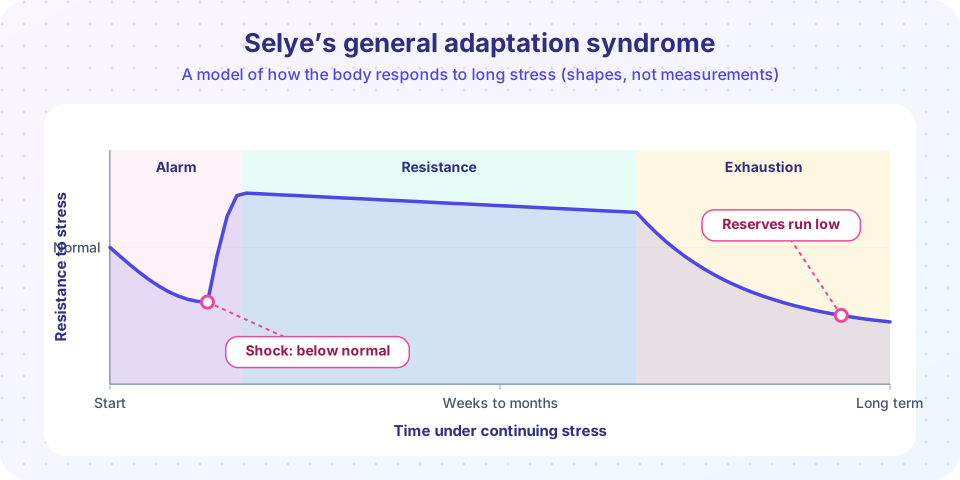
- Alarm. The body mobilizes, though resistance first dips as the shock hits.
- Resistance. The body adapts and holds up under continuing stress, but uses resources.
- Exhaustion. If stress persists, reserves run low and the risk of illness rises.
The GAS was historically important because it linked stress to health. Critics note that it treats stress as an automatic physical reaction and underplays the role of thinking and context, which is where the next theory begins.
Appraisal: stress is in the interpretation too
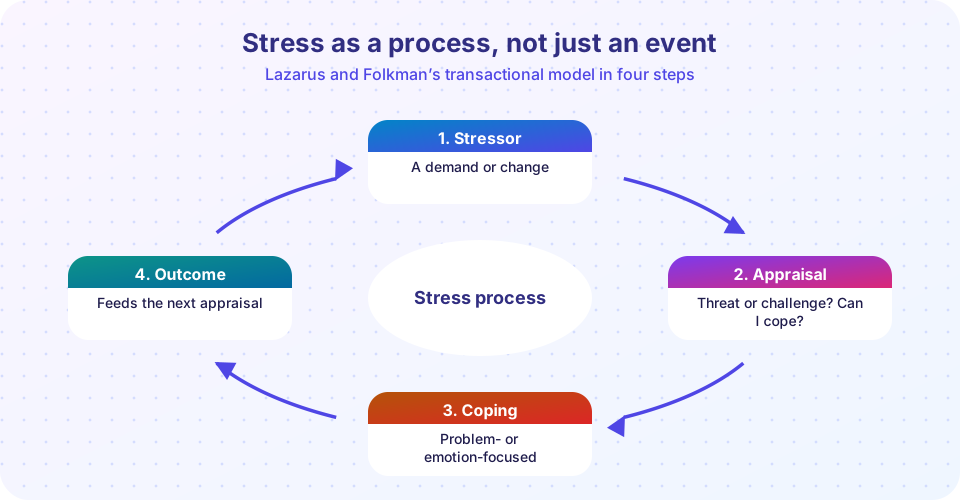
Richard Lazarus and Susan Folkman (1984) proposed the transactional model. Stress arises from the relationship between a person and the environment, and depends on two appraisals:
- Primary appraisal: "Is this relevant to me? Is it a threat (possible harm), a challenge (possible gain) or irrelevant?"
- Secondary appraisal: "Do I have the resources to cope?"
When demands seem to exceed resources, stress is high. Two people facing the same exam may differ: one appraises a challenge and feels energized; the other appraises a threat and feels dread. Experiments by Jeremy Jamieson and colleagues suggest that teaching people to reframe arousal as helpful ("my racing heart is preparing me") can improve performance in some tasks, though effects vary.
Coping
Coping strategies are often grouped into two broad types.
| Type | Aim | Examples |
|---|---|---|
| Problem-focused | Change the situation | Making a plan, asking for information, setting priorities |
| Emotion-focused | Manage the feeling | Reappraisal, talking to a friend, relaxation, exercise |
Neither is always better. Problem-focused coping works when the situation can be changed; emotion-focused coping helps when it cannot, as with a serious illness or loss. Avoidance, such as ignoring a problem, may bring short-term relief but often worsens things later. A flexible repertoire is generally associated with better adjustment.
Stressful life events and daily hassles
In 1967 Thomas Holmes and Richard Rahe developed the Social Readjustment Rating Scale, which assigned points to life events (such as a death in the family, marriage or moving) and found that higher totals were linked to illness. The approach was influential but has limits: the link is modest, it counts positive and negative events together, and it ignores how people appraise events. Later work suggests that daily hassles and chronic stressors, such as ongoing financial strain or caregiving, may be at least as important as big events.
Stress and illness
Evidence connects chronic stress with health, though most of it is correlational and effects are modest for any one person.
- In a 1991 study by Sheldon Cohen and colleagues, healthy volunteers were exposed to a common cold virus. Those who reported higher levels of stress before exposure were more likely to develop a cold.
- Janice Kiecolt-Glaser and colleagues found that small wounds healed more slowly in people under chronic stress such as caring for a relative with dementia.
- Psychoneuroimmunology studies how the nervous system, hormones and immune system interact.
- The idea of the Type A personality (competitive, hurried) was linked to heart disease in early studies by Meyer Friedman and Ray Rosenman. Later work suggests that hostility and, separately, depression are the more important risk factors.
Many health behaviors, such as sleep, smoking, diet, alcohol and activity, are also affected by stress and mediate some of its effects.
What helps: a summary of the evidence
None of this is personal medical advice, but research points to several factors.
- Social support. Julianne Holt-Lunstad and colleagues' 2010 meta-analysis of 148 studies found that people with stronger social relationships had a substantially higher likelihood of survival over follow-up periods than those with weaker ones, comparable in size to some well-known health risks. The studies are observational, so direction of cause is not certain.
- Sleep. Poor sleep is linked with mood, attention, and many health problems.
- Physical activity. Regular activity is linked with better mood and lower anxiety in many studies.
- Sense of control. Believing you can influence outcomes relates to better coping; the opposite is seen in learned helplessness.
- Mindfulness and relaxation. Many studies report modest benefits for stress and anxiety. Quality varies, and results are less dramatic than popular claims.
Mental health: a brief orientation
Psychologists and doctors use the term psychological disorders or mental health conditions for patterns of thinking, feeling or behavior that cause significant distress or impair functioning, and which go beyond what is expected in the culture and situation. Common examples include anxiety disorders, depressive disorders and substance use disorders. Professionals use classification systems such as the DSM-5-TR and the ICD-11 and a combination of interview, history and sometimes questionnaires.
Several points from this field are worth knowing:
- Mental health conditions are common, and many people experience one at some point.
- They have multiple causes. The diathesis–stress model suggests that a vulnerability (genetic, early experience) combined with stress can lead to a disorder.
- Labels from a quiz or a short description cannot establish a diagnosis; only a qualified professional can.
- Effective treatments exist for many conditions, including several evidence-based psychotherapies and medicines, and support from family and friends helps.
- Seeking help early is a sign of good judgment. Start with a doctor, school or workplace counselor, or a local mental health service. For deeper study see clinical psychology.
Common misconceptions
"Stress is purely mental." It involves measurable changes in hormones, the nervous system and the immune system.
"All stress is harmful." Short-term, manageable stress can improve performance; the harm comes from chronic, uncontrollable stress with too little recovery.
"People with mental health conditions are weak." Mental health conditions arise from many biological, psychological and social factors and are not a character flaw.
Try it
Press Run (or Ctrl + Enter) to see the result here.
Program input · what you'd type while the program runs
Type the answers before you press Run, one per line. Each time the program reads a line (with input()), it gets the next line from this box.
Check your understanding
Quick check · 5 questions
of 5 answered You scored / 5 · perfect!
-
1. Which stage of Selye's general adaptation syndrome comes after resistance?
If stress continues, resources run down in the exhaustion stage. -
2. In Lazarus and Folkman's model, secondary appraisal asks:
Secondary appraisal compares demands with coping resources. -
3. Making a study plan for an exam is which kind of coping?
It aims to change the situation, not only the feeling. -
4. What did Holt-Lunstad and colleagues' meta-analysis find?
The link was substantial, but the studies were observational. -
5. Which statement about mental health labels is most accurate?
Diagnosis needs a professional assessment, and many conditions respond to treatment.
Summary
- The stress response mobilizes the body quickly (sympathetic system) and more slowly (HPA axis, cortisol); Selye described alarm, resistance and exhaustion.
- Appraisal matters: stress depends on perceived demands and resources, and coping can focus on the problem or the emotion.
- Chronic stress is linked with illness, mostly in correlational studies; social support, sleep and activity are linked with better outcomes.
- Mental health conditions are common and treatable; diagnosis and treatment belong to qualified professionals.
Next: Chapter 8 review
Track your progress
Create a free account to tick off lessons and pick up where you left off on any device.
of Introduction to Psychology lessons completed